Crafting Publications and Cultivating Community

A recap of the AIGA Baltimore and BmoreArt panel at MICA

On November 28, 2024, the auditorium at the Maryland Institute College of Art (MICA) was filled with the energy of Baltimore’s and the DMV’s graphic design community. They gathered for the panel “Crafting the Page,” an event hosted by MICA, BmoreArt, and AIGA Baltimore as part of AIGA Baltimore Design Month.

The event featured presentations by Ellen Lupton, Raquel Castedo, and Tony Venne. Each shared their expertise, insights, and experiences, offering valuable advice to aspiring designers, artists, and writers. The presentations were followed by a lively Q&A session with the audience, fostering a vibrant exchange of ideas.

Moderated by BmoreArt’s editor-in-chief Cara Ober, this event provided valuable insights into design, partnership, and storytelling in publishing as part of the Design Month celebrations. For those who missed it, a recording of the panel is available to watch on YouTube.

Designing While Writing: four tips for creating engaging books

Ellen Lupton, a renowned author, designer, and educator, opened the evening by emphasizing the power of design and the magic of books. Lupton, who serves as the Betty Cooke and William O. Steinmetz Design Chair at MICA, has authored and co-authored over 30 books on graphic design, including Design Is Storytelling, Graphic Design Thinking, Health Design Thinking, and Extra Bold: A Feminist, Inclusive, Anti-Racist, Nonbinary Field Guide for Graphic Designers.

Lupton shared her four essential tips for creating compelling books, gleaned from her extensive experience as both author and designer:

  • Start with a Table of Contents: The table of contents acts as a roadmap for the book, outlining its structure and guiding readers through the content. A well-crafted table of contents provides a clear overview of the book’s thesis and theory, like a map leading readers to treasures within.
  • Design in Spreads: Recognizing that readers often jump around a book, Lupton advocates for designing in spreads, ensuring each two-page spread is visually appealing and makes sense on its own. This approach caters to diverse reading habits and ensures a satisfying experience for those who may not read the entire book linearly.
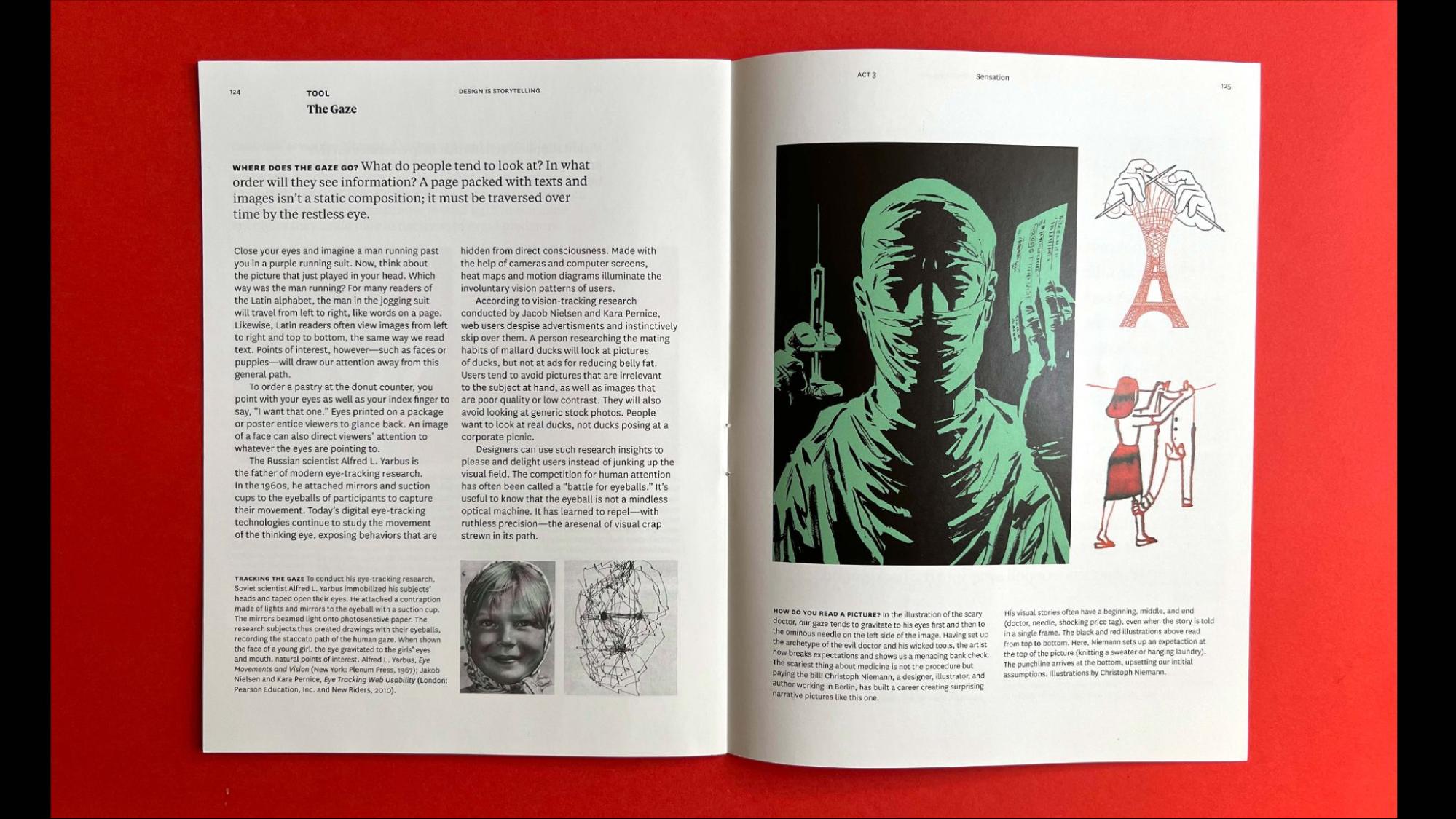
Page spread from the book Design Is Storytelling. Page spread from the book Design Is Storytelling

  • Picture Your Reader: Lupton stresses the importance of considering the reader’s perspective and knowledge base. Authors and designers should strive for inclusive, simple, and direct language that respects the reader and avoids assuming a shared vocabulary. Visual elements can play a crucial role in making complex ideas more accessible to a broader audience.
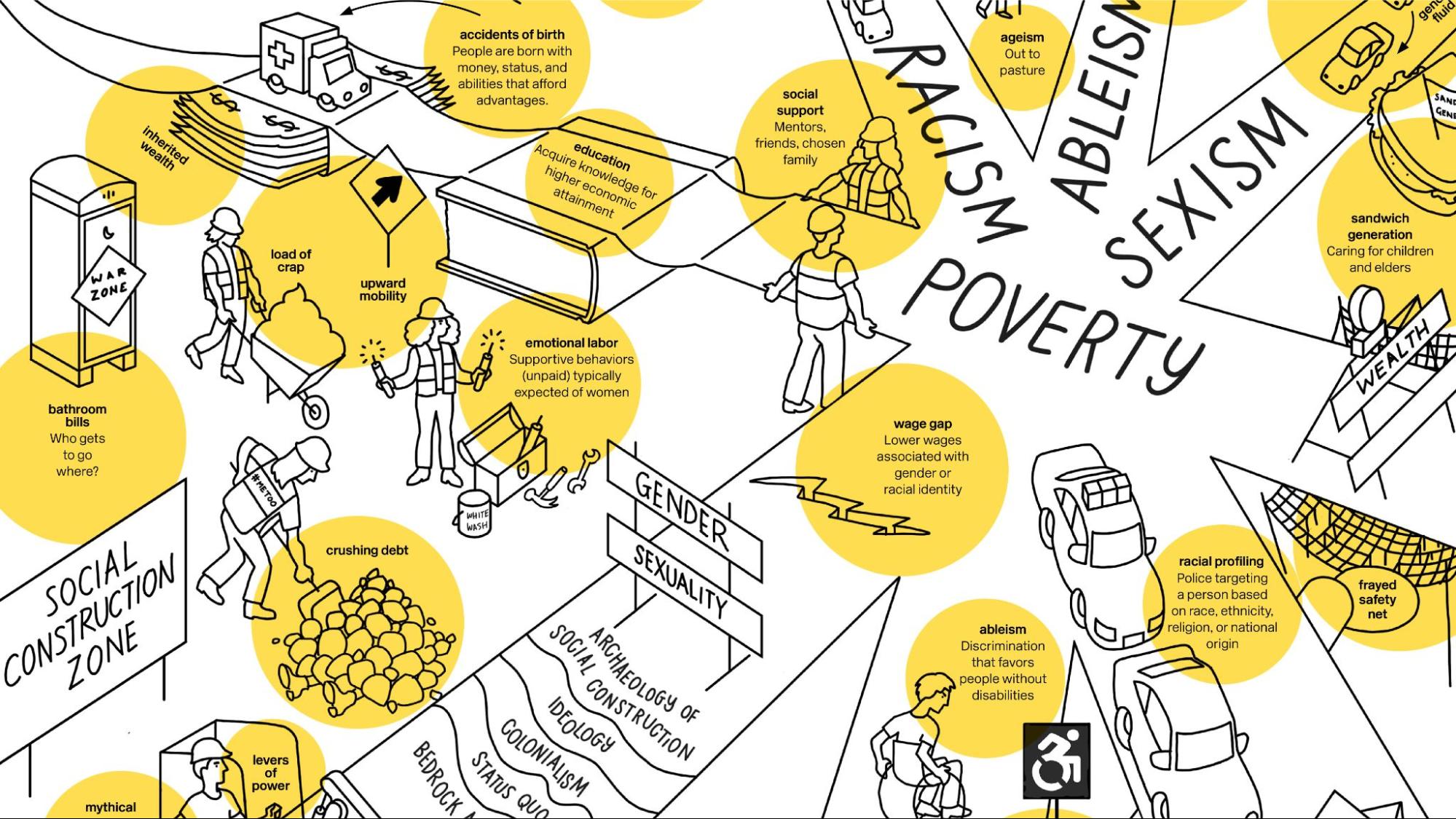
Page spread from the book Extra Bold.Page spread from the book Extra Bold.

  • Design the Cover Last: While envisioning the cover early on might be tempting, Lupton recommends waiting until the content is finalized to design the cover. This ensures the cover accurately reflects the book’s essence and appeals to the target audience.
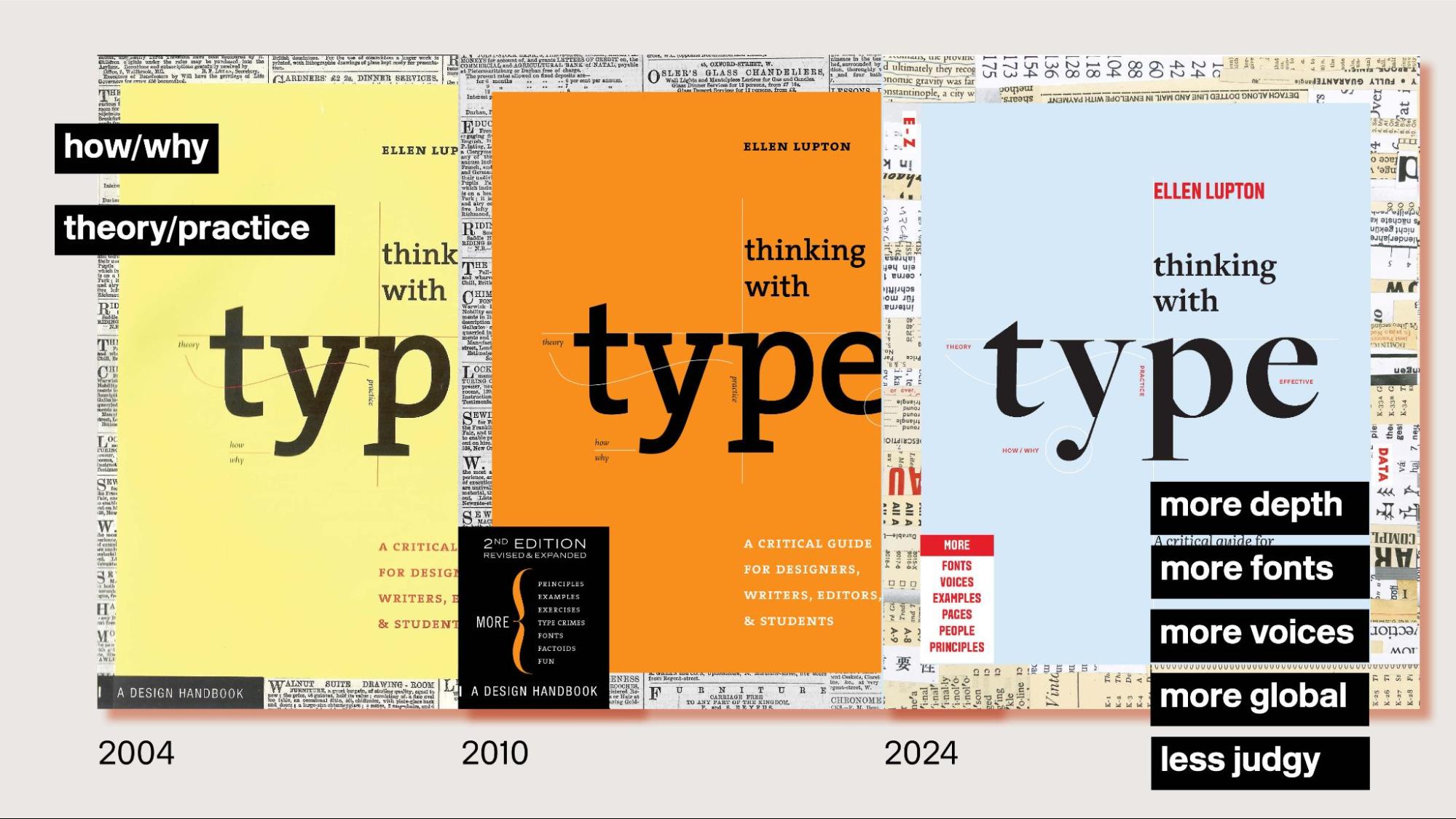
Books covers from different editions of Thinking with Type.Book covers from different editions of Thinking with Type.

Lupton illustrated these principles with examples from her own work, including Design Is Storytelling and Extra Bold, showcasing how a thoughtful approach to structure, layout, and language can enhance the reader’s experience and create engaging and impactful publications. Her third edition of Thinking with Type serves as a compelling example of how a book’s design can evolve to reflect changing perspectives and a more inclusive philosophy.

Towards A Collaborative Publication

Tony Venne, Head of Design at the Walters Art Museum and publication designer for BmoreArt Magazine, shifted the focus to the collaborative process behind BmoreArt’s print journal. He highlighted how BmoreArt has consistently embraced collaboration, fostering a unique creative process involving photographers, artists, and writers.

Venne’s presentation traced the evolution of BmoreArt’s collaborative approach, sharing anecdotes and behind-the-scenes glimpses of the magazine’s development.

Early in the process, Venne realized the importance of shared knowledge and mutual learning, as he brought his print experience to the team while Cara Ober, BmoreArt’s publisher, provided extensive knowledge of Baltimore’s art community. This dynamic exchange, evident in their first team meeting and Cara’s first press check, laid the foundation for a fruitful collaboration.
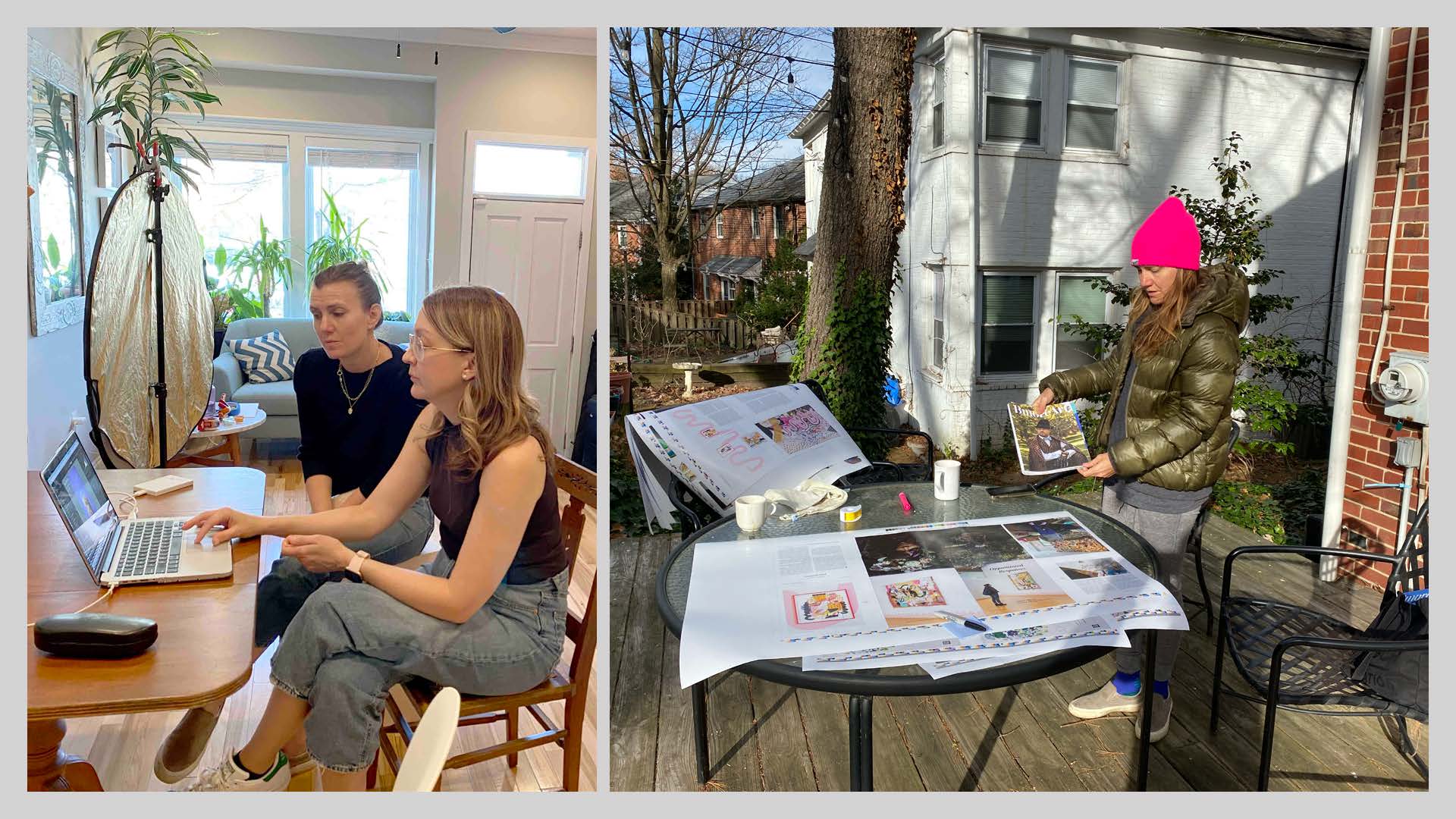
BmoreArt Magazine’s editor Cara Ober with photographer Brady Robinson.BmoreArt Magazine’s editor Cara Ober with photographer Brady Robinson.

Venne emphasized that BmoreArt’s collaborative process extended beyond the core team. They actively engaged photographers, like Brady Robinson, in the creative process, moving away from traditional models where photographers worked in isolation. This collaborative approach gave the team more control over the visual storytelling and facilitated a deeper understanding of the artists and their work.

This spirit of collaboration even led to unexpected ventures, like a “takeout photoshoot” during the pandemic, highlighting Baltimore’s comfort food scene and supporting local restaurants struggling amidst lockdowns. These spontaneous collaborations, driven by shared interests and a desire to support the community, became a defining characteristic of BmoreArt’s approach.

Venne also described how BmoreArt’s design adapted to the evolving content, demonstrating how publications can “learn” and evolve over time. The need to credit artists featured in photoshoots led to significant changes in the publication’s grid, including repositioning folio numbers for longer captions. This evolution showcased how collaboration can necessitate flexibility and creative problem-solving in publication design.
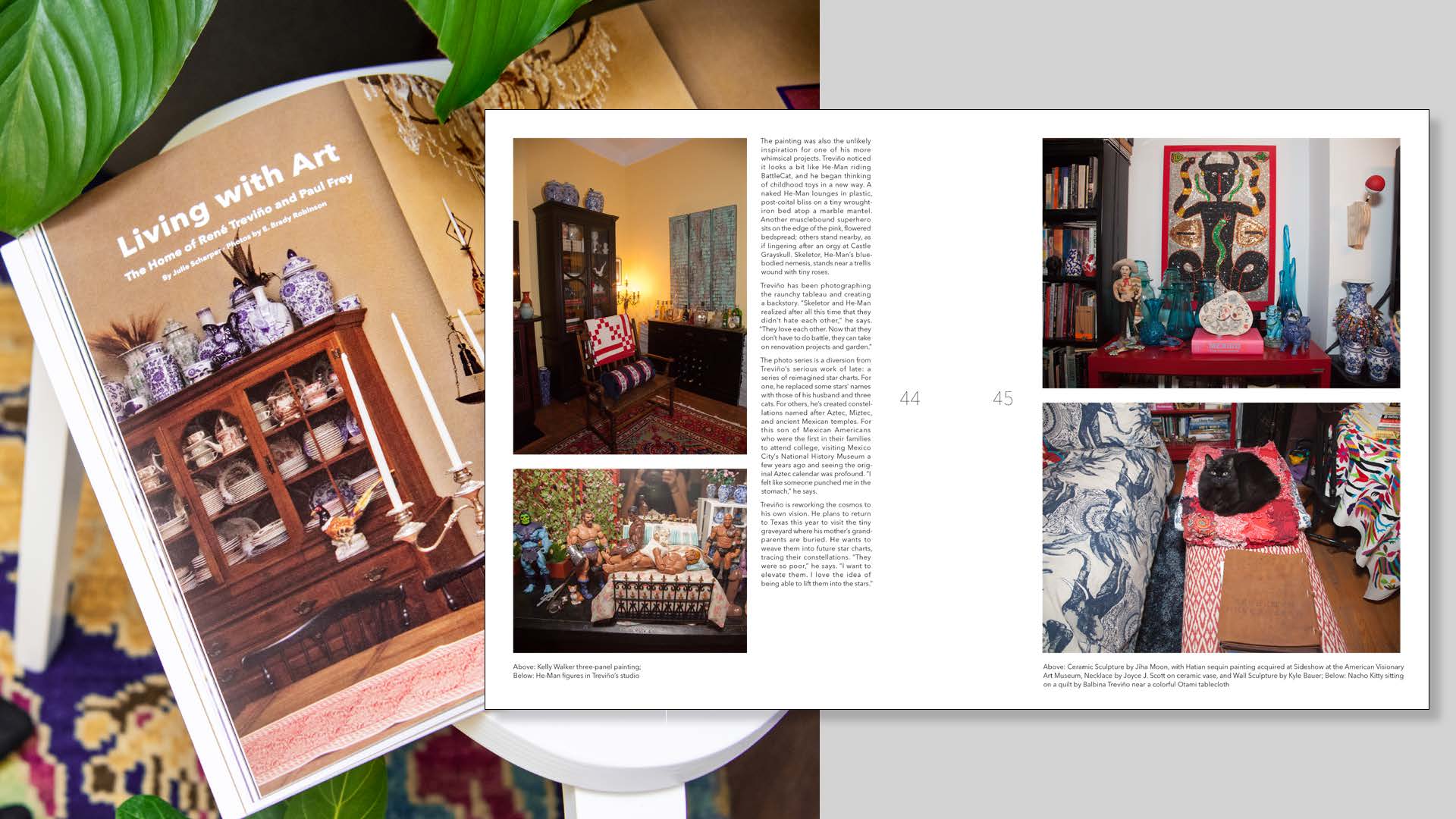
Repositioning folio numbers on BmoreArt Magazine pages to accommodate longer captions.Repositioning folio numbers on BmoreArt Magazine pages to accommodate longer captions.

Furthermore, Venne emphasized the significance of cover design, revealing how Amy Sherald’s cover photoshoot marked a turning point for BmoreArt. The team’s dedication to this shoot, recognizing Sherald’s rising national prominence, led to a more sophisticated and elevated aesthetic, solidifying BmoreArt’s position as a platform for showcasing Baltimore’s vibrant art scene.
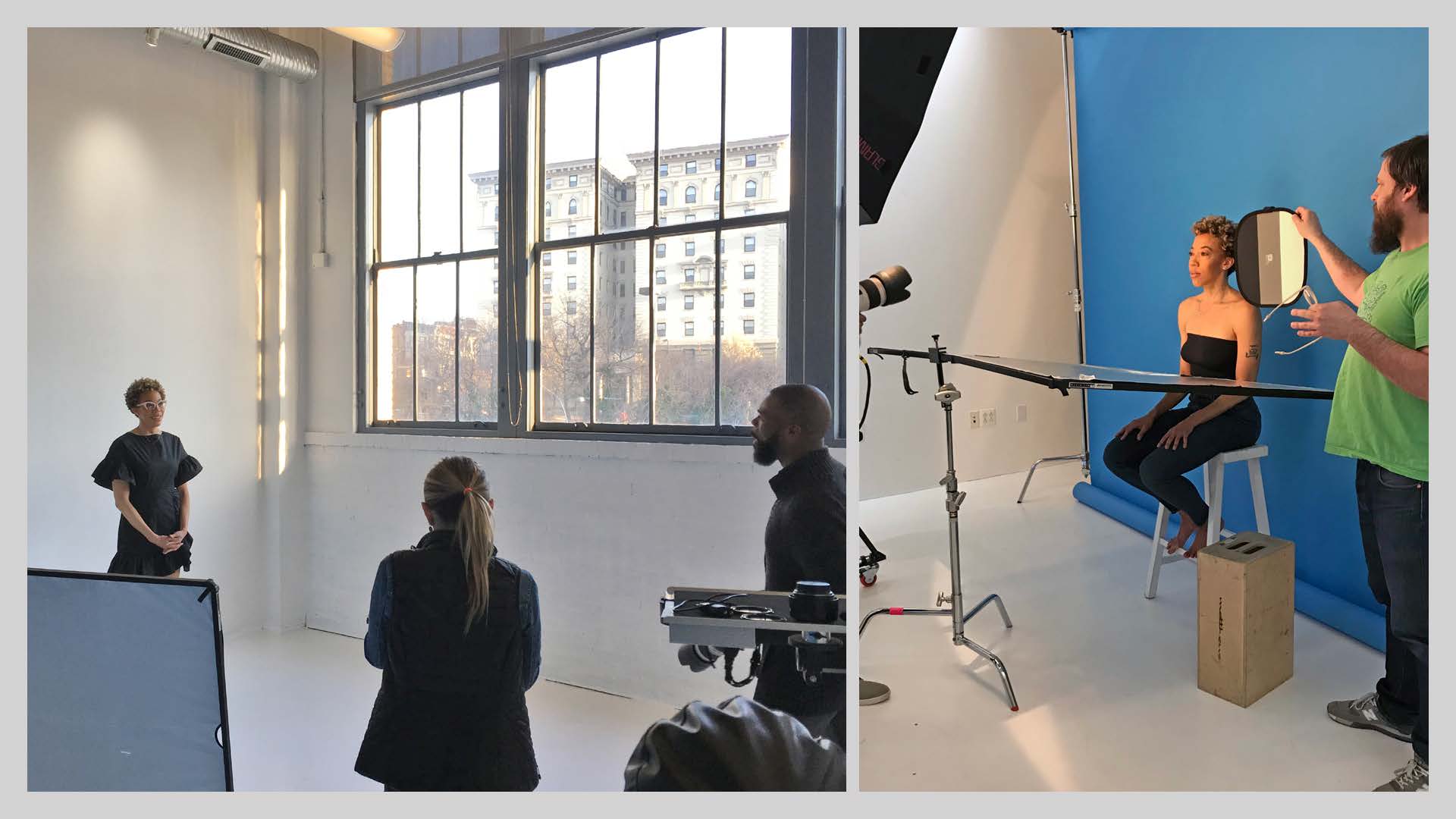
Amy Sherald’s BmoreArt Magazine cover photoshoot by Kelvin Bulluck.Amy Sherald’s BmoreArt Magazine cover photoshoot by Kelvin Bulluck.

Throughout his presentation, Venne underscored the importance of being open to new ideas and perspectives, embracing the unexpected turns that collaboration can bring. He concluded by reflecting on the enriching experience of collaborating with a diverse group of creatives, which has broadened his understanding of design and fostered a more inclusive approach to his work.

Crafting Artist Books as Collaborative Art

Raquel Castedo, a Brazilian graphic designer, educator, and researcher based in Baltimore, brought her expertise on artist books to the forefront. Castedo, who teaches book design at MICA and serves as BmoreArt’s Creative Director, focused on the collaborative aspects of crafting artist books, highlighting the unique challenges and rewards of such projects.

Castedo framed her presentation by emphasizing the significance of artist books, not only for designers and artists seeking to showcase their work but also for art enthusiasts, collectors, writers, and anyone interested in understanding the collaborative efforts behind these unique publications.

She then detailed the creation of Post-Consumption Benediction, a limited-edition artist book published as a companion to a two-person exhibit featuring Adam Stab and Jordan Tierney. The exhibition ran at BmoreArt’s Connect + Collect Gallery from December 2022 to March 2023. This project served as a case study, demonstrating the collaborative process and the importance of honoring the artists’ vision and materiality.
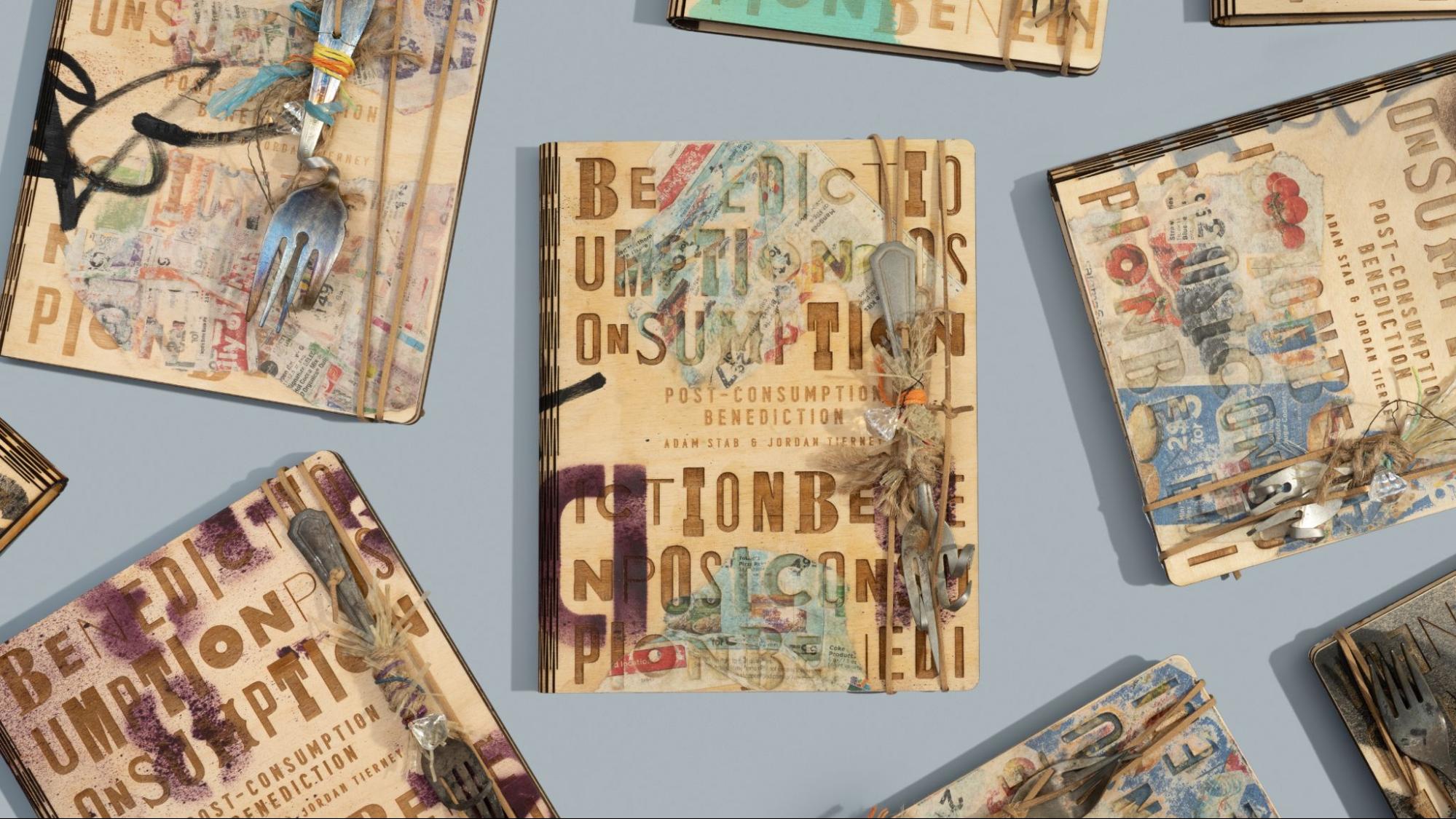
Limited-edition artist book Post-Consumption Benediction, featuring the work of Baltimore artists Adam Stab and Jordan Tierney, published by BmoreArt.Limited-edition artist book Post-Consumption Benediction, featuring the work of Baltimore artists Adam Stab and Jordan Tierney, published by BmoreArt.

Castedo’s journey began with studio visits, where she immersed herself in Stab and Tierney’s creative process, learning about their materials, techniques, and inspirations. These visits were crucial in fostering a connection with the artists and understanding their work’s essence.

Drawing inspiration from the artists’ use of found objects and their commentary on consumer culture and environmental crisis, Castedo sought to create a book that felt like a “found treasure.” The unique typography discovered in their artwork informed the book’s visual identity, including a custom-designed texture incorporating the exhibition’s title.

Castedo’s presentation also delved into the production process, highlighting the collaborative efforts required to bring the book to life. The decision to use wood for the cover led to a partnership with Open Works, a Baltimore-based makerspace. The team at Open Works, led by Zack Adams, experimented with laser engraving techniques, testing various wood thicknesses and refining the design to achieve the desired aesthetic and durability.
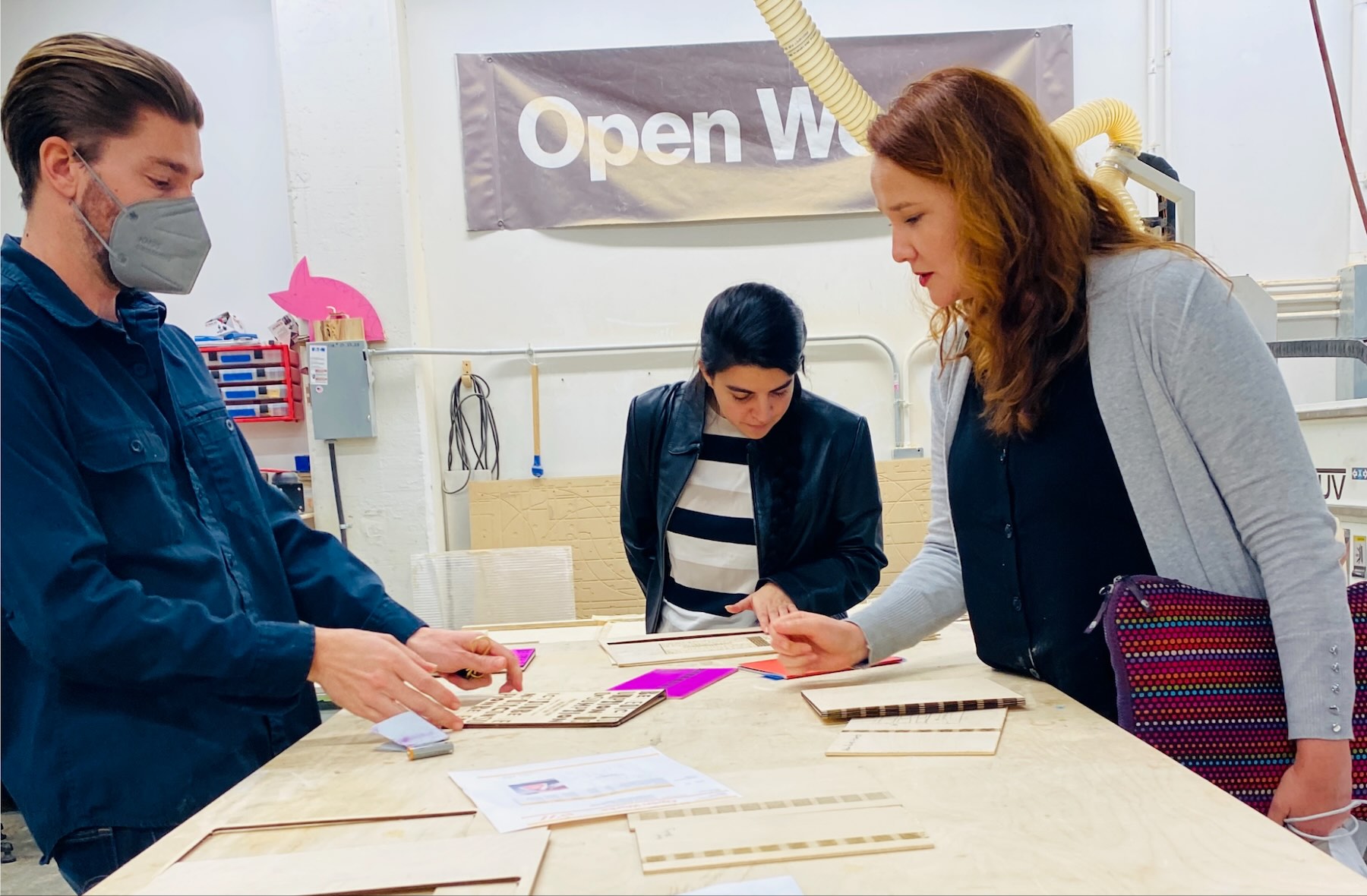
Zack Adams, project coordinator Inés Sanches de Lozada, and Raquel Castedo at Open Works.Zack Adams, BmoreArt project coordinator Inés Sanches de Lozada, and Raquel Castedo at Open Works.

The production process involved a multi-stage approach, with each layer adding a new dimension to the book’s physicality. After laser engraving, the covers were spray painted by Adam Stab, followed by a second round of laser cutting. Jordan Tierney then added collaged elements to each cover, creating a unique textural interplay. Stab then added handwritten details with permanent markers, further enhancing the book’s handcrafted feel.

Finally, the BmoreArt team gathered at Tierney’s studio to attach the interiors to the covers and add a final touch: unique forks sourced by Tierney from Baltimore rivers, adding a symbolic and evocative element to the book.

Castedo highlighted that the success of Post-Consumption Benediction—recently awarded Gold in the 10th Bornancini Award for Editorial Design, a prestigious honor presented by ApDesign in Brazil—was rooted in the strength of the collaborative network behind its creation. She emphasized the importance of fostering connections with artists, designers, production teams, and vendors, including Open Works and Indigo Ink, which handled the printing of the book’s interior.
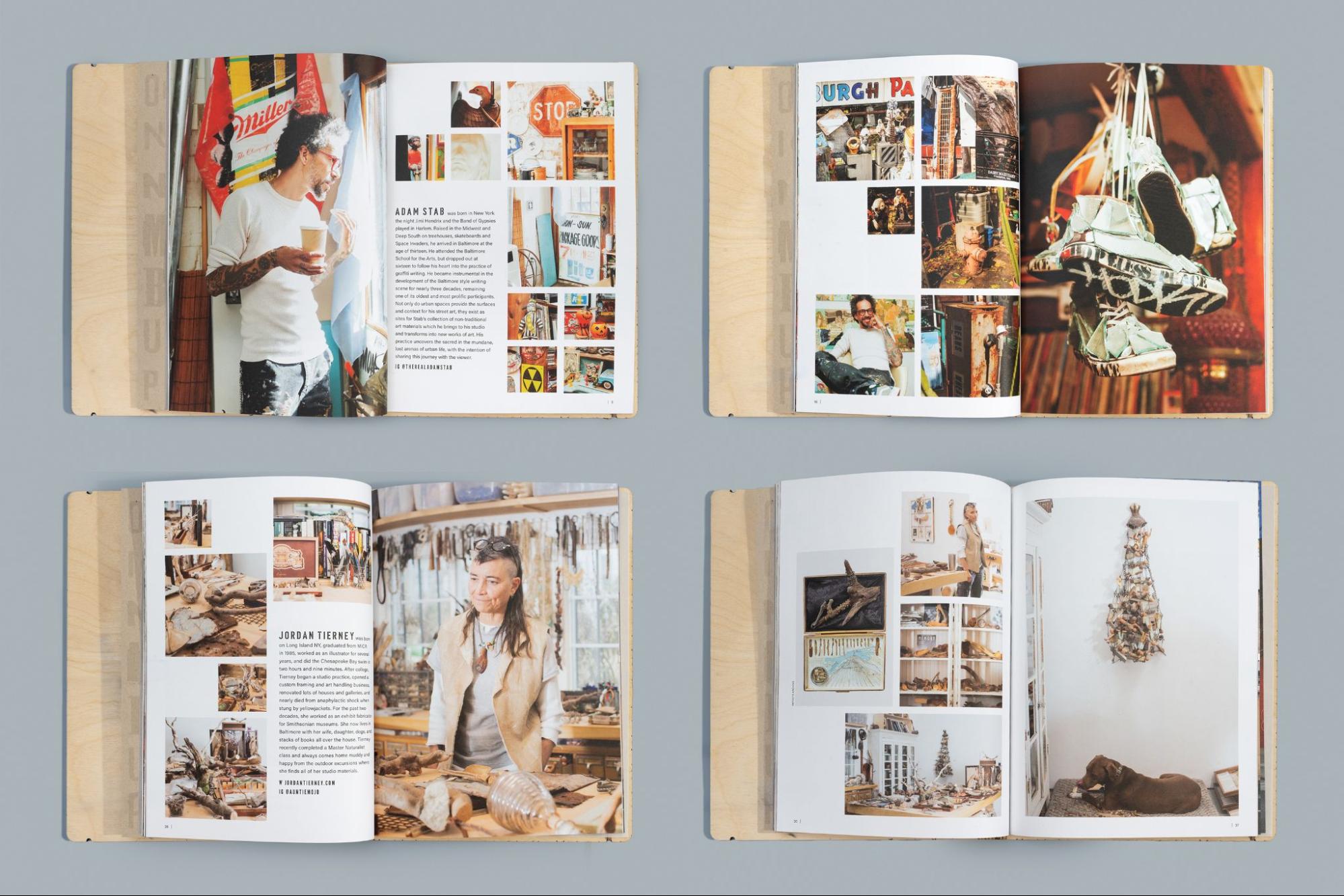
Post-Consumption Benediction book interior pages.Post-Consumption Benediction book interior pages.

Furthermore, Castedo highlighted the often-overlooked aspects of book production, such as shipping and distribution. She advised designers to consider the practicalities of shipping and the costs involved early in the process. She also emphasized the importance of finding the right community for the book, ensuring its accessibility and preservation for future readers.

Post-Consumption Benediction, now part of the special collections at several Baltimore institutions, stands as a testament to the power of collaboration. It transcends mere documentation, becoming an extension of Stab and Tierney’s artistic practice, embodying their creative spirit and the unique materiality of their work.

Discussion and Audience Q&A

Following the presentations, a lively Q&A session offered the audience a chance to engage directly with the panelists, raising insightful questions about the future of design, the intersection of art and capitalism, and the challenges of navigating the digital landscape. The discussion underscored the importance of inclusivity, audience awareness, and the enduring value of physical objects in an increasingly digital world.

The panelists highlighted the lasting significance of books and publications, recognizing them as time capsules that preserve cultural moments and artistic expressions for future generations. They encouraged attendees to be thoughtful in their creative practices, considering not only their message and audience but also the long-term impact of their work.

Ethical considerations in design were also addressed, particularly regarding the tension between artistic expression and commercial pressures. The panelists advocated for a balanced approach that supports creative freedom while critically engaging with the systems that influence artistic production.

The role of social media and online platforms in contemporary design was another key topic. While acknowledging their value for communication and promotion, the panelists stressed the importance of maintaining a discerning perspective—prioritizing authentic connections over superficial online engagement.

The “Crafting the Page” panel at MICA provided an invaluable opportunity to explore the multifaceted world of publication design. Through engaging presentations, thoughtful discussions, and a dynamic Q&A session, the event fostered a sense of community among designers, artists, and writers, inspiring creatives to embrace collaboration, challenge conventions, and craft publications with meaning and purpose.

Resume Writing: Guidance for Designers

Writing a resume can be a daunting task for many. What template should you use? Remembering and articulating your tasks PLUS results? Do you need to customize every resume?

But do designers have different rules than other professions? When I have partnered with Creative and Design directors to identify design talent, they have all requested that the designers have a portfolio or samples of work to supplement the resume. In fact, many have prioritized the portfolio over a resume.

This article offers two distinct perspectives on crafting powerful resumes for design roles. First, I’ll share my comprehensive resume guidance applicable to all professionals.

Next, to go beyond assumptions, I interviewed 11 design leaders in the DC and Baltimore area. They offer their unique insights on what truly catches their eye when evaluating design talent.

Clarity before Writing

Before you decide upon the formatting of your resume, spend time to self-assess and reflect on your career journey up until this point. What projects have you enjoyed contributing to? What type of work environment do you work best in? What are your strengths and weaknesses? What are your longer-term career goals, and what stepping stones do you need to take to get there?

By identifying where you have been and the experiences you have had, you can create a unique value proposition to market to employers. What factors could make you different?

  • The projects you have worked on
  • The industries you have helped
  • Hard skills, training, and methodologies
  • Aesthetic/style (shown in the portfolio)

Have you analyzed the job descriptions you are applying for to make sure your resume speaks to the job requirements? If the job supports government clients, a requirement may include knowledge of Section 508 compliance or the need for an active security clearance. Other requirements could include design software exposure, industry experience, or project type.

Will the ATS kick me out?

The short answer is no. First, an Applicant Tracking System (ATS) is the centralized software system that businesses deploy to manage the recruitment process. Typically, if you are applying to a job online there is a software system where you upload your resume and fill out open fields with your personal information. I wrote an article about the Myths of the ATS system with insights from a dozen recruiters who are the end users.

Many people believe that if your resume isn’t formatted correctly or has the right keywords, the system will boot you out and reject you for the job. Some recruiters and companies may set a job opening to screen with a knockout question, such as “are you authorized to work in the US” or “do you have X years of experience.” If the answer doesn’t align to the requirements, an automated rejection may trigger.

Otherwise, up until today, I do not know any recruiters who are fully relying on keyword match or ranking tools to move applicants on to interviews.

The one thing to be mindful of is how the content of your resume parses into the fields of the ATS system. Text boxes, columns, and images can alter the data extraction of the parsing. With the systems I have worked with, I can view PDF and Word docs as they were submitted.

General Resume Advice

Formatting:

  • Choose a chronological format, prioritizing your most recent experience.
  • Enhance readability by incorporating a fair balance of white space rather than cramming content into the document.
  • Use readable fonts and adopt a font size larger than 10. I shouldn’t have to zoom in to read your resume.
  • Avoid unnecessary visual elements, like a headshot or subjective skill graphics. While I’ve seen a huge uptick in including a headshot over the last five years, you may want to take precautions due to concerns about discrimination based on appearance.
  • Consider offering both PDF and Word document formats, although PDF documents will maintain formatting consistency.

Content:

  • Contact Information: Include relevant details like email, phone, city/state, and LinkedIn/portfolio URLs. A street address is not necessary and maintains your privacy.
  • Summary: Ditch “Objective” and use a targeted statement showcasing your value proposition. This field is a simple space where you can customize your resume to the target job.
    • Consider removing generic sentences inflated with soft skills. For example: Passionate and results-driven web designer with X years of experience crafting user-friendly and visually stunning websites
    • For more impact, you could transform it into a unique statement aligned to the job: Web designer with 5 years of experience creating high-performing websites for SaaS companies. Passionate about leveraging design to empower users and streamline financial processes in the fintech space.
  • Experience: The majority of your content should be dedicated to this field. For readability, format the sentences in a bullet-point list. Include the tasks + results, and quantify your results when you can. Examples:
    • Example: Increased website conversion rate by 15% by redesigning checkout flow using user-centered design principles and A/B testing.
    • Designed a captivating logo for tech startup, resulting in 42% increase in brand recognition within first 6 months.
  • Skills: List relevant software, technical, and language skills, possibly categorized for clarity.
  • Achievements: Consider a separate section for awards, scholarships, certifications, or honors (limit to 2-5).
  • Education: List recent degree, institution, and relevant awards/honors. Include coursework details only if you have no work experience.
  • References: Remove any mention of Reference, as this information can be provided once you convert to an interview. Plus, do you want anyone reaching out to your references without your knowledge?

Additional Tips:

  • Proofread meticulously to avoid grammatical errors or typos. If you aren’t using software tools like Grammarly, hand it off to a trusted colleague or friend to proofread.
  • Have a few copies of your resume if you are targeting different job titles. For example, if the job is for a “Content Designer” then include any project details around content design principles or methodologies. In the summary, swap out the copy “Summary” for “Content Designer.” Do you have an achievement you can highlight here that matches a job requirement?
  • Adding interests or hobbies is your personal choice.
  • Don’t keyword stuff. Instead of creating a laundry list of skills, weave the keywords into your experience section to demonstrate context.

Insights from Design Leaders

Resume advice can be subjective, as everyone has their preferences (and biases). I also wanted to seek out advice from people who are influencing and making the hiring decisions. Here are the recommendations of eleven design leaders from the DC metro area:

Jay Selway, Creative Director at Accenture Federal, prioritizes the portfolio over the resume. “If the resume isn’t nicely designed, that’s a red flag.” However, Jay admits he has seen not-so-impressive resumes from people with amazing portfolios. He said, “the work gets you in the door, and your personality and passion close the deal. The qualifications are the cherry on top.”

A Chief Creative and Founder of a DC-based boutique firm reviews both the resume and portfolio to assess design talent. For the portfolio, he looks for a consistency and sense of style across pieces, along with a sense of proportions and typography. For the resume, design is as important as the content. Seen as a self-marketing opportunity, he looks for creativity and personable branding. Specifically, “how they handle their names? Do they give themselves a logomark? Are there widows and orphans in the type?” Even the decision to use a Word document doesn’t demonstrate the full potential of a creative.

A VP of Design from a real estate tech firm says that a resume that is easy to read and is well-organized, paired with relevant experience is the ideal recipe for an effective resume. What else catches their eye? If the applicant showcases skills needed for the job requirements, like flows, wires, research, and design systems. If you are entry-level, the coursework outweighs the academic performance (like GPA). If the resume is poorly designed with excessive fancy formatting, it negatively impacts the readability.

A VP of Creative & Design, with experience in both a corporate and global agency setting, says that the “portfolio will always be king.”, but be sure to demonstrate your process. Include your sketches, inspiration, and round builds to demonstrate your thinking and unique contribution to the project. For the resume, keep it simple, well-organized, and thoughtfully crafted. Choose a clean typeface that allows the content to be the hero.

Billy Candela, SVP Creative Director at Vox Global, believes that the resume design matters. A well-designed resume (preferably in PDF) showcases a designer’s attention to detail and reflects their overall design skills. The portfolio is a confirmation of the capabilities on the resume. Both the resume and portfolio are a first impression and an extension of your self-marketing, so make them easy to navigate and highlight your relevant experience.

A resume is the sneak peak of your design style before getting into the cool stuff in your portfolio, an AVP, Creative of an agency stated. A clean, readable layout with a bit of creative spark will stand, but it’s about how the design and information work together.

A marketing executive at a SaaS technology company believes less is more with resume writing, but keep it relevant. Crafting an impressive resume is all about telling a concise and captivating story that sets you apart. Focus on clear, tailored writing for your target job level, skip the fancy designs, and cut out the excess. Utilize solid facts and stats to prove your expertise, ditch the flowery language. Research keywords for those resume-scanning bots. Keep it to one page-ish, sync it with your LinkedIn, and add a professional pic and background. Personalize those opening letters, 100% avoid any typos(triple check), and keep it snappy. If you share a portfolio, make it straightforward and showcase your value with meaningful metrics. Your resume should tell a compelling tale of your intentions and your desired company fit. Stay flexible and realistic, avoiding both self-doubt and overconfidence.

“The creativity should not overshadow or overpower the message,” says a Creative and Marketing leader, about the criteria of a strong resume. A one-page resume is preferred, without a personal photo, and it must have clean visual design language and a hierarchy of information. They also seek a business-minded creative, so showing metrics and KPIs shows they understand the value ifor delivering results. As a leader of people, they do give weight to skills and behaviors–not just what they can do but how they do it. A portfolio is also a must-have!

The owner of a Baltimore creative agency prioritizes a strong portfolio and a compelling narrative of the thought process and context behind the work. Real-world experience trumps formal education. As for a resume? It’s not a necessity, especially if the designer has a robust LinkedIn presence.

A Sr. Creative Director from a global PR agency prioritizes 3 main sources when evaluating a design candidate: LinkedIn, a portfolio, and a resume. A LinkedIn profile provides a history of experience and education, and the portfolio showcases the designer’s skills and style. A resume is still important, as it hones in on the designer’s attention to detail. This includes typography, choices of visual hierarchy, and formatting like sentence breaks. Designers who make resumes too “designy” or branded like infographics risk being offputting and overselling their authenticity.

The design leader of a digital solution firm emphasizes the importance of targeted, clear, and visually appealing application materials to demonstrate an understanding of the job and how you can add value. With a resume, focus on clarity and relevance–help the hiring manager understand how you could apply those skills and learnings to the new role. For formatting, make it succinct and scannable. The portfolio connects the dots of the skills and experience stated in the resume. Content design matters! Treat your portfolio design with the same care you’d give client work. And if you consider a cover letter? First, ditch the generic template. Secondly, don’t focus just on your experience. Bridge the gap by showing how that experience will meet the business challenge at hand.

Wrapping up

While I’ve shared my approach to resume writing paired with the valuable insights from design leaders who are calling the shots on hiring, remember that hiring is nuanced. If anything, the perspective from the 11 is a clear example of this.

Ultimately, each interviewer brings their own unique perspective and priorities. Don’t be afraid to tailor your resume and highlight experiences that resonate with specific companies and roles. Experiment, seek feedback, and trust your instincts to craft a resume that authentically reflects your talent and aligns with your target job.

About the writer

Kelli Hrivnak

LinkedIn | Website

Kelli Hrivnak is a leader with over 15 years of experience in staffing and recruitment services. Recognizing the limitations of quantity-driven staffing models, Kelli embarked on a mission to create a forward-thinking alternative. She is founder of Knak Digital, a recruiting agency prioritizing strategy and quality over high-volume recruitment. Throughout her career, Kelli has partnered with various companies, from Fortune 500 corporations to start-ups. Her extensive background in the technology and marketing industry has provided her with valuable insights and a deep understanding of client needs.

2022 Flux Student Design Competition Winners

Judging for AIGA Baltimore’s annual Flux Student Design Competition has been completed. Flux is a nationwide competition that recognizes outstanding design work produced by students in the categories of Identity, Packaging, Poster, Publication, Social Impact Design, UX/UI, and Video/Motion Graphics. This year, 205 projects were selected by a jury of creative professionals including Jenny Hoffman, Alberto Rigau, and Liese Zahabi. 631 entries were submitted making the 2022 Flux Student Design Competition one of our largest and most competitive yet.

The Flux22 awards reception and 15th-anniversary celebration were held at Price Modern on Friday, February 3rd. Thank you to our sponsors: MindgrubAlpha Graphics, & Price Modern. We honored recipients for the following categories; identity, packaging, poster, publication, social impact design, UX/UI, and video/motion graphics. Thank you to the AIGA Baltimore board and volunteers for putting on a fantastic reception!

[siteorigin_widget class=”SiteOrigin_Widget_Image_Widget”][/siteorigin_widget]
[siteorigin_widget class=”SiteOrigin_Widget_Image_Widget”][/siteorigin_widget]
[siteorigin_widget class=”SiteOrigin_Widget_Image_Widget”][/siteorigin_widget]
[siteorigin_widget class=”SiteOrigin_Widget_Image_Widget”][/siteorigin_widget]
[siteorigin_widget class=”SiteOrigin_Widget_Image_Widget”][/siteorigin_widget]
[siteorigin_widget class=”SiteOrigin_Widget_Image_Widget”][/siteorigin_widget]


2022 Winners


[siteorigin_widget class=”SiteOrigin_Widget_Image_Widget”][/siteorigin_widget]


[siteorigin_widget class=”SiteOrigin_Widget_Image_Widget”][/siteorigin_widget]


[siteorigin_widget class=”SiteOrigin_Widget_Image_Widget”][/siteorigin_widget]


[siteorigin_widget class=”SiteOrigin_Widget_Image_Widget”][/siteorigin_widget]


[siteorigin_widget class=”SiteOrigin_Widget_Image_Widget”][/siteorigin_widget]


[siteorigin_widget class=”SiteOrigin_Widget_Image_Widget”][/siteorigin_widget]


[siteorigin_widget class=”SiteOrigin_Widget_Image_Widget”][/siteorigin_widget]


[siteorigin_widget class=”SiteOrigin_Widget_Image_Widget”][/siteorigin_widget]

AIGA Baltimore Becomes Caretaker for AIGA Blue Ridge Legacy: Flux Student Design Competition

Flux, a student design competition that’s attracted over 900 entries in past years, has a new host, AIGA Baltimore.

Flux celebrates the best creative work produced by undergraduate and graduate students from across the country. Entries are selected by a jury of leading design professionals and showcased in a gallery exhibition as well as online. Flux has been an outlet for student designers of all practices, and despite a change in ownership, the foundation of Flux has ensured that its success will not waver.

The competition was established in 2007 by the former AIGA chapter, Blue Ridge. Board Member Katlynn Almansor led Flux in 2021 and felt the impact of the Blue Ridge leadership before her.

“I believe we were very lucky to be able to maintain that event, and that was in large part because of all the work over the years by past presidents and board members… Flux was built on a solid foundation, and it’s stood the test of time and change thus far,” said Almansor.

Kicking off the competition and growing it to a nationwide audience took the dedication and commitment of many AIGA Blue Ridge members. Joe Wagner, served as a long-time advisor and sponsor of Flux. Wagner credits former President Laura Webster and Board Members Cathy Bruce and Jenn Laumann with establishing the competition’s solid foundation.

[siteorigin_widget class=”SiteOrigin_Widget_Image_Widget”][/siteorigin_widget]

Katlynn Almansor

President Emeritus
LinkedIn

[siteorigin_widget class=”SiteOrigin_Widget_Image_Widget”][/siteorigin_widget]

Cathy Bruce

President Emeritus
LinkedIn

[siteorigin_widget class=”SiteOrigin_Widget_Image_Widget”][/siteorigin_widget]

Kevin Bruce

Web Director
LinkedIn

[siteorigin_widget class=”SiteOrigin_Widget_Image_Widget”][/siteorigin_widget]

Troy Dean

President Emeritus
LinkedIn

[siteorigin_widget class=”SiteOrigin_Widget_Image_Widget”][/siteorigin_widget]

James Hersick

President Emeritus
LinkedIn

[siteorigin_widget class=”SiteOrigin_Widget_Image_Widget”][/siteorigin_widget]

Jenn Laumann

Past Treasurer
LinkedIn

[siteorigin_widget class=”SiteOrigin_Widget_Image_Widget”][/siteorigin_widget]

Matt Laumann

Past Vice President
LinkedIn

[siteorigin_widget class=”SiteOrigin_Widget_Image_Widget”][/siteorigin_widget]

Joe Wagner

AIGA Baltimore, President Emeritus, AIGA Central PA, President Emeritus, and AIGA Blue Ridge Volunteer / Flux Sponsor
LinkedIn

[siteorigin_widget class=”SiteOrigin_Widget_Image_Widget”][/siteorigin_widget]

Laurel Webster

President Emeritus
LinkedIn

Former Blue Ridge member Kevin Bruce has been the long-time owner of Flux’s online presence. Bruce is a designer that found himself in the world of coding, a skill that AIGA Blue Ridge needed when building a national competition site. In 2010, Bruce was asked to clean up the code and by 2014, he was in charge of maintaining the website, which is now complete with competition details, judge profiles, and an entry portal.

Flux has several admission categories ranging from packaging design to motion graphics and so much more. Students must be enrolled in undergraduate or graduate programs to be eligible to enter, and they can participate in multiple categories. Bruce has seen Flux become a great motivator for students each year.

“Having helped run Flux over the years, you learn a few of the professors’ names because they rely on the Flux competition to challenge their students every year,” said Bruce. “That was the real reason why we didn’t want to just let it die.”

Since Flux’s creation, entries have grown from around 600 to 950, according to Bruce. With AIGA Blue Ridge dissolving and an overwhelming desire to grow the competition even more, Almansor says it was a no-brainer to contact their sister chapter in Baltimore.

“My hope is for Flux to not only maintain its quality and longevity, but to exceed it,” said Almansor. “The closure of AIGA Blue Ridge was a hard decision, but passing on Flux to another chapter was not. It was the one thing we wanted to see continue to impact and promote young designers, and we are so happy Baltimore took it over. I believe they might have the resources to not only sustain Flux but make it bigger and better.”

Current AIGA Baltimore President Frances Miller says the Baltimore chapter was excited to take on the challenge and acknowledges the opportunity that Flux provides to the college curriculum.

“We are excited to produce something that touches hundreds of students and educators across the country while putting a spotlight on Baltimore,” said Miller. “We’re off to a great start! [Board Member] Karole Kessler has hit the ground running as this year’s Flux leader and already has our reception on the calendar for February, with support from new Flux sponsors: Price Modern, Alpha Graphics, and Mindgrub.”

AIGA Baltimore launched Flux 2022 on September 27th and have their judges ready to review entries when the portal closes on November 16. Judges typically evaluate entries based on the students’ interpretation of the project, level of creativity and originality, and their artistic skills demonstrated, according to former Flux advisor Joe Wagner. Awards in the past have included a best of show for each category and an overall best of show.

All awarded entries will be displayed online and exhibited at a reception at Price Modern in Baltimore. The special reception will recognize participants and take place at Price Modern on February 3rd, 2023. Miller is already looking to the future of Flux beyond next year’s reception.

“Our goal in 2023 is to establish our Education Committee to envision and build the future of Flux,” said Miller. “We’d like to see an impressive online gallery to showcase the work…As a 100% volunteer-run organization, all of these ideas rely on a passionate board of volunteers.”

AIGA Baltimore is currently seeking their next Education Chair to help establish the competition’s future. Professionals can nominate themselves or a colleague on the AIGA Baltimore’s website. 

The dedication of countless volunteers has allowed Flux to impact the lives of 15 graduating classes of designers. Flux has given young artists a place to showcase their work and without it, there are limited, organized events for student designers to get their work in front of the public.

“Emerging designers are doing great work, which often goes unseen past their critique room and portfolio…Plus, when you’re new to a field, building confidence can be a huge hurdle,” said Miller. “Of course winning an award helps with confidence, but even submitting is a statement to yourself that your work deserves to be seen.”

While the Baltimore chapter is focused on growing Flux as a student competition, they’ve also considered how Flux can fuel other initiatives, like introducing a contest to professionals.

“We’ve also discussed the possibility of opening a professional competition, using Flux to fund a scholarship, or partnering with other AIGA chapters,” said Miller. “We’d love to hear feedback from educators and students about what they’d like to see.”

For now, AIGA Baltimore is focused on Flux 2022, which is well underway. This year’s judges are Liese Zahabi, a graphic/interaction designer and Assistant Professor of Design at the University of New Hampshire, Jenny Romei Hoffman, co-owner of Ashton Design and board member for the Baltimore Design School and the Charles Street Development Corporation, and Alberto Rigau, graphic design instructor and co-chair for AIGA’s Design Educators Community.

Learn more about the 2022 judges at the Flux Competition website.

[siteorigin_widget class=”SiteOrigin_Widget_Image_Widget”][/siteorigin_widget]
[siteorigin_widget class=”SiteOrigin_Widget_Image_Widget”][/siteorigin_widget]
[siteorigin_widget class=”SiteOrigin_Widget_Image_Widget”][/siteorigin_widget]

The deadline to submit projects is November 16. To enter the competition visit  Flux Design Competition. Interested in volunteering to help with Flux? Please email flux@baltimore.aiga.org

Meet the Designers Behind the Ink & Pixels Branding 2022

Ink & Pixels is coming up at the end of April! Save the dates for the virtual panel, “From Portfolio to Offer: The Art of Getting Hired” on April 23rd and the in-person portfolio reviews on April 30th. This year, the branding for Ink & Pixels was designed by Jamie Wheeler of Jelly Creative Co. (@jellycreativeco) and Jess Langley of White Coffee Creative (@whitecoffeecreativeco).

Can you tell us about yourself? What’s your story?
Jamie — My go-to line is, “I’ve been getting paid to design for almost 15 years.” It started with a high school internship, a design degree from York College of PA, various design jobs, a few years teaching, and now I own Jelly Creative Co. A branding and design studio for the creatively ambitious. I also like lava lamps, Nutella, my dog Nova, reading fiction, and playing board games with my husband. When I’m working towards a deadline you’ll find 90’s hits or EDM blasting on my Spotify.

Jess — My story has been full of lessons and ups and downs. In college, I landed my first design-related job as a Store Artist at Whole Foods. I learned lettering, how to work with others, and built up my confidence. That led to my first internship turned design job after graduating with a BFA in Graphic Design from Towson University. After being laid off from there in June 2017, I decided I was done with the typical 9-5 culture and went out on my own. I started White Coffee Creative and haven’t looked back since! My services, style, branding, and who I like to work with have changed drastically since then but I’m so grateful for the journey. I started coaching creatives in 2020 and now am learning to balance the two businesses with ease. When I’m not working, you can find me sipping coffee (obviously, with extra cream and sugar), bingeing Netflix shows, hiking with my 2 pups and partner, or dreaming about having a cabin in the woods.

How did you meet and start working together?

Jess had been running her business for two years when I DM’d her on Instagram asking if we could meet for coffee and talk shop. We met up at Spoons for breakfast and just clicked! She was my first local design/business owner friend and a huge supporter as I went full-time with my company in 2019. Community is really important to us both so when I brought the idea of a group for local designers to Jess she was on board to help start the Facebook group, Baltimore Graphic Designers, which now has 300 members! We have worked on local branding projects together, drank lots of local coffee, sent countless voice messages, and continue to cheer each other on. After Ink & Pixels, we’re excited to see what design mischief we can get into next!

How did you approach this branding project and what was your design process?

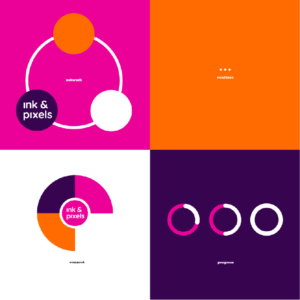
We were inspired by the juxtaposition of ink (organic) and pixels (geometric). We started with basic shapes within the AIGA color palette, then using only these shapes we started creating icons that can be used in various ways. The final touch is the wavy lines that intersect with the shapes and icons to create movement and bring everything together.

Having a stark black background allows the colorful elements to be brought to life and grab your attention while scrolling on Instagram or walking by on campus.

The fonts are designed by our friend Alex of The Routine Creative, a Texas-based designer. The jackknife font just felt too perfect not to highlight!

Can you describe your inspiration and any challenges you came across them while designing the branding?

If we had been working solo, there may have been more challenges, but we were able to pass the files back and forth when one of us was feeling stuck creatively. We have worked on branding projects together so we hopped right back into a nice groove. When we say it was a fun project, we really mean it!

What’s your favorite part about designing branding?

Jamie — Like any large design project there are the peaks and valleys, I think the moments right after the valleys are my favorite. I think all designers have the thoughts of “this is never going to work, what am I doing” but it’s the “oh yeah, this is it!” that I’m always chasing.

Jess — I love pulling visual inspiration and using strategy and color psychology to tie in meaning. It’s always a fun challenge to create branding that visually captures the essence of a business while maintaining simplicity. So that beginning exciting energy and the finale of when it’s all done and ready to show the world are my favorite parts.

Was there an aha moment when you knew you wanted to be a designer?

Jamie — Why yes, yes there was. It was when I photoshopped Ashton Kutcher into my homecoming photo and posted it to my Myspace. Technically, that’s when I opened the world to design, but the moment I learned it was an actual career and a college major I knew that was the path I was taking.

Jess — Yes! In college, I dabbled in a few different majors—journalism, photography, general fine arts, and design. I vividly remember one of my college professors (shoutout to Carolyn Norton!) in an Intro to Design class telling me I was already a designer. Getting that recognition and encouragement made me feel ready to step into this direction as a designer full-heartedly, and I got accepted into the GD program at Towson that following semester!

In the long term, what do you hope to eventually accomplish as a designer? What is your biggest goal/dream as a creative?

Jamie — This question is making me realize how much I have accomplished as a designer already, which is really cool. My dream client at the moment would be to work with a performing arts company. Lately, I’ve been searching for ways to bring all my talents and interests together while also helping other designers and keepin’ it real. A huge dream of mine was to host a retreat for designers, which is happening this spring, so I’m too sure what’s next!

Jess — I’m really enjoying running my own studio. I love being a multi-faceted creative offering design, murals, AND coaching. I hope to continue to navigate balancing a variety of tasks, projects, and clients while continuing to reinvent myself and where I want to go next. My big dreamy goal right now is to speak on stage at a creative conference one day about intentionally finding that balance as a business owner while having the freedom to explore a variety of creative outlets.

Thank you to Jamie and Jess for sharing their stories! We cannot thank you both enough for creating the branding for this year’s Ink & Pixels. Make sure to follow them on their various social channels!

White Coffee Creative
Designer + Muralist
whitecoffeecreative.com | @whitecoffeecreativeco

The Colorful Jess
Mindset + Pricing Coach
thecolorfuljess.com | @thecolorfuljess

Jamie Wheeler
Owner + Creative Director
jellycreativeco.com | Instagram | Facebook

Best Practices for Creating a Design Portfolio & Preparing for Interviews in 2022

AIGA Baltimore is here to help you succeed in your design portfolio reviews and interviews! Here is a guide for creating a design portfolio and some tips on how to prepare for an interview.

1. Quality over quantity. Showcase your best work.

We recommend starting and ending with an awesome piece. Don’t be afraid to include self-initiated work to stand out from the crowd. ONLY show your best work in your portfolio. If you aren’t 100% happy with a particular piece, don’t include it. It’s better to have 5-7 amazing projects than 10-15 projects that aren’t so great.

2. Think about how you will present your design portfolio—whether it is a PDF or an online portfolio. 

Traditional portfolios are printed in a flipbook style. If you have mostly print pieces, the traditional route may be the way to go. A bonus of having a printed portfolio is the opportunity to showcase printed pieces and to give reviewers a takeaway. Or if you have mostly web pieces, think about creating a portfolio website.

If you create a traditional printed portfolio or just a PDF, we suggest using Adobe InDesign to create the best design layout! Use 1-2 pages for each project and make sure you have a good hierarchy in terms of typography and images. A good size is 12×18 inches. 

Don’t forget to make your projects pop by placing them in mockups. We recommend keeping your mockup files organized to avoid re-downloading huge files. Some good mockup sites are mockupworld.co, creativemarket.com, graphicburger.com, and unblast.com. If you can’t find a free mockup, sometimes it’s easier to just create your own. 

If you need more design resources, check out this *FREE* Design Resource Guide from YouTuber & Graphic Designer, Kel Lauren.

3. Create a graphic design online portfolio.

It is a good idea to have a graphic design online portfolio so you can easily share it on LinkedIn, via email. Think about using Behance (free to use), Adobe Portfolio (you need a Creative Cloud account), Dribbble (you need to be invited), or a custom website such as Squarespace, Wix, or WordPress. Keep an out on the Creative Market freebies as they sometimes offer free website templates. 

4. Seek design opportunities outside of school.

There are lots of ways to get involved in design outside of school. Join the Baltimore Graphic Designers group on Facebook. It’s a group for Baltimore area-based graphic designers to create community, ask questions, get advice, share jobs, and plan meet-ups.

One way is to get involved with AIGA Baltimore! AIGA Baltimore is gearing up for another year of learning, connecting, and growing, and we need your help! Join board leaders on 1/26 at 12PM to hear about open roles and volunteer needs and find out where you can make a difference.

5. Keep your career goals in mind.

What do you want a career in? Think about all of these categories:

  • Brand Identity Design
  • Marketing & Advertising Design
  • Packaging Design
  • Motion & Video Design
  • Web & User Interface Design
  • Print & Publication Design
  • Lettering & Type Design
  • Graphic illustration
  • Data Visualization & Infographic Design

Learn more about these specific career types on dribbble: https://dribbble.com/resources/types-of-graphic-design

6. Practice how you will present your work. 

Be ready to discuss the goal of the project and how you reached the solution. Consider bringing any process sketches with you as well since reviewers are interested in your overall process.

Make sure that the pieces you include are the ones you are proud of. Make sure you can talk confidently in your meeting, interview, or review. Practice with a professional if you can.

7. Seek expert feedback. Attend Ink & Pixels 2022!

Take the next step towards your design career! Whether you want to make a good impression in interviews, need a new perspective on your portfolio, or want fresh eyes on a current project, we’re here to help. Ink & Pixels is one of AIGA Baltimore’s largest events focused on helping designers prepare for a career or career shift. 

This year, Ink & Pixels will be a 2-part event. The first event will be a virtual panel, From Portfolio to Offer: The Art of Getting Hired on Saturday, April 23rd. The Ink & Pixels portfolio reviews returns on Saturday, April 30th at Towson University. Mark your calendars and clean up those portfolios!

Meet the Designer: Paige Olsen | Ink & Pixels 2021

Have you seen the branding for this year’s Ink & Pixels on social media, our website, or the emails? The branding, patterns, and images were created by Stevenson University Alumna, Paige Olsen. We interviewed Paige recently to learn more about her process and her story.

Can you tell us about yourself? What’s your story?

I recently graduated with a degree in Visual Communication Design and am currently working as a Freelance Graphic Designer. In this role, I am designing promotional assets, visual identities, and graphic art according to client specifications.

In addition to my love for design, I have a love for fitness. I approach design similarly to how I approach fitness. Fitness requires a consistent effort to progress and a desire to persevere. I’m looking for an opportunity to take the next step in my Design career and am hoping to do so by merging both of my passions with a focus on graphic design in the fitness industry.

How did you approach this branding project and what was your design process? Can you describe your inspiration and any challenges you came across them while designing the branding?

My first step in approaching the branding project started by really understanding AIGA’s brand (goals and vision) and allowing the ideas to come to me. This general information led me to a better understanding of where the brand is vs. where they want to go. I continued my research by identifying the audience, as well as, reviewing past events/similar portfolio events in the area. Knowing what has previously been done allowed me to differentiate Ink and Pixels 2021 from what currently exists.

The number one strategy I used that inspired the brand’s identity was a Word Association list. I generated keywords associated with the main goals of the event, instead of pulling all of my inspiration from the title of the event, “Ink and Pixels”. The strategy led me to 4 main keywords that represent the event (Network, Continue (to learn), Connect, and Progress). I developed these keywords into icons to visually communicate the value of the event. By integrating these keywords directly, it is easy to understand what the event offers. The icons are also designed into an abstract pattern to reinforce this idea.

The main idea behind the visual identity is to show that even with different audiences (Students, Design Professionals, Speakers), they all have a common goal at Ink and Pixels (connecting, growing, and coming together). One challenge I faced along the way is the abstract pattern itself. The style I was attempting was new to me and needed to be designed heavily off of a grid. I overcame the obstacle by studying patterns that were also designed from a grid to understand how I can create my own.

What’s your favorite part about designing branding?

My favorite part about designing branding is turning my ideas into reality. I love the process of creating something impactful and memorable in the world that once wasn’t there.

Was there an aha moment when you knew you wanted to be a designer?

My journey as a designer is very different from what you would normally expect. I did not know anything about Graphic Design and wasn’t exposed to the idea until my senior year of High School when I enrolled in a Computer Graphics course. When growing up, I always had a love for art, but I never knew this would be the path I would take.

What led me to be a designer is that I felt as if it fit my personality. I am known for being driven and diligent. I enjoy challenging myself and in design, you need to constantly challenge yourself out of your comfort zone. Design is a challenge for me and that is what drew me to it. I have a willingness to always learn and progress. I believe consistent, disciplined action beats natural talent and that’s the approach I take in all aspects of my design work.

In the long term, what do you hope to eventually accomplish as a designer? What is your biggest goal/dream as a creative?

In the long term, I see myself further developing my skill set to create recognizable and noteworthy work at a reputable studio/company. I desire to evoke emotion and to bring the unexpected to the target audience of my designs. My end goal is to have a positive impact through the messaging of my designs while offering a high level of creativity.

Thank you, Paige Olsen, for sharing your story! We cannot thank you enough for creating the branding for this year’s Ink & Pixels. Make sure to give Paige a follow on her Behance portfolio page and on LinkedIn!

14+ Events to Attend Around the World!

9/15-10/15

Hispanic Heritage Talks

AIGA Unidos was created for Everyone!
We highlight Hispanic and Latinx creatives, so we can share their stories and work with the world—that’s you! Our first ever event is a series of talks called Hispanic Heritage Talks, which will take place during Hispanic Heritage Month. It is a series of virtual talks featuring Latinx and Hispanic creatives from different backgrounds and disciplines. ¡Acompañanos!

Join the AIGA Unidos familia, and hear from all the amazing creatives our heritage has to offer. From us to you, with love and a little sazón… who are we kidding? A lot of sazón! We are Unidos for Everyone!

Hosted by: AIGA Unidos
→ Register Here
FREE


10/1-31

Doors Open Baltimore

Doors Open Baltimore is going virtual-only in 2020 with a month’s worth of programming throughout October. Organized by the Baltimore Architecture Foundation (BAF), Doors Open Baltimore is the free citywide festival of architecture and neighborhoods that invites thousands of people to explore the city and make meaningful connections to the built environment. Replacing a weekend of open houses and in-person tours will be a month’s worth of virtual programs. Every week of October will include a new theme and new ways to virtually engage with Baltimore’s architecture and neighborhoods. 

Hosted by: Doors Open Baltimore
→ Register Here
FREE 


10/2-10/9

Phoenix Design Week – PHXDW

Phoenix Design Week (PHXDW) is a week-long celebration of design organized by AIGA Arizona to unite our state’s creative community and provide a forum for sharing best practices, showcasing exceptional work, and gaining inspiration.

Hosted by: AIGA Phoenix
→ Register Here
$25-$49 Tickets


10/5-10/10

St. Louis Design Week

St. Louis Design Week is a seven-day celebration of our local design community, featuring a variety of panel discussions, workshops, presentations, open houses, and other community growth-oriented events. Our mission is to grow design and breakdown design silos through making St. Louis design week all-inclusive, to all designers.

Hosted by: AIGA St. Louis
→ Register Here
FREE


10/5-10/9

Salt Lake Design Week – Dimensional Design

What is “Dimensional Design?” It is the idea that we, as designers and creatives, have to be multifaceted in our disciplines. Becoming a dimensional designer includes exposing oneself to creatives of other disciplines and perspectives to be able to see the broader context of their own work. Experience dimensional design in action during this year’s SLDW.

Salt Lake Design Week celebrates and promotes the impact of all design in Utah. By providing a forum for designers, business professionals, students, and the general public to interact, collaborate, and learn from each other, we build a stronger creative community. We are inclusive of all people and disciplines including; graphic, digital, product, fashion, photography, architecture, interior, and more. From October 5-10, 2020 we will host the first-ever virtual SLDW to celebrate Utah creatives and promote the impact of design throughout the state and beyond.

Hosted by: AIGA Salt Lake City
→ Register Here
FREE


10/7 | 6:30–8pm EDT

And She Could Be Next Virtual Screening

This film follows the grassroots campaigns of six women of color running for political office during the contentious 2018 United States midterm elections. Produced by female filmmakers of color, the documentary offers a behind-the-scenes glimpse of these women leaders whose personal motivations, political coalitions, and ground-level activism steamroll the expectations of their opponents and of the broader public — defying traditional notions of what it means to be a U.S. politician in the process. 

A co-production of POV and ITVS. A co-presentation of Black Public Media and the Center for Asian American Media.  Film running time is 40 mins. Watch the trailer for And She Could be Next.

The screening will be hosted through Zoom. Zoom information will be sent to attendees prior to start time. Event will start at 6:30 PM EST and screening will start at 6:45 PM EST to allow attendees time to log on. 

After the screening, there will be a discussion based on prompts created for the film. Attendees will be grouped into break rooms for open discussion. Discussion time will be 15 mins.

This event is part of Design for Democracy, an AIGA initiative to increase civic participation through design. This event is a collaboration with POV, the award-winning independent non-fiction film series on PBS www.pbs.org/pov

Hosted by: AIGA Pittsburgh
→ Get Your Ticket Here
FREE


10/9

Baltimore Innovation Week

A one-day virtual event series celebrating good news stories and innovation in Baltimore.

Baltimore Innovation Week 2020 is a one-day virtual Innovation Celebration featuring multiple sessions that are focused on showcasing local companies and good news stories that have emerged during these continuously changing and trying times. Save your seat at spotlight discussions with industry experts, workshops from top companies, and networking with local businesses. You’ll have an insider look at the positive effect this city is having on the U.S. and World markets with premier access to the latest products and ideas. 

This annual event series is a unique collaborative effort from industry leaders across seven defined sectors. This is where technology meets science, creatives, students, entrepreneurs, sales representatives, marketing executives, economic developers, social activists and everyone in-between.  The best part? It’s all FREE.

Hosted by: ETC (EMERGING TECHNOLOGY CENTERS)
→ Get Your Ticket Here
FREE


10/14 | 6:30 PM–8:00 PM EDT

Changing the Face of Voting with UX

Join us for a conversation with Kathryn Summers about making voting inclusive and accessible through design. Design has the ability to include or exclude people. Join us for a conversation with Kathryn Summers about making voting inclusive and accessible through design. We will be discussing the implication of bad design and its implication on the voting process in the wake of the 2016 election and the coming 2020 election. In addition, Kathryn will be showing us the benefits of using eye-tracking machine and how it helps to analyze the visual behavior of your user.

Hosted by: Ladies Wine and Design Baltimore
→ Register Here
FREE


10/14 | 7–9 PM EDT

Talking Strategy with Douglas Davis

Join us on October 15th as Douglas shares how to turn the rational language of business into the emotional language of design. Douglas’ inspiring journey has taken him from designer to strategist, to now teaching other creatives the business of design. Wherever he shares, he helps provide a framework for the design industry. A framework that can be applied to concept pitches or to how to think about your career. Strategy has been something design schools haven’t focused on, and it’s more important than ever we understand it. After stepping into Harvard Business school, Douglas realized how big the disconnect was for designers. Since then, he’s taught at NYU, HOW Design University, Manhattan Early College School for Advertising, and the City College of New York, all while running The Davis Group LLC. Douglas took it upon himself to fill the void between design and business and teaches left-brain business skills to right-brain creative thinkers with his book, Creative Strategy and the Business of Design. He’s helped creatives across the country better understand business goals, how to set them up, but most importantly, how to measure their success for clients. There is a need to understand more than what looks good for your career to blossom. Join us on October 15th as Douglas shares how to turn the rational language of business into the emotional language of design. You already have the creativity, now it’s time to gain the business insights.

Hosted by: AIGA Charlotte
→ Register Here
$10


10/19-23

AIGA Colorado Presents Colorado Creatives

Colorado’s creative community thrives when its members are able to come together to share stories and experiences, however, the pandemic has moved these communities online and made it more difficult for people to come together in person. That’s where AIGA Colorado Creatives comes in.

The best part? Our project is all about YOU, the AIGA Colorado Creatives. It’s your chance to share your stories, advice, experiences and inspiration in a short video. Selected videos will be featured on an event site and combined with others in a storytelling reel which will be shown to thousands of people.

→ Participate Here
Submit your Video by October 12


10/20-22

Adobe MAX—The Creativity Conference

Make plans to join Adobe MAX for a uniquely immersive and engaging digital experience, guaranteed to inspire. Three full days of luminary speakers, celebrity appearances, musical performances, global collaborative art projects, and 350+ sessions — and all at no cost.

Hosted by: Adobe MAX
→ Register Here
FREE (with Adobe Account ID)


10/30

Creative Mornings Talk – Speaker Lola B. Pierson

Your Home! (part of a series on Stress)

Lola B. Pierson is a highly collaborative artist who was born and raised in Baltimore City. She is a playwright, writer, and director. Her work challenges theatrical form, incorporating elements of social media, performance art, visual art, switcheroos, and boredom. Other words she has used to describe her work in bios include: presence, explore, dynamic, and representation. A graduate of Baltimore School for the Arts, Bard College, and Towson University, she is passionate about the intersections of language, time, presence, and philosophy. She writes new work and messes with classics (that deserve it). She is the co-founding Artistic Director of The Acme Corporation.

Hosted by: Creative Mornings
→ Register Here
FREE


10/31 | 6 PM EDT

Counter Narratives Show: Black Liberation & Queer Resistance

The purpose of the show is to provide a critical examination of society and culture through the intersectional lens of race, gender, and class, more specifically it seeks to provide a COUNTER-NARRATIVE. The Show encourages a reflective assessment and critique of unique standpoints and their potential contribution to popular discourse.

What you can expect from the COUNTER-NARRATIVE:
Quality conversations about critical issues in communities of color, with guests who don’t just talk about the problem they are active in finding solutions.  Guests share their lived-experiences, insights, information, opinions, and personal narratives.

Hosted by: Rasheem
→ Register Here
FREE


AIGA Get Out The Vote

Every four years since 2000, AIGA has activated its community of designers across the U.S. and beyond to Get Out the Vote. The campaign is part of Design for Democracy, an AIGA initiative to increase civic participation through design.

In 2020, AIGA recognizes the centennial of the ratification of the 19th Amendment, granting women the right to vote in 1920 with a special edition of Get Out the Vote: Empowering the Women’s Vote. It commemorates the first legislation for women’s voting rights. Not until the passage of the Voting Rights Act in 1965 were voting rights of all women protected and enforced.

AIGA members–submit your posters today until election day, Tuesday, November 3, 2020, and help us get out the vote! Posters received by National Voter Registration Day (September 22, 2020) and Vote Early Day (October 24, 2020) will have the greatest impact.

Hosted by: AIGA

There are two opportunities. Please see below for the submission portals and galleries:

Finding Your Creative Communities

National and Local Professional Organizations


AIGA: The Professional Association for Design | National
AIGA Baltimore | @aigabaltimore
AIGA advances design as a professional craft, strategic advantage, and vital cultural force. As the largest community of design advocates, we bring together practitioners, enthusiasts, and patrons to amplify the voice of design and create the vision for a collective future. We define global standards and ethical practices, guide design education, enhance professional development, and make powerful tools and resources accessible to all.


AAF: American Advertising Federation | National
AAF Baltimore | @aafbaltimore
The American Advertising Federation of Baltimore (AAFB) traces its roots back to 1918, originally established as the women’s auxiliary to the men’s Advertising Club. In 1920, the women formed their own organization, naming it the Women’s Advertising Club of Baltimore. It was affiliated with the Associated Advertising Clubs of the World, the predecessor to the modern-day American Advertising Federation.

AGI Alliance Graphique Internationale
AGI: Alliance Graphique Internationale | @agigraphic
Alliance Graphique Internationale [AGI] is, as its name suggests, a member-based association of professionals, united by working in the field of graphic design and drawn from across the globe.

AMA American Marketing Association logo
AMA: American Marketing Association | National
AMA Baltimore@amabaltimore
The American Marketing Association Baltimore Chapter is Maryland’s leading provider of networking, educational programming, and resources for marketing professionals. AMA Baltimore provides extensive opportunities for marketers to expand their networks, grow professionally, and learn about current industry trends.

Creative Mornings logo
Creative Mornings | National
Creative Mornings Baltimore@CreativeMorningsBaltimore
CreativeMornings/Baltimore is a FREE monthly breakfast lecture series based on the two core principles that everyone is creative and everyone is invited. CM/Bal is one of over 200 chapters around the world meeting each month. Every month, all chapters organize talks based on the same theme. CreativeMornings is fueled by an engine of generosity and is 100% volunteer-run, partnering with great local businesses and organizations. If you’re interested in volunteering, please complete this form.

Baltimore Creative Community

BOPA: Baltimore Office of Promotion & the Arts
@promoandarts
As Baltimore City’s arts council, The Baltimore Office of Promotion & The Arts provides resources and opportunities to artists and artist organizations to continue to make Baltimore a city for the arts.

BCAN
@baltimorecreates
The Baltimore Creatives Acceleration Network (BCAN) is a 10-year, city-wide initiative providing both strategic and as-needed, just-in-time entrepreneurship support for Baltimore creatives of all disciplines and backgrounds. At BCAN, we define artists, creatives, and entrepreneurs the same way: visionaries who create something new from raw and often limited resources.

bfc: Baltimore Freelancers Collective
IG: @bmore_freelancers
FB: @baltimorefreelancers
Whether you own your own business, freelance on the side, work remotely for a large company, or just want to learn more about entrepreneurship—we would love for you to join us at our next event.

The Bmore Creatives
@thebmorecreatives
Hi, welcome to The Bmore Creatives! We are a community platform and a social media brand that celebrates the creatives, the makers, the get sh*t done-ers, the people that make Charm City charming! We promote and connect local artists, small businesses, and avid IGers throughout the city. We want to prove that everyone can be creative when they are open to being inspired by everyday life in our city.

Ladies, Wine & Design
Ladies, Wine and Design Baltimore holds monthly events which are limited to eight creative ladies. We’ll have drinks and casual conversations on a wide variety of topics relating to creativity, business, and life. If you’re a female student or creative and would like to join, please email us. It’s free and reservations are first-come, first-serve. You can follow us on Instagram and Facebook, and if you’d like to host us in your space, teach a workshop, or lead a discussion, please do get in touch.

Open Works
@open_works_bmore
Our mission is to make tools, technology, and the knowledge to use them accessible to all. We connect you to manufacturing equipment, space, education, and Baltimore’s largest community of maker professionals. With programs for ages eight and up, we can help you make just about anything!

Production Club of Baltimore
@ProductionClub
Join the Production Club of Baltimore, along with hundreds of other local creative and marketing professionals, for an evening of networking and fresh production ideas from the mid-atlantic’s very best printers, paper suppliers, image producers, and technologists. Grow your swatch book collection and samples library. Cultivate new vendor partnerships. Seed your future project timelines with new media. Dig into deeper relationships with fellow creatives by face-to-face networking. This is a time to flourish!

SoDA | Society of Design Arts
@sodabaltimore
The Society of Design Arts (SoDA) presents a monthly program in Baltimore, Maryland to further attendees’ knowledge of the history of the design arts including graphic design, illustration, architecture, book arts, and photography. Programs are free and open to anyone.

SoDA consists of a planning committee that meets quarterly to discuss future programs. Formerly known as Society for History and Graphics (SHAG), the all-volunteer group has been active since 2007 providing more than 100 programs which have explored such diverse subjects as Bauhaus methodology and practice, Patent Medicine labels, The Real Mad Men of Advertising, Science Fiction illustration, and many others.

Baltimore Cake & Whiskey
Fresh, authentic, purposeful networking events for the modern businesswoman.

Baltimore Graphic Designers
This group is for Baltimore area based graphic designers to create community, ask questions, get advice, share jobs, and plan meet-ups.

Monument Women’s Creative Alliance
@monumentwomen
Our mission is to support women creatives by cultivating a community that enables connection, inspiration, and education.

Baltimore Tech Community

Baltimore UX Meetup
@BaltimoreUX
Calling all those who create excellent user experiences for sites, systems, applications, software, and hardware! From the startup to the enterprise. From user research to implementation. If you’re designing and building great experiences in the Baltimore area, please join us.

Code for Baltimore
@CodeForBaltimore
We are a community of volunteers who develop open-source projects as a Code for America Brigade by focusing on open government, open data, great design, and social good in Baltimore.

Code in the Schools
@CodeintheSchool
We empower Baltimore City youth to thrive in the 21st-century economy by expanding access to quality computer science education and building pathways from school to jobs and higher education. By focusing on youth traditionally under-represented in technology fields, we work to eliminate structural barriers and inequities in education and industry.

Technical.ly Baltimore
@TechnicallyBMR
Technical.ly Baltimore is a local technology news organization dedicated to how innovation is impacting the region.

Creative Job Boards

AIGA
designjobs.aiga.org

Creative Hot List
www.creativehotlist.com

The Creative Group (TLC) | A Robert Half Company
www.roberthalf.com/employers/creativegroup

Creative Mornings
creativemornings.com/jobs

Behance
www.behance.net/joblist

If You Could
ifyoucouldjobs.com

Media Bistro
www.mediabistro.com

Authentic
authenticjobs.com

Coroflot
www.coroflot.com

Smash
jobs.smashingmagazine.com/jobs

Futurism(s): An Inclusive History of Graphic Design

It is always an honor and a pleasure to have Ellen Lupton present. A huge thank you to Ellen for her generosity in delivering the recent talk on Futurism(s) as well as writing this article, for those who weren’t able to listen live.

On Wednesday, April 22, 2020, Baltimore’s stalwart design history group launched its new identity. Formerly known as SHAG (Society for History and Graphics), the group is now called SoDA, Society of Design Arts. It was my pleasure to deliver a talk called “Futurism(s)” as SoDA’s first event, in collaboration with AIGA Baltimore and Stevenson University. This online event attracted over 200 guests from the Baltimore region and beyond. Thanks to SoDA’s energetic new member Raquel Castedo, many designers from Brazil logged on to hear the talk and participate, as well as people from Utah, Tennessee, and elsewhere.

Below is my short summary of the talk, which was not recorded. —Ellen Lupton


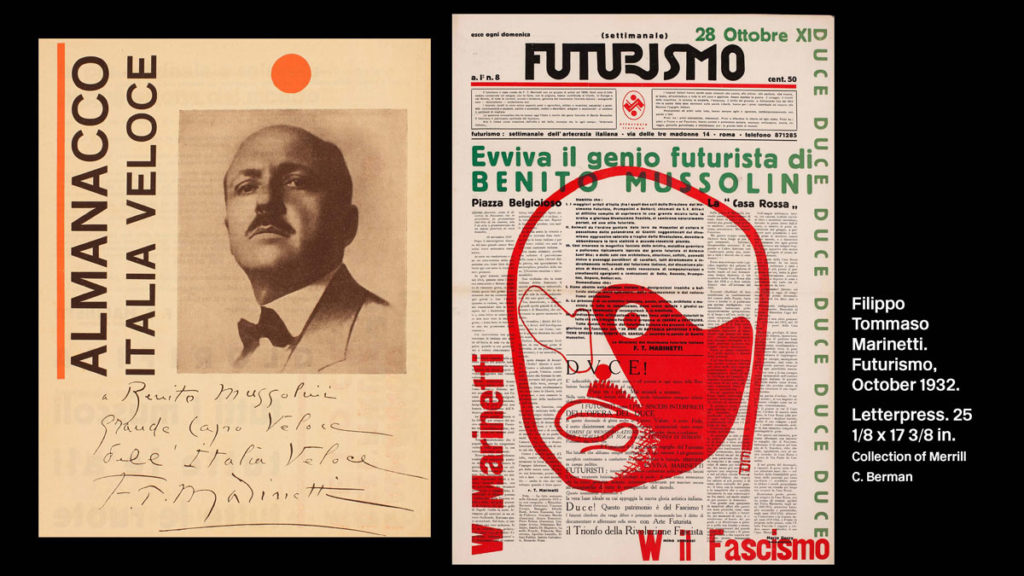
“Futurism(s)” represents an approach to teaching Graphic Design History. At MICA, my colleague Brockett Horne and I are striving to tell a more inclusive history of design than the chronology we learned back when we were students. Most GD History courses include an ode to Italian Futurism. This canonical all-male art movement can be a leaping-off point for discussing other forms of future-leaning art and creativity. “Futurism(s)” is a talk with three chapters: Italian Futurism, Afrofuturism, and the Cyborg Manifesto.

Italian Futurism

Italian Futurism was launched by F. T. Marinetti in 1909. Frankly, it’s hard to find a more patriarchal, exclusionary, white-dominated movement in the history of design-isms. Marinetti expanded our view of the printed page with his innovative typography, but he infused his ideas with hatred and violence. He wrote, “We will glorify war—the world’s only hygiene—militarism, patriotism, the destructive gesture of freedom.” He wanted to destroy museums, libraries, and schools in order to make way for a factory-born future.

Futurismo-filippo-tommaso-marinetti

Although Italian Futurism scorned women and embraced fascist ideology, the Futurists explored liberated styles of masculinity. The Futurist painter Giacomo Balla, who published his “Futurist Manifesto of Men’s Clothing” in 1913, dreamed of menswear tailored with interactive fabrics that could be changed at will to represent a man’s shifting moods: “Loving, Arrogant, Persuasive, Diplomatic, Unitonal, Multitonal, Shaded, Polychrome, Perfumed.” Italian Futurism took place in a particular place and time, and many of us reject its politics while admiring its revolutionary aesthetics.

Afrofuturism

Afrofuturism is a movement in music, art, and literature that arose in the 1950s and continues today. (The term was invented by critic Mark Dery in 1994.) Afrofuturism embraces world-building, a creative methodology arising from science-fiction and gaming. World-building emphasizes mythic time rather than historical time. It employs storytelling across many genres, from novels, comic books, and toys to fashion, movies, music, and fan fiction. World-building actively engages an audience in experiencing a world that is both real and imagined.

Afrofuturist artists include the musician Sun Ra (1914–1993), an American jazz composer, bandleader, and poet who claimed to be an alien from Saturn—and always dressed appropriately for his role, building a mythic world around his persona. George Clinton’s funk band Parliament created their own “P-Funk mythology,” generating an elaborate backstory to the music. The Afrofuturist album covers of the 1960s and 70s featured space ships, Egyptian pyramids, and other symbols of cosmic knowledge. Today, a new generation has brought feminist identities to Afrofuturism. Artists including Solange Knowles, Rihanna, and Janelle Monae use sound, performance, fashion, and storytelling to build vivid worlds ruled by warrior queens and rebellious androids.

Billy Graham was the first black art director in the comics industry. In addition to creating a character called Luke Cage, based on Blaxploitation action films, Graham was the main comic artist to work on the Black Panther comic book series, from 1969 through 1976. These comics continue to be published today, with storylines created by renowned Black authors including Ta-Nehisi Coates and Roxane Gay. In 2018 Ryan Coogler directed the international blockbuster film The Black Panther, featuring production design by Hannah Beachler and costumes by Ruth E. Carter. Together, this creative team designed a high-tech civilization that combines aspects of contemporary African urbanism, architecture, and fashion with futuristic details.

Each of these exercises in Afrocentric world-building questions culturally dominant readings of technology. Mainstream representations of the future—whether utopian or dystopian—have pictured technology as a primarily white, male instrument of power, in contrast with subjugated human bodies that are seen as female and/or non-white. These artists have transformed how technology is represented and understood across cultures.

The Cyborg Manifesto

Donna Haraway’s essay “Cyborg Manifesto” (1985) represents a third vein of futurist design and philosophy. Haraway questions the binaries that privilege white, male, human creatures while “othering” countless alternative modes of life. The cyborg is a being who is both biological and mechanical. The cyborg challenges cultural binaries such as male/female, animal/human, and human/machine. According to Haraway, cyborgs don’t appear only in science fiction. The cyborgs have arrived! They are here among us! Examples of cyborg life include A.I., virtual reality, bioengineering, psychoactive drugs, and countless medical technologies, from fertility treatments to cloning and transgender medicine. Fashion has always altered the body, while people with physical differences use wheelchairs, prosthetics, glasses, and hearing aids to expand their mobility and change their sense perceptions.

Designers working in the field of speculative design use techniques such as illustration, model-making, animation, and photo-illustration to imagine new, often dystopian futures. In their project Life Support: Respiratory Dog (2008), Revital Cohen and Tuur van Balen explored whether a dog could breathe for a human being. Living “service animals” help humans overcome many sensory and emotional challenges; the designers ask, why not have service animals augment our essential biological functions as well? The project is intended to be fictional and provocative, not realistic.

revital-cohen-respiratory-dog-design-futurism

Despite its fictional aims, Respiratory Dog has assumed new relevance today, a time when thousands of patients with severe Covid-19 require artificial life support. Every intubated Covid patient is a cyborg. Devices for respiratory life support are landmarks in the history of design and medicine. The Negative Pressure Ventilator—also known as the “iron lung”—was used to artificially ventilate patients who were paralyzed by polio. An iron lung encloses the user’s body in a negative-pressure chamber. Rhythmic pressure changes inside the chamber cause the person’s lungs to expand and contract. Thousands of these machines were mass-produced for use in homes and care facilities before the discovery of the polio vaccine in 1955. Iron lungs were eventually replaced with positive-pressure ventilators, which force air in and out of the patient’s lungs through the airway rather than exerting pressure against the chest. These modern ventilators require heavy sedation and put tremendous strain on the body. Today, modern versions of the iron lung are being reconsidered as a technology that is less expensive and more humane than a standard ventilator. One such prototype, Exovent, is being developed in the UK (as of April 2020). According to the developers of this old/new medical technology, the Exovent is a simpler, cheaper, and less invasive technology; it allows patients to remain awake, to eat, drink, and take medications on their own, and to talk on their phones.

What is “futurism”? All futurist movements, from Italian Futurism to Afrofuturism and speculative design, are opportunities to challenge the present by picturing what comes next. Designers are imagining the future whenever they question how things look, work, or signify in the current moment. Sometimes, the future arrives on the wings of catastrophe. Sometimes, the future must be created by excavating the past. Design history doesn’t have to be chronological. Like world-building, design history can pursue ideas across simultaneous and overlapping dimensions.


Bibliography


  • Reynaldo Anderson, “Afrofuturism 2.0 & the Black Speculative Arts Movement: Notes on a Manifesto,” Obsidian, Vol. 42, No. 1/2, (2016), pp. 228-236
  • Yytasha L. Womack, Afrofuturism: The World of Black Sci-Fi and Fantasy Culture (Chicago Review Press, 2013).
  • Ruth la Ferla, “Afrofuturism: The Next Generation,” New York Times, December 12, 2016, https://www.nytimes.com/2016/12/12/fashion/afrofuturism-the-next-generation.html
  • Anthony Dunne and Fiona Raby, Speculative Everything: Design, Fiction, and Social Dreaming (Cambridge: MIT Press, 2014).
  • Donna J. Haraway, Simians, Cyborgs, and Women: The Reinvention of Nature (New York: Routledge, 1991).
  • Dan Hassler-Forest, “The Politics of World Building: Heteroglossia in Janelle Monáe’s Afrofuturist WondaLand,” World Building, ed. Marta Boni (Amsterdam University Press, 2017).


About the Author

Ellen Lupton | Senior Curator of Contemporary Design at Cooper Hewitt, Smithsonian Design Museum in New York City. Her exhibitions include “How Posters Work,” “Beautiful Users,” and “The Senses: Design Beyond Vision.” Lupton is founding director of the Graphic Design MFA Program at MICA in Baltimore, where she has authored numerous books on design processes, including “Thinking with Type,” “Graphic Design Thinking,” and “Graphic Design: The New Basics.” Her recent books “Design Is Storytelling” and “Health Design Thinking” were published by Cooper Hewitt. She is an AIGA Gold Medalist and a Fellow of the American Academy of Arts & Sciences.