AIGA Baltimore Wins the Communicator Awards

AIGA Baltimore is proud to share that we’ve been recognized in the 32nd Annual Communicator Awards, a global competition honoring excellence in marketing, communications, and creative work.

This year’s winners were selected from thousands of entries across the United States and around the world. We’re honored to be included among organizations and creative teams whose work reflects care, clarity, and impact.

AIGA Baltimore is honored to be recognized alongside a wide range of respected organizations and creative teams, including The Walt Disney Company, Special Olympics, PepsiCo, PwC, Marriott International, Lenovo, Penn Medicine, Create Baltimore, and many others. The full group of honorees is available through the Communicator Awards Winners Gallery.

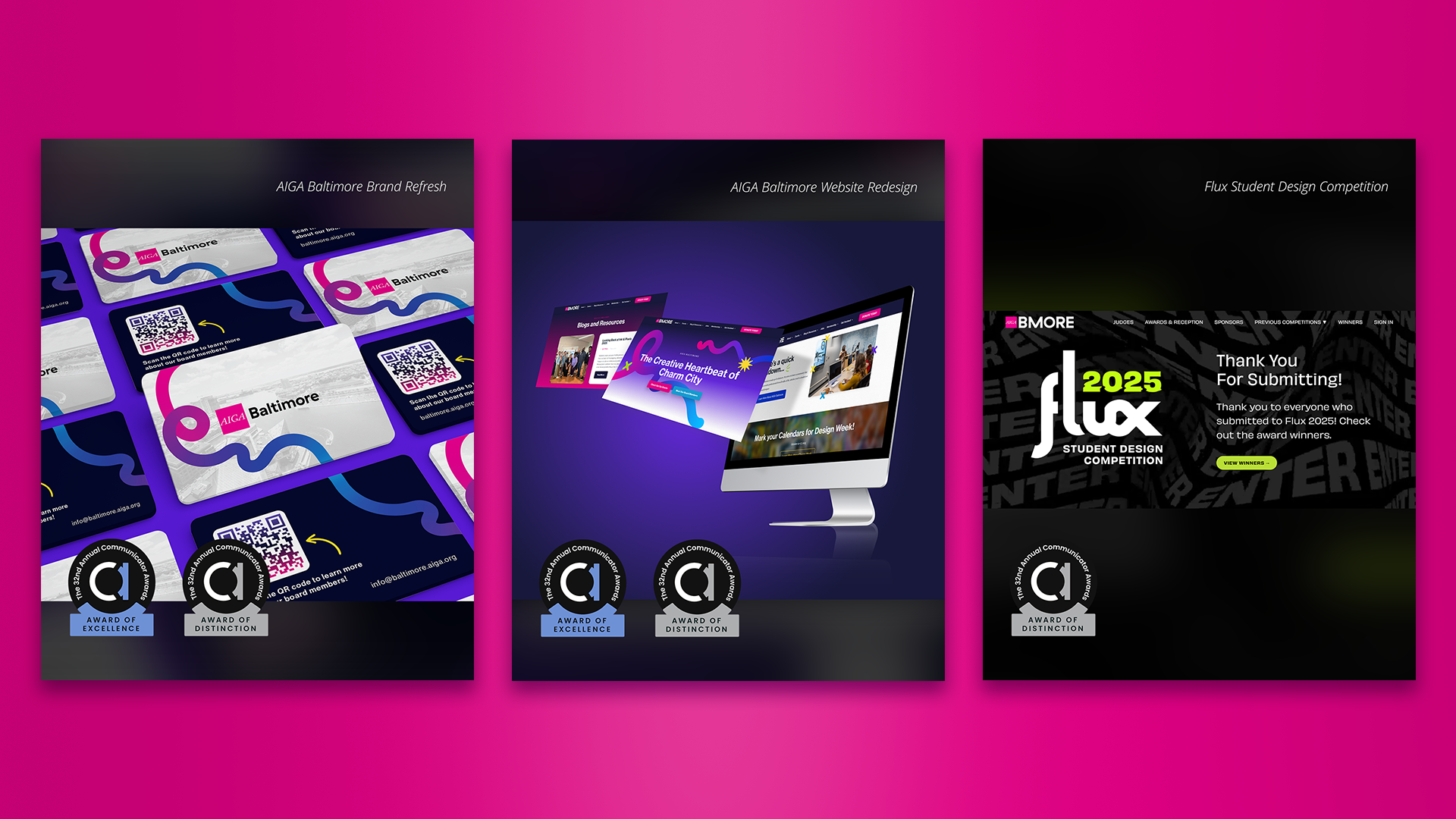
AIGA Baltimore received recognition for three entries:

AIGA Baltimore Brand Refresh
AIGA Baltimore Website Redesign
Flux Student Design Competition

These awards feel especially meaningful because they mark a new chapter for our chapter. Our previous brand served AIGA Baltimore for the past eight years. It carried us through years of programming, community building, student support, partnerships, and change. We’re proud to have updated the brand with that history in mind.

The refresh and website redesign were created to better reflect who we are now. AIGA Baltimore is a community shaped by designers, students, educators, organizers, and creative leaders across the city. Our goal was to create a visual and digital experience that feels more accessible, more flexible, and more connected to the people we serve.

We’re also grateful to see Flux Student Design Competition recognized. Flux continues to be one of the clearest expressions of our mission. It gives emerging designers a platform to share their work, build confidence, and feel seen by the broader creative community.

Thank you to everyone who has supported AIGA Baltimore over the years. From board members and volunteers to partners, sponsors, students, speakers, mentors, and attendees, this recognition belongs to the community we’re building together.

We’re proud of this moment, and we’re even more excited for what’s ahead as we continue growing the Baltimore design community together.

The Power of an Optimized LinkedIn Profile

When I joined LinkedIn 14 years ago, the platform was known as the place where you transferred your resume and work history into an online version. LinkedIn has evolved far beyond a platform for just placeholding your digital resume, as your profile is the first impression you will make to people in and outside your network.

But a LinkedIn profile isn’t your resume–it is static, searchable, and offers more features to showcase your expertise beyond just the history of your job experience.   I’m going to touch on the impact of an optimized LinkedIn profile for designers, exploring how it can attract job opportunities, foster connections, and enhance your reputation (aka personal brand). Let’s embark on a journey to unravel the secrets of LinkedIn success in the design arena.

Where to Start?

LinkedIn provides a variety of sections for you to input information.  As a recruiter who proactively uses LinkedIn to source and identify potential prospects for job opportunities, I’ll emphasize the areas and content I seek out when scanning a profile to assess the alignment for a role.

Headliner

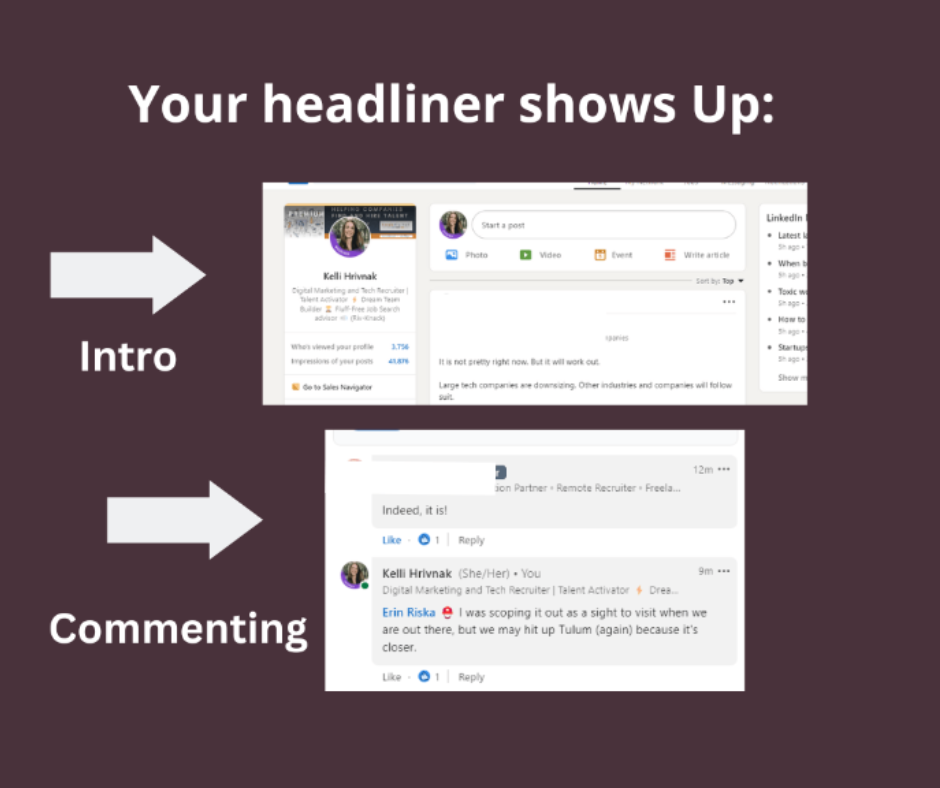
Your headliner is the copy that is located right below your name on the LinkedIn profile and it will be the first thing people see (along with your name).  Not only does it show on your profile page, but also when you comment, send invitations, “Who Viewed your Profile“, and in the intro section of your profile. You have a 220-character limit. A shortened version of your headliner will be visible when commenting (75 characters), sent invitation (80 characters), and in search results (82 characters).

The words in the headliner do affect the search results.  Keeping this in mind, I advise to be clear about your expertise and use keywords that a recruiter may look for when sourcing.  This may include job title, skill sets, certifications, and companies.  A Unique Value Prop (USP) is a popular choice for a headliner, like “turning ideas into visual symphony,” but I urge people that it’s not the best (SEO) option if you are in an active search.  A USP can be ambiguous and a recruiter isn’t using those keywords when searching.

A simple format I suggest is:

Job title + Company + (skill sets, results/achievements, awards) + (fun add about personality or USP).

If your current job title is vague or you are making a career pivot, the headliner is an alternative field to sub in your target job title.  Example:  Your job title is “creative specialist” which doesn’t encompass your expertise in design.  Use “Graphic designer” in your headliner instead.
Photo

Is there a greater chance of receiving outreach when you include a photo on your profile? Discrimination is real, unfortunately, and I’ve talked to people who strategically omit or strengthen their privacy settings by design to hide their headshots on their profiles. Make decisions based on your comfort level.

If you opt for a photo, a DIY iphone session can quickly produce a credible headshot Here is an article with some helpful tips!


Location

If a company is looking to hire a local candidate within commuting distance,  they could be using a radius search by location.  Users can search by by Region or Postal Code. The latter option enables a nuanced radius search, allowing users to filter results within 5, 10, 25, 35, 50, 75, and 100 miles.

To enhance your discoverability, consider selecting a broader metro area rather than specifying your exact city. For instance, instead of “Baltimore,” use “Washington DC-Baltimore” to increase your inclusion in wider-radius searches.   If you are in the midst or open to relocation, set the targeted location as your geography so your visibility will be amplified in those geographical searches.

Industry

Companies could be prioritizing their search by industry experience.  While you can include vertical exposure in your About and Experience section, you can choose an industry sector in your account settings.  LinkedIn expanded their industry codes from 24 core functions to sub categories, likely expanding to over 400+ soon.  Pick one most important to you, and again–you can mention others in other areas.

Keywords

Before I cover the About and Experience section, I encourage everyone to conduct keyword research to identify what skills and keywords are associated with your current job and target.  Wordtracker and Google Keyword Planner are excellent tools, but what works on Google won’t be a replica on LinkedIn.   ChatGPT can generate a list of associated words too.


Review the words and think about how you can integrate these words into the content of your profile. For example, instead of listing out a bullet-pointed list of keywords like “Storyboarding,” “campaign development,” and “advertising,”  try weaving them into the story of your experience and about section.


Consider the keywords you prefer not to be associated with on your LinkedIn profile. While retaining your work history is advisable, it’s beneficial to eliminate skills or keywords that hold no relevance to your future career aspirations.  Unfortunately, some recruiters are lazy and will mass message anyone who possesses a keyword they are searching for–regardless of context.  Proactively removing skills or titles misaligned with your target job can potentially curtail unwarranted outreach.


Scope out your competition.  Run a keyword search on job titles (like “Art Director” or “Sr. Graphic Designer) and pay particular attention to the initial pages of search results.  How does the algorithm prioritize profiles related to content?


About Section

This is your canvas to craft a narrative of your career journey and an opportunity to reveal more information beyond the facts of your experience.  Did you make a career pivot or your path has been non-linear?  Has design been your passion since you were a child? How did this path become your “why”?

What’s your opening hook?  Keep the mobile user in mind, as they’ll likely encounter the initial 90 to 150 characters of this section before having to click down. Desktop viewers may extend to around 300 characters.

As you share your story, consider incorporating a call to action (CTA) to encourage recruiters to engage further. This could involve providing a link to your portfolio, sharing your email address, or including a phone number (consider using Google Voice for added privacy). Embrace the first-person perspective to infuse authenticity into your narrative (a third-person narrative may be more suitable for fields like legal or finance.)

Reinforce your expertise.  Don’t forget to enhance your visibility by strategically integrating those relevant keywords and skills into the narrative.  You also have the option to add your top 5 skills that will be promoted in this section.


Experience Section

I’ll argue that this section is the most significant in your profile. While other sections can represent your branding, the experience section unveils the application of your keyword skills and the outcomes achieved. It provides the crucial context to assess your qualification for a role.

In each job experience, include details on project work, tasks, results, industry exposure, management roles, certifications, specific software proficiency, training, and promotions. Adopting a format with bulleted points or well-structured sentences enhances readability.

Utilize LinkedIn’s feature to add skills to each experience entry, showcasing your expertise aligned with each job title and company.  If you used Adobe XD in your current job but only Indesign at your prior, you can distinguish how recent you were exposed to tools here.  In addition to hard skills, consider adding other tasks like project management, motion design, business development, etc


Featured Section:

Designers, do not overlook this section!  This space is your place to add content, from articles, videos, URLS, podcasts, photos, and presentations.  Most importantly, if you have an online portfolio, include the link.  This is the visual “highlight real” of your achievements.

Contact Information
Ensure your email is up to date to efficiently receive timely notifications. If anyone is using Inmails, messages, or general invitations, your notifications will go to this email. If you using your work email domain, keep this in mind (especially if you fear that your employer is monitoring your emails). This article will show you how to adjust the visibility of your email. Consider a pseudo email strictly for LinkedIn outreach and messaging.

Along with the Featured section, you can include your portfolio link here. If you were assigned a generic URL, you can explore custom options.  If there is a custom domain that is available and aligned with your personal branding, snatch it up.

What else should you consider?

A background photo, which is the large image behind your profile picture, is customizable.  I usually recommend Canva as a tool to create a unique banner that highlights your brand or expertise, however I recognize an audience of designers will have the skills and other tools to execute this task at a higher level.  The dimensions are 1584 x 396 pixels and accepts PNG, JPG, and GIF files.

Should you use the Open to Work Banner?  My opinion is mine alone, but I do not hold a bias against anyone who is actively in a job search and chooses the visual cue of the banner.  My objective, as a recruiter, is to identify a candidate who is motivated and qualified to make a job move.  Some others may discriminate against people unemployed, so you need to make the best choice for yourself.  If your job search is confidential, I would encourage you to use the Recruiters Only option.  The Recruiters Only option is limited to users who subscribe to the Premium Recruiter seat, so that isn’t limited to recruiters only but to those who pay for that level of service.

A LinkedIn Allstar Status increases your visibility. While the meter is no longer on display in your profile, reference this link on how to access your level. Hint: Look for the “Suggested for you” prompt.

What qualifies as an Allstar Status?  Complete all of the following sections.

  • Industry/Location
  • 3 positions (including current). If you don’t have 3 job experiences, consider volunteering, freelance, or gap options.
  • Education
  • Skills (3 minimum)
  • Profile Photo
  • 50 Connections

In today’s competitive job market, having a well-optimized LinkedIn profile is more important than ever. This is a passive, one-stop effort that can generate inbound leads and increase your chances of being discovered by recruiters and potential employers.

About the writer

Kelli Hrivnak

LinkedIn | Website

Kelli Hrivnak is a leader with over 15 years of experience in staffing and recruitment services.  Recognizing the limitations of quantity-driven staffing models, Kelli embarked on a mission to create a forward-thinking alternative.  She is founder of Knak Digital, a recruiting agency prioritizing strategy and quality over high-volume recruitment. Throughout her career, Kelli has partnered with various companies, from Fortune 500 corporations to start-ups.  Her extensive background in the technology and marketing industry has provided her with valuable insights and a deep understanding of client needs.

Best Practices for Creating a Design Portfolio & Preparing for Interviews in 2022

AIGA Baltimore is here to help you succeed in your design portfolio reviews and interviews! Here is a guide for creating a design portfolio and some tips on how to prepare for an interview.

1. Quality over quantity. Showcase your best work.

We recommend starting and ending with an awesome piece. Don’t be afraid to include self-initiated work to stand out from the crowd. ONLY show your best work in your portfolio. If you aren’t 100% happy with a particular piece, don’t include it. It’s better to have 5-7 amazing projects than 10-15 projects that aren’t so great.

2. Think about how you will present your design portfolio—whether it is a PDF or an online portfolio. 

Traditional portfolios are printed in a flipbook style. If you have mostly print pieces, the traditional route may be the way to go. A bonus of having a printed portfolio is the opportunity to showcase printed pieces and to give reviewers a takeaway. Or if you have mostly web pieces, think about creating a portfolio website.

If you create a traditional printed portfolio or just a PDF, we suggest using Adobe InDesign to create the best design layout! Use 1-2 pages for each project and make sure you have a good hierarchy in terms of typography and images. A good size is 12×18 inches. 

Don’t forget to make your projects pop by placing them in mockups. We recommend keeping your mockup files organized to avoid re-downloading huge files. Some good mockup sites are mockupworld.co, creativemarket.com, graphicburger.com, and unblast.com. If you can’t find a free mockup, sometimes it’s easier to just create your own. 

If you need more design resources, check out this *FREE* Design Resource Guide from YouTuber & Graphic Designer, Kel Lauren.

3. Create a graphic design online portfolio.

It is a good idea to have a graphic design online portfolio so you can easily share it on LinkedIn, via email. Think about using Behance (free to use), Adobe Portfolio (you need a Creative Cloud account), Dribbble (you need to be invited), or a custom website such as Squarespace, Wix, or WordPress. Keep an out on the Creative Market freebies as they sometimes offer free website templates. 

4. Seek design opportunities outside of school.

There are lots of ways to get involved in design outside of school. Join the Baltimore Graphic Designers group on Facebook. It’s a group for Baltimore area-based graphic designers to create community, ask questions, get advice, share jobs, and plan meet-ups.

One way is to get involved with AIGA Baltimore! AIGA Baltimore is gearing up for another year of learning, connecting, and growing, and we need your help! Join board leaders on 1/26 at 12PM to hear about open roles and volunteer needs and find out where you can make a difference.

5. Keep your career goals in mind.

What do you want a career in? Think about all of these categories:

  • Brand Identity Design
  • Marketing & Advertising Design
  • Packaging Design
  • Motion & Video Design
  • Web & User Interface Design
  • Print & Publication Design
  • Lettering & Type Design
  • Graphic illustration
  • Data Visualization & Infographic Design

Learn more about these specific career types on dribbble: https://dribbble.com/resources/types-of-graphic-design

6. Practice how you will present your work. 

Be ready to discuss the goal of the project and how you reached the solution. Consider bringing any process sketches with you as well since reviewers are interested in your overall process.

Make sure that the pieces you include are the ones you are proud of. Make sure you can talk confidently in your meeting, interview, or review. Practice with a professional if you can.

7. Seek expert feedback. Attend Ink & Pixels 2022!

Take the next step towards your design career! Whether you want to make a good impression in interviews, need a new perspective on your portfolio, or want fresh eyes on a current project, we’re here to help. Ink & Pixels is one of AIGA Baltimore’s largest events focused on helping designers prepare for a career or career shift. 

This year, Ink & Pixels will be a 2-part event. The first event will be a virtual panel, From Portfolio to Offer: The Art of Getting Hired on Saturday, April 23rd. The Ink & Pixels portfolio reviews returns on Saturday, April 30th at Towson University. Mark your calendars and clean up those portfolios!

14+ Events to Attend Around the World!

9/15-10/15

Hispanic Heritage Talks

AIGA Unidos was created for Everyone!
We highlight Hispanic and Latinx creatives, so we can share their stories and work with the world—that’s you! Our first ever event is a series of talks called Hispanic Heritage Talks, which will take place during Hispanic Heritage Month. It is a series of virtual talks featuring Latinx and Hispanic creatives from different backgrounds and disciplines. ¡Acompañanos!

Join the AIGA Unidos familia, and hear from all the amazing creatives our heritage has to offer. From us to you, with love and a little sazón… who are we kidding? A lot of sazón! We are Unidos for Everyone!

Hosted by: AIGA Unidos
→ Register Here
FREE


10/1-31

Doors Open Baltimore

Doors Open Baltimore is going virtual-only in 2020 with a month’s worth of programming throughout October. Organized by the Baltimore Architecture Foundation (BAF), Doors Open Baltimore is the free citywide festival of architecture and neighborhoods that invites thousands of people to explore the city and make meaningful connections to the built environment. Replacing a weekend of open houses and in-person tours will be a month’s worth of virtual programs. Every week of October will include a new theme and new ways to virtually engage with Baltimore’s architecture and neighborhoods. 

Hosted by: Doors Open Baltimore
→ Register Here
FREE 


10/2-10/9

Phoenix Design Week – PHXDW

Phoenix Design Week (PHXDW) is a week-long celebration of design organized by AIGA Arizona to unite our state’s creative community and provide a forum for sharing best practices, showcasing exceptional work, and gaining inspiration.

Hosted by: AIGA Phoenix
→ Register Here
$25-$49 Tickets


10/5-10/10

St. Louis Design Week

St. Louis Design Week is a seven-day celebration of our local design community, featuring a variety of panel discussions, workshops, presentations, open houses, and other community growth-oriented events. Our mission is to grow design and breakdown design silos through making St. Louis design week all-inclusive, to all designers.

Hosted by: AIGA St. Louis
→ Register Here
FREE


10/5-10/9

Salt Lake Design Week – Dimensional Design

What is “Dimensional Design?” It is the idea that we, as designers and creatives, have to be multifaceted in our disciplines. Becoming a dimensional designer includes exposing oneself to creatives of other disciplines and perspectives to be able to see the broader context of their own work. Experience dimensional design in action during this year’s SLDW.

Salt Lake Design Week celebrates and promotes the impact of all design in Utah. By providing a forum for designers, business professionals, students, and the general public to interact, collaborate, and learn from each other, we build a stronger creative community. We are inclusive of all people and disciplines including; graphic, digital, product, fashion, photography, architecture, interior, and more. From October 5-10, 2020 we will host the first-ever virtual SLDW to celebrate Utah creatives and promote the impact of design throughout the state and beyond.

Hosted by: AIGA Salt Lake City
→ Register Here
FREE


10/7 | 6:30–8pm EDT

And She Could Be Next Virtual Screening

This film follows the grassroots campaigns of six women of color running for political office during the contentious 2018 United States midterm elections. Produced by female filmmakers of color, the documentary offers a behind-the-scenes glimpse of these women leaders whose personal motivations, political coalitions, and ground-level activism steamroll the expectations of their opponents and of the broader public — defying traditional notions of what it means to be a U.S. politician in the process. 

A co-production of POV and ITVS. A co-presentation of Black Public Media and the Center for Asian American Media.  Film running time is 40 mins. Watch the trailer for And She Could be Next.

The screening will be hosted through Zoom. Zoom information will be sent to attendees prior to start time. Event will start at 6:30 PM EST and screening will start at 6:45 PM EST to allow attendees time to log on. 

After the screening, there will be a discussion based on prompts created for the film. Attendees will be grouped into break rooms for open discussion. Discussion time will be 15 mins.

This event is part of Design for Democracy, an AIGA initiative to increase civic participation through design. This event is a collaboration with POV, the award-winning independent non-fiction film series on PBS www.pbs.org/pov

Hosted by: AIGA Pittsburgh
→ Get Your Ticket Here
FREE


10/9

Baltimore Innovation Week

A one-day virtual event series celebrating good news stories and innovation in Baltimore.

Baltimore Innovation Week 2020 is a one-day virtual Innovation Celebration featuring multiple sessions that are focused on showcasing local companies and good news stories that have emerged during these continuously changing and trying times. Save your seat at spotlight discussions with industry experts, workshops from top companies, and networking with local businesses. You’ll have an insider look at the positive effect this city is having on the U.S. and World markets with premier access to the latest products and ideas. 

This annual event series is a unique collaborative effort from industry leaders across seven defined sectors. This is where technology meets science, creatives, students, entrepreneurs, sales representatives, marketing executives, economic developers, social activists and everyone in-between.  The best part? It’s all FREE.

Hosted by: ETC (EMERGING TECHNOLOGY CENTERS)
→ Get Your Ticket Here
FREE


10/14 | 6:30 PM–8:00 PM EDT

Changing the Face of Voting with UX

Join us for a conversation with Kathryn Summers about making voting inclusive and accessible through design. Design has the ability to include or exclude people. Join us for a conversation with Kathryn Summers about making voting inclusive and accessible through design. We will be discussing the implication of bad design and its implication on the voting process in the wake of the 2016 election and the coming 2020 election. In addition, Kathryn will be showing us the benefits of using eye-tracking machine and how it helps to analyze the visual behavior of your user.

Hosted by: Ladies Wine and Design Baltimore
→ Register Here
FREE


10/14 | 7–9 PM EDT

Talking Strategy with Douglas Davis

Join us on October 15th as Douglas shares how to turn the rational language of business into the emotional language of design. Douglas’ inspiring journey has taken him from designer to strategist, to now teaching other creatives the business of design. Wherever he shares, he helps provide a framework for the design industry. A framework that can be applied to concept pitches or to how to think about your career. Strategy has been something design schools haven’t focused on, and it’s more important than ever we understand it. After stepping into Harvard Business school, Douglas realized how big the disconnect was for designers. Since then, he’s taught at NYU, HOW Design University, Manhattan Early College School for Advertising, and the City College of New York, all while running The Davis Group LLC. Douglas took it upon himself to fill the void between design and business and teaches left-brain business skills to right-brain creative thinkers with his book, Creative Strategy and the Business of Design. He’s helped creatives across the country better understand business goals, how to set them up, but most importantly, how to measure their success for clients. There is a need to understand more than what looks good for your career to blossom. Join us on October 15th as Douglas shares how to turn the rational language of business into the emotional language of design. You already have the creativity, now it’s time to gain the business insights.

Hosted by: AIGA Charlotte
→ Register Here
$10


10/19-23

AIGA Colorado Presents Colorado Creatives

Colorado’s creative community thrives when its members are able to come together to share stories and experiences, however, the pandemic has moved these communities online and made it more difficult for people to come together in person. That’s where AIGA Colorado Creatives comes in.

The best part? Our project is all about YOU, the AIGA Colorado Creatives. It’s your chance to share your stories, advice, experiences and inspiration in a short video. Selected videos will be featured on an event site and combined with others in a storytelling reel which will be shown to thousands of people.

→ Participate Here
Submit your Video by October 12


10/20-22

Adobe MAX—The Creativity Conference

Make plans to join Adobe MAX for a uniquely immersive and engaging digital experience, guaranteed to inspire. Three full days of luminary speakers, celebrity appearances, musical performances, global collaborative art projects, and 350+ sessions — and all at no cost.

Hosted by: Adobe MAX
→ Register Here
FREE (with Adobe Account ID)


10/30

Creative Mornings Talk – Speaker Lola B. Pierson

Your Home! (part of a series on Stress)

Lola B. Pierson is a highly collaborative artist who was born and raised in Baltimore City. She is a playwright, writer, and director. Her work challenges theatrical form, incorporating elements of social media, performance art, visual art, switcheroos, and boredom. Other words she has used to describe her work in bios include: presence, explore, dynamic, and representation. A graduate of Baltimore School for the Arts, Bard College, and Towson University, she is passionate about the intersections of language, time, presence, and philosophy. She writes new work and messes with classics (that deserve it). She is the co-founding Artistic Director of The Acme Corporation.

Hosted by: Creative Mornings
→ Register Here
FREE


10/31 | 6 PM EDT

Counter Narratives Show: Black Liberation & Queer Resistance

The purpose of the show is to provide a critical examination of society and culture through the intersectional lens of race, gender, and class, more specifically it seeks to provide a COUNTER-NARRATIVE. The Show encourages a reflective assessment and critique of unique standpoints and their potential contribution to popular discourse.

What you can expect from the COUNTER-NARRATIVE:
Quality conversations about critical issues in communities of color, with guests who don’t just talk about the problem they are active in finding solutions.  Guests share their lived-experiences, insights, information, opinions, and personal narratives.

Hosted by: Rasheem
→ Register Here
FREE


AIGA Get Out The Vote

Every four years since 2000, AIGA has activated its community of designers across the U.S. and beyond to Get Out the Vote. The campaign is part of Design for Democracy, an AIGA initiative to increase civic participation through design.

In 2020, AIGA recognizes the centennial of the ratification of the 19th Amendment, granting women the right to vote in 1920 with a special edition of Get Out the Vote: Empowering the Women’s Vote. It commemorates the first legislation for women’s voting rights. Not until the passage of the Voting Rights Act in 1965 were voting rights of all women protected and enforced.

AIGA members–submit your posters today until election day, Tuesday, November 3, 2020, and help us get out the vote! Posters received by National Voter Registration Day (September 22, 2020) and Vote Early Day (October 24, 2020) will have the greatest impact.

Hosted by: AIGA

There are two opportunities. Please see below for the submission portals and galleries:

Finding Your Creative Communities

National and Local Professional Organizations


AIGA: The Professional Association for Design | National
AIGA Baltimore | @aigabaltimore
AIGA advances design as a professional craft, strategic advantage, and vital cultural force. As the largest community of design advocates, we bring together practitioners, enthusiasts, and patrons to amplify the voice of design and create the vision for a collective future. We define global standards and ethical practices, guide design education, enhance professional development, and make powerful tools and resources accessible to all.


AAF: American Advertising Federation | National
AAF Baltimore | @aafbaltimore
The American Advertising Federation of Baltimore (AAFB) traces its roots back to 1918, originally established as the women’s auxiliary to the men’s Advertising Club. In 1920, the women formed their own organization, naming it the Women’s Advertising Club of Baltimore. It was affiliated with the Associated Advertising Clubs of the World, the predecessor to the modern-day American Advertising Federation.

AGI Alliance Graphique Internationale
AGI: Alliance Graphique Internationale | @agigraphic
Alliance Graphique Internationale [AGI] is, as its name suggests, a member-based association of professionals, united by working in the field of graphic design and drawn from across the globe.

AMA American Marketing Association logo
AMA: American Marketing Association | National
AMA Baltimore@amabaltimore
The American Marketing Association Baltimore Chapter is Maryland’s leading provider of networking, educational programming, and resources for marketing professionals. AMA Baltimore provides extensive opportunities for marketers to expand their networks, grow professionally, and learn about current industry trends.

Creative Mornings logo
Creative Mornings | National
Creative Mornings Baltimore@CreativeMorningsBaltimore
CreativeMornings/Baltimore is a FREE monthly breakfast lecture series based on the two core principles that everyone is creative and everyone is invited. CM/Bal is one of over 200 chapters around the world meeting each month. Every month, all chapters organize talks based on the same theme. CreativeMornings is fueled by an engine of generosity and is 100% volunteer-run, partnering with great local businesses and organizations. If you’re interested in volunteering, please complete this form.

Baltimore Creative Community

BOPA: Baltimore Office of Promotion & the Arts
@promoandarts
As Baltimore City’s arts council, The Baltimore Office of Promotion & The Arts provides resources and opportunities to artists and artist organizations to continue to make Baltimore a city for the arts.

BCAN
@baltimorecreates
The Baltimore Creatives Acceleration Network (BCAN) is a 10-year, city-wide initiative providing both strategic and as-needed, just-in-time entrepreneurship support for Baltimore creatives of all disciplines and backgrounds. At BCAN, we define artists, creatives, and entrepreneurs the same way: visionaries who create something new from raw and often limited resources.

bfc: Baltimore Freelancers Collective
IG: @bmore_freelancers
FB: @baltimorefreelancers
Whether you own your own business, freelance on the side, work remotely for a large company, or just want to learn more about entrepreneurship—we would love for you to join us at our next event.

The Bmore Creatives
@thebmorecreatives
Hi, welcome to The Bmore Creatives! We are a community platform and a social media brand that celebrates the creatives, the makers, the get sh*t done-ers, the people that make Charm City charming! We promote and connect local artists, small businesses, and avid IGers throughout the city. We want to prove that everyone can be creative when they are open to being inspired by everyday life in our city.

Ladies, Wine & Design
Ladies, Wine and Design Baltimore holds monthly events which are limited to eight creative ladies. We’ll have drinks and casual conversations on a wide variety of topics relating to creativity, business, and life. If you’re a female student or creative and would like to join, please email us. It’s free and reservations are first-come, first-serve. You can follow us on Instagram and Facebook, and if you’d like to host us in your space, teach a workshop, or lead a discussion, please do get in touch.

Open Works
@open_works_bmore
Our mission is to make tools, technology, and the knowledge to use them accessible to all. We connect you to manufacturing equipment, space, education, and Baltimore’s largest community of maker professionals. With programs for ages eight and up, we can help you make just about anything!

Production Club of Baltimore
@ProductionClub
Join the Production Club of Baltimore, along with hundreds of other local creative and marketing professionals, for an evening of networking and fresh production ideas from the mid-atlantic’s very best printers, paper suppliers, image producers, and technologists. Grow your swatch book collection and samples library. Cultivate new vendor partnerships. Seed your future project timelines with new media. Dig into deeper relationships with fellow creatives by face-to-face networking. This is a time to flourish!

SoDA | Society of Design Arts
@sodabaltimore
The Society of Design Arts (SoDA) presents a monthly program in Baltimore, Maryland to further attendees’ knowledge of the history of the design arts including graphic design, illustration, architecture, book arts, and photography. Programs are free and open to anyone.

SoDA consists of a planning committee that meets quarterly to discuss future programs. Formerly known as Society for History and Graphics (SHAG), the all-volunteer group has been active since 2007 providing more than 100 programs which have explored such diverse subjects as Bauhaus methodology and practice, Patent Medicine labels, The Real Mad Men of Advertising, Science Fiction illustration, and many others.

Baltimore Cake & Whiskey
Fresh, authentic, purposeful networking events for the modern businesswoman.

Baltimore Graphic Designers
This group is for Baltimore area based graphic designers to create community, ask questions, get advice, share jobs, and plan meet-ups.

Monument Women’s Creative Alliance
@monumentwomen
Our mission is to support women creatives by cultivating a community that enables connection, inspiration, and education.

Baltimore Tech Community

Baltimore UX Meetup
@BaltimoreUX
Calling all those who create excellent user experiences for sites, systems, applications, software, and hardware! From the startup to the enterprise. From user research to implementation. If you’re designing and building great experiences in the Baltimore area, please join us.

Code for Baltimore
@CodeForBaltimore
We are a community of volunteers who develop open-source projects as a Code for America Brigade by focusing on open government, open data, great design, and social good in Baltimore.

Code in the Schools
@CodeintheSchool
We empower Baltimore City youth to thrive in the 21st-century economy by expanding access to quality computer science education and building pathways from school to jobs and higher education. By focusing on youth traditionally under-represented in technology fields, we work to eliminate structural barriers and inequities in education and industry.

Technical.ly Baltimore
@TechnicallyBMR
Technical.ly Baltimore is a local technology news organization dedicated to how innovation is impacting the region.

Creative Job Boards

AIGA
designjobs.aiga.org

Creative Hot List
www.creativehotlist.com

The Creative Group (TLC) | A Robert Half Company
www.roberthalf.com/employers/creativegroup

Creative Mornings
creativemornings.com/jobs

Behance
www.behance.net/joblist

If You Could
ifyoucouldjobs.com

Media Bistro
www.mediabistro.com

Authentic
authenticjobs.com

Coroflot
www.coroflot.com

Smash
jobs.smashingmagazine.com/jobs

A Day in the Life: YOU can change your audience.

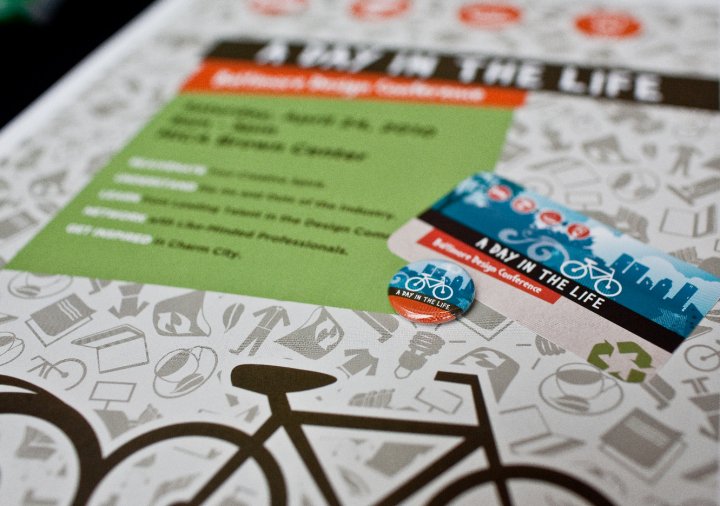
As designers we are visual problem solvers. We work to connect clients with their audiences in a visual way.  This was very evident at the Day in the life conference I attended in Baltimore, MD on this past Saturday.

From students to professionals, there were people from non-profits as well as corporations and design firms.  There were big ideas and conversations about design and the community that went on through out the day.

Some nuggets of knowledge that people got out of it:

“Great Conference, let’s do it again next year!”

“.  . . it’s time to get on twitter!”

“ I am not alone in this business.”

“Baltimore has a beautiful design future — this event proves it.”

This entire event was a hit, and exceeded my expectations.  The sessions that I attended were great, and the only problem I had was I left wanting more, but was motivated to do good.  I was wishing we had more sessions and the choice of more then 2, and I heard the same from other attendees as well but overall it was a positive experience, High Five to the organizers!

Quoting Ross Nover from free range studios “We can take an idea and make it a valid Credible thing” At free range studio they specialize in designing for social impact not consumption, working to enable and empower their clients to transform their audience.

The discussion was engaging and it was refreshing to see other designers out there similar frustrations, and issues when learning to try and design for their community.  There is an idea that you first must raise awareness then engage your audience.  Your audience is more impressionable then you think.  Some interesting resources and projects they worked on: the story of stuff, no impact project

Another session that I attended: The green movement and the creative industry presented by Eryn Willard from Studio 22. Being a green design firm, they are determined to be sustainable and lower the clients’ footprint at every step.  From paper to ink to process, I was educated on the way we print and what is the harm that is done in the process.  Learning that there is a life cycle to what we do.  When designing sustainably you are impacting the community, environment, and the economy, giving your client and their audience a better life. Here are some interesting resources that were shared during the session:  calculate your project footprintDesign ignites change

As designers we have the POWER to influence our audiences and design for social change.  Having the opportunity to meet other like-minded individuals and discuss these topics within the confines of a creative space can strengthen our skills and expand our ideas.  Here’s to hoping for an even greater session next year!

News Flash: Referencing Master of Kung Fu in a Career Fair Is No Longer Useful

grabbed from Wikipedia page on Master of Kung Fu (http://en.wikipedia.org/wiki/Kung_Fu_(TV_series))

Recently I attended a resumé workshop for an AIGA Student Chapter. A number of professionals sat through the rudiments of resumé writing—all good stuff, of course and in the end, there was a question and answer period. During that time, I ended up answering a number of questions—maybe because I was most willing to be loquacious than anything else, but I was asked a question that in answering seemed to confound the students.

A student asked me what skills does one need to be a “successful solo designer”. Strike successful and this is something I can answer. I kid. I referenced the television show Master of Kung Fu which aired during the late seventies. The show followed the adventures of Caine who walked the earth, having adventures every week in search of enlightenment presumably. (I included the Wikipedia link). Also, note that Quentin Tarantino was a fan of the series, using David Carradine, the series’ star as Bill in the movies Kill Bill 1 and 2.

Well, the series always started with a flashback to the student’s training, always showing the young student mastering some skill and the flashback would always end with the saying “once you take the pebble from my hand, it’ll be time to leave.” So, the pebble-hand thing is like a final and the lessons is like the work. My point—long-winded as it was—is to say that those lessons become the life’s blood of a young designer’s understanding of business. Those lessons, wide and varied, each become part of the skill set that the young designer must use to stay ahead or at very least keep up with the changing nature of business. For that reason, I suggested that a designer who is planning to be solo should at some point be in the opposite situation—work for a time in a corporation or a design firm, to help them understand themselves.

Anyway, that was main point—which with great difficulty—I explained. The students are about half my age, so the show was lost on them and almost the analogy. I told this story to a colleague and she said: Why didn’t you use Batman Begins?

Random Creativity-Related Quotes:

“To do, is to be.”
~ Socrates

“To be, is to do.”
~ Aristotole

“Art is making something out of nothing and selling it”.
~ Frank Zappa

“Every artist was first an amateur”
~ Ralph Waldo Emerson

“To live a creative life we must lose our fear of being wrong.”
~ Joseph Chilton Pearce

“Creativity is allowing yourself to make mistakes.
Art is knowing which ones to keep.”
~ Scott Adams, The Dilbert Principle

“Do not let what you cannot do interfere with what you can do.”
~ John Wooden

“Don’t worry about people stealing your ideas. If your ideas are any good, you’ll have to ram them down people’s throats.”
~ Howard Aiken

“He who stops being better stops being good.”
~ Oliver Cromwell

“Minds are like parachutes – they only function when open.”
~ Thomas Dewar

“Success is just a matter of attitude.”
~ Darcy E. Gibbons

“Democratic Design. Design with no price tag has no meaning. Good design. Smart solutions. Low prices.”
~ IKEA

“Writers write. Writing is a process. You don’t know what your writing will be like until the end of the process. If writing is your practice, the only way to fail is not to write.”
~ Gail Sher

“No Is Negative. Erase It From Your Agency’s Vocabulary.”
~ Bart Cleveland

“Relinquish your need for external approval. You alone are the judge of your worth.”
~ Deepak Chopra

“Replace fear-motivated behavior with love-motivated behavior.”
~ Deepak Chopra

“Identify your problems but give your power and energy to solutions.”
~ Tony Robbins

From an email to a friend about creative work …

Friend: “I think it turned out kinda nice, but there is nothing but stoney silence coming from him…so i guess that sucks.”

Me: “I’ve been reading alot, lately, to ‘raise my creative game’ and one thing that I read is analyze the movie (your work) when you’re done. If later, you find out it sucks, re-edit it. The best minds make the best failures so they say. Fail and fail again, if necessary.

… As a trumpeter you might appreciate this. when Miles Davis was young (circa 20s) he dropped out of Julliard and played with some heavy-hitters in the jazz world —the likes of Charlie Parker and others, of course. As i remember it (from his auto-biography), he made a mistake in a song once, completely noticeable at least to the band members. The band leader, Parker told him to play the [messed] up note again—and get used to it. [Because] jazz’s existence is based on “changing the thing” (i’m paraphrasing). As far i know this your first movie. you’re not Michael Moore, you’re [you] so do your thing and don’t apologize.”

Milton Glaser’s Design Process: “Turn 40 then turn on a computer…”

“…Glaser revealed his design process, he said he starts with a drawing done by hand, scans the image and transfers it into a computer where he modifies it electronically. “I love the computer. I hate stupid work done on the computer,” he also said, “Graphic designers shouldn’t use a computer until they’re 40-45 [years old]””

Read more at: Milton Glaser & Chip Kidd In Conversation, Just Creative Design

http://justcreativedesign.com/2010/03/12/milton-glaser-chip-kidd-in-conversation/