Meet the Designers Behind the Ink & Pixels Branding 2022

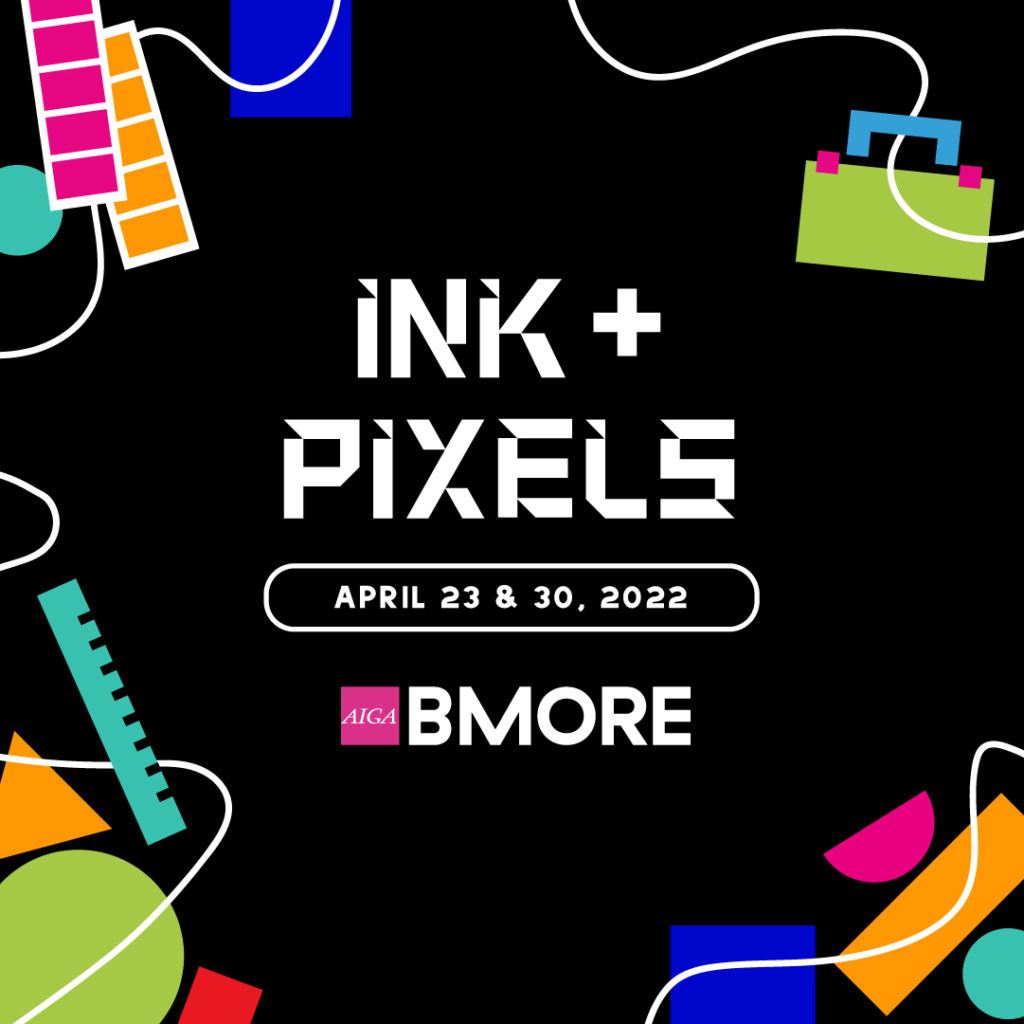
Ink & Pixels is coming up at the end of April! Save the dates for the virtual panel, “From Portfolio to Offer: The Art of Getting Hired” on April 23rd and the in-person portfolio reviews on April 30th. This year, the branding for Ink & Pixels was designed by Jamie Wheeler of Jelly Creative Co. (@jellycreativeco) and Jess Langley of White Coffee Creative (@whitecoffeecreativeco).

Can you tell us about yourself? What’s your story?

Jamie — My go-to line is, “I’ve been getting paid to design for almost 15 years.” It started with a high school internship, a design degree from York College of PA, various design jobs, a few years teaching, and now I own Jelly Creative Co. A branding and design studio for the creatively ambitious. I also like lava lamps, Nutella, my dog Nova, reading fiction, and playing board games with my husband. When I’m working towards a deadline you’ll find 90’s hits or EDM blasting on my Spotify.

Jess — My story has been full of lessons and ups and downs. In college, I landed my first design-related job as a Store Artist at Whole Foods. I learned lettering, how to work with others, and built up my confidence. That led to my first internship turned design job after graduating with a BFA in Graphic Design from Towson University. After being laid off from there in June 2017, I decided I was done with the typical 9-5 culture and went out on my own. I started White Coffee Creative and haven’t looked back since! My services, style, branding, and who I like to work with have changed drastically since then but I’m so grateful for the journey. I started coaching creatives in 2020 and now am learning to balance the two businesses with ease. When I’m not working, you can find me sipping coffee (obviously, with extra cream and sugar), bingeing Netflix shows, hiking with my 2 pups and partner, or dreaming about having a cabin in the woods.

How did you meet and start working together?

Jess had been running her business for two years when I DM’d her on Instagram asking if we could meet for coffee and talk shop. We met up at Spoons for breakfast and just clicked! She was my first local design/business owner friend and a huge supporter as I went full-time with my company in 2019. Community is really important to us both so when I brought the idea of a group for local designers to Jess she was on board to help start the Facebook group, Baltimore Graphic Designers, which now has 300 members! We have worked on local branding projects together, drank lots of local coffee, sent countless voice messages, and continue to cheer each other on. After Ink & Pixels, we’re excited to see what design mischief we can get into next!

How did you approach this branding project and what was your design process?

We were inspired by the juxtaposition of ink (organic) and pixels (geometric). We started with basic shapes within the AIGA color palette, then using only these shapes we started creating icons that can be used in various ways. The final touch is the wavy lines that intersect with the shapes and icons to create movement and bring everything together.

Having a stark black background allows the colorful elements to be brought to life and grab your attention while scrolling on Instagram or walking by on campus.

The fonts are designed by our friend Alex of The Routine Creative, a Texas-based designer. The jackknife font just felt too perfect not to highlight!

Can you describe your inspiration and any challenges you came across them while designing the branding?

If we had been working solo, there may have been more challenges, but we were able to pass the files back and forth when one of us was feeling stuck creatively. We have worked on branding projects together so we hopped right back into a nice groove. When we say it was a fun project, we really mean it!

What’s your favorite part about designing branding?

Jamie — Like any large design project there are the peaks and valleys, I think the moments right after the valleys are my favorite. I think all designers have the thoughts of “this is never going to work, what am I doing” but it’s the “oh yeah, this is it!” that I’m always chasing.

Jess — I love pulling visual inspiration and using strategy and color psychology to tie in meaning. It’s always a fun challenge to create branding that visually captures the essence of a business while maintaining simplicity. So that beginning exciting energy and the finale of when it’s all done and ready to show the world are my favorite parts.

Was there an aha moment when you knew you wanted to be a designer?

Jamie — Why yes, yes there was. It was when I photoshopped Ashton Kutcher into my homecoming photo and posted it to my Myspace. Technically, that’s when I opened the world to design, but the moment I learned it was an actual career and a college major I knew that was the path I was taking.

Jess — Yes! In college, I dabbled in a few different majors—journalism, photography, general fine arts, and design. I vividly remember one of my college professors (shoutout to Carolyn Norton!) in an Intro to Design class telling me I was already a designer. Getting that recognition and encouragement made me feel ready to step into this direction as a designer full-heartedly, and I got accepted into the GD program at Towson that following semester!

In the long term, what do you hope to eventually accomplish as a designer? What is your biggest goal/dream as a creative?

Jamie — This question is making me realize how much I have accomplished as a designer already, which is really cool. My dream client at the moment would be to work with a performing arts company. Lately, I’ve been searching for ways to bring all my talents and interests together while also helping other designers and keepin’ it real. A huge dream of mine was to host a retreat for designers, which is happening this spring, so I’m too sure what’s next!

Jess — I’m really enjoying running my own studio. I love being a multi-faceted creative offering design, murals, AND coaching. I hope to continue to navigate balancing a variety of tasks, projects, and clients while continuing to reinvent myself and where I want to go next. My big dreamy goal right now is to speak on stage at a creative conference one day about intentionally finding that balance as a business owner while having the freedom to explore a variety of creative outlets.

Thank you to Jamie and Jess for sharing their stories! We cannot thank you both enough for creating the branding for this year’s Ink & Pixels. Make sure to follow them on their various social channels!

White Coffee Creative
Designer + Muralist
whitecoffeecreative.com | @whitecoffeecreativeco

The Colorful Jess
Mindset + Pricing Coach
thecolorfuljess.com | @thecolorfuljess

Jamie Wheeler
Owner + Creative Director
jellycreativeco.com | Instagram | Facebook
14+ Events to Attend Around the World!

9/15-10/15

Hispanic Heritage Talks

AIGA Unidos was created for Everyone!
We highlight Hispanic and Latinx creatives, so we can share their stories and work with the world—that’s you! Our first ever event is a series of talks called Hispanic Heritage Talks, which will take place during Hispanic Heritage Month. It is a series of virtual talks featuring Latinx and Hispanic creatives from different backgrounds and disciplines. ¡Acompañanos!

Join the AIGA Unidos familia, and hear from all the amazing creatives our heritage has to offer. From us to you, with love and a little sazón… who are we kidding? A lot of sazón! We are Unidos for Everyone!

Hosted by: AIGA Unidos
→ Register Here
FREE


10/1-31

Doors Open Baltimore

Doors Open Baltimore is going virtual-only in 2020 with a month’s worth of programming throughout October. Organized by the Baltimore Architecture Foundation (BAF), Doors Open Baltimore is the free citywide festival of architecture and neighborhoods that invites thousands of people to explore the city and make meaningful connections to the built environment. Replacing a weekend of open houses and in-person tours will be a month’s worth of virtual programs. Every week of October will include a new theme and new ways to virtually engage with Baltimore’s architecture and neighborhoods. 

Hosted by: Doors Open Baltimore
→ Register Here
FREE 


10/2-10/9

Phoenix Design Week – PHXDW

Phoenix Design Week (PHXDW) is a week-long celebration of design organized by AIGA Arizona to unite our state’s creative community and provide a forum for sharing best practices, showcasing exceptional work, and gaining inspiration.

Hosted by: AIGA Phoenix
→ Register Here
$25-$49 Tickets


10/5-10/10

St. Louis Design Week

St. Louis Design Week is a seven-day celebration of our local design community, featuring a variety of panel discussions, workshops, presentations, open houses, and other community growth-oriented events. Our mission is to grow design and breakdown design silos through making St. Louis design week all-inclusive, to all designers.

Hosted by: AIGA St. Louis
→ Register Here
FREE


10/5-10/9

Salt Lake Design Week – Dimensional Design

What is “Dimensional Design?” It is the idea that we, as designers and creatives, have to be multifaceted in our disciplines. Becoming a dimensional designer includes exposing oneself to creatives of other disciplines and perspectives to be able to see the broader context of their own work. Experience dimensional design in action during this year’s SLDW.

Salt Lake Design Week celebrates and promotes the impact of all design in Utah. By providing a forum for designers, business professionals, students, and the general public to interact, collaborate, and learn from each other, we build a stronger creative community. We are inclusive of all people and disciplines including; graphic, digital, product, fashion, photography, architecture, interior, and more. From October 5-10, 2020 we will host the first-ever virtual SLDW to celebrate Utah creatives and promote the impact of design throughout the state and beyond.

Hosted by: AIGA Salt Lake City
→ Register Here
FREE


10/7 | 6:30–8pm EDT

And She Could Be Next Virtual Screening

This film follows the grassroots campaigns of six women of color running for political office during the contentious 2018 United States midterm elections. Produced by female filmmakers of color, the documentary offers a behind-the-scenes glimpse of these women leaders whose personal motivations, political coalitions, and ground-level activism steamroll the expectations of their opponents and of the broader public — defying traditional notions of what it means to be a U.S. politician in the process. 

A co-production of POV and ITVS. A co-presentation of Black Public Media and the Center for Asian American Media.  Film running time is 40 mins. Watch the trailer for And She Could be Next.

The screening will be hosted through Zoom. Zoom information will be sent to attendees prior to start time. Event will start at 6:30 PM EST and screening will start at 6:45 PM EST to allow attendees time to log on. 

After the screening, there will be a discussion based on prompts created for the film. Attendees will be grouped into break rooms for open discussion. Discussion time will be 15 mins.

This event is part of Design for Democracy, an AIGA initiative to increase civic participation through design. This event is a collaboration with POV, the award-winning independent non-fiction film series on PBS www.pbs.org/pov

Hosted by: AIGA Pittsburgh
→ Get Your Ticket Here
FREE


10/9

Baltimore Innovation Week

A one-day virtual event series celebrating good news stories and innovation in Baltimore.

Baltimore Innovation Week 2020 is a one-day virtual Innovation Celebration featuring multiple sessions that are focused on showcasing local companies and good news stories that have emerged during these continuously changing and trying times. Save your seat at spotlight discussions with industry experts, workshops from top companies, and networking with local businesses. You’ll have an insider look at the positive effect this city is having on the U.S. and World markets with premier access to the latest products and ideas. 

This annual event series is a unique collaborative effort from industry leaders across seven defined sectors. This is where technology meets science, creatives, students, entrepreneurs, sales representatives, marketing executives, economic developers, social activists and everyone in-between.  The best part? It’s all FREE.

Hosted by: ETC (EMERGING TECHNOLOGY CENTERS)
→ Get Your Ticket Here
FREE


10/14 | 6:30 PM–8:00 PM EDT

Changing the Face of Voting with UX

Join us for a conversation with Kathryn Summers about making voting inclusive and accessible through design. Design has the ability to include or exclude people. Join us for a conversation with Kathryn Summers about making voting inclusive and accessible through design. We will be discussing the implication of bad design and its implication on the voting process in the wake of the 2016 election and the coming 2020 election. In addition, Kathryn will be showing us the benefits of using eye-tracking machine and how it helps to analyze the visual behavior of your user.

Hosted by: Ladies Wine and Design Baltimore
→ Register Here
FREE


10/14 | 7–9 PM EDT

Talking Strategy with Douglas Davis

Join us on October 15th as Douglas shares how to turn the rational language of business into the emotional language of design. Douglas’ inspiring journey has taken him from designer to strategist, to now teaching other creatives the business of design. Wherever he shares, he helps provide a framework for the design industry. A framework that can be applied to concept pitches or to how to think about your career. Strategy has been something design schools haven’t focused on, and it’s more important than ever we understand it. After stepping into Harvard Business school, Douglas realized how big the disconnect was for designers. Since then, he’s taught at NYU, HOW Design University, Manhattan Early College School for Advertising, and the City College of New York, all while running The Davis Group LLC. Douglas took it upon himself to fill the void between design and business and teaches left-brain business skills to right-brain creative thinkers with his book, Creative Strategy and the Business of Design. He’s helped creatives across the country better understand business goals, how to set them up, but most importantly, how to measure their success for clients. There is a need to understand more than what looks good for your career to blossom. Join us on October 15th as Douglas shares how to turn the rational language of business into the emotional language of design. You already have the creativity, now it’s time to gain the business insights.

Hosted by: AIGA Charlotte
→ Register Here
$10


10/19-23

AIGA Colorado Presents Colorado Creatives

Colorado’s creative community thrives when its members are able to come together to share stories and experiences, however, the pandemic has moved these communities online and made it more difficult for people to come together in person. That’s where AIGA Colorado Creatives comes in.

The best part? Our project is all about YOU, the AIGA Colorado Creatives. It’s your chance to share your stories, advice, experiences and inspiration in a short video. Selected videos will be featured on an event site and combined with others in a storytelling reel which will be shown to thousands of people.

→ Participate Here
Submit your Video by October 12


10/20-22

Adobe MAX—The Creativity Conference

Make plans to join Adobe MAX for a uniquely immersive and engaging digital experience, guaranteed to inspire. Three full days of luminary speakers, celebrity appearances, musical performances, global collaborative art projects, and 350+ sessions — and all at no cost.

Hosted by: Adobe MAX
→ Register Here
FREE (with Adobe Account ID)


10/30

Creative Mornings Talk – Speaker Lola B. Pierson

Your Home! (part of a series on Stress)

Lola B. Pierson is a highly collaborative artist who was born and raised in Baltimore City. She is a playwright, writer, and director. Her work challenges theatrical form, incorporating elements of social media, performance art, visual art, switcheroos, and boredom. Other words she has used to describe her work in bios include: presence, explore, dynamic, and representation. A graduate of Baltimore School for the Arts, Bard College, and Towson University, she is passionate about the intersections of language, time, presence, and philosophy. She writes new work and messes with classics (that deserve it). She is the co-founding Artistic Director of The Acme Corporation.

Hosted by: Creative Mornings
→ Register Here
FREE


10/31 | 6 PM EDT

Counter Narratives Show: Black Liberation & Queer Resistance

The purpose of the show is to provide a critical examination of society and culture through the intersectional lens of race, gender, and class, more specifically it seeks to provide a COUNTER-NARRATIVE. The Show encourages a reflective assessment and critique of unique standpoints and their potential contribution to popular discourse.

What you can expect from the COUNTER-NARRATIVE:
Quality conversations about critical issues in communities of color, with guests who don’t just talk about the problem they are active in finding solutions.  Guests share their lived-experiences, insights, information, opinions, and personal narratives.

Hosted by: Rasheem
→ Register Here
FREE


AIGA Get Out The Vote

Every four years since 2000, AIGA has activated its community of designers across the U.S. and beyond to Get Out the Vote. The campaign is part of Design for Democracy, an AIGA initiative to increase civic participation through design.

In 2020, AIGA recognizes the centennial of the ratification of the 19th Amendment, granting women the right to vote in 1920 with a special edition of Get Out the Vote: Empowering the Women’s Vote. It commemorates the first legislation for women’s voting rights. Not until the passage of the Voting Rights Act in 1965 were voting rights of all women protected and enforced.

AIGA members–submit your posters today until election day, Tuesday, November 3, 2020, and help us get out the vote! Posters received by National Voter Registration Day (September 22, 2020) and Vote Early Day (October 24, 2020) will have the greatest impact.

Hosted by: AIGA

There are two opportunities. Please see below for the submission portals and galleries:

Futurism(s): An Inclusive History of Graphic Design

It is always an honor and a pleasure to have Ellen Lupton present. A huge thank you to Ellen for her generosity in delivering the recent talk on Futurism(s) as well as writing this article, for those who weren’t able to listen live.

On Wednesday, April 22, 2020, Baltimore’s stalwart design history group launched its new identity. Formerly known as SHAG (Society for History and Graphics), the group is now called SoDA, Society of Design Arts. It was my pleasure to deliver a talk called “Futurism(s)” as SoDA’s first event, in collaboration with AIGA Baltimore and Stevenson University. This online event attracted over 200 guests from the Baltimore region and beyond. Thanks to SoDA’s energetic new member Raquel Castedo, many designers from Brazil logged on to hear the talk and participate, as well as people from Utah, Tennessee, and elsewhere.

Below is my short summary of the talk, which was not recorded. —Ellen Lupton


“Futurism(s)” represents an approach to teaching Graphic Design History. At MICA, my colleague Brockett Horne and I are striving to tell a more inclusive history of design than the chronology we learned back when we were students. Most GD History courses include an ode to Italian Futurism. This canonical all-male art movement can be a leaping-off point for discussing other forms of future-leaning art and creativity. “Futurism(s)” is a talk with three chapters: Italian Futurism, Afrofuturism, and the Cyborg Manifesto.

Italian Futurism

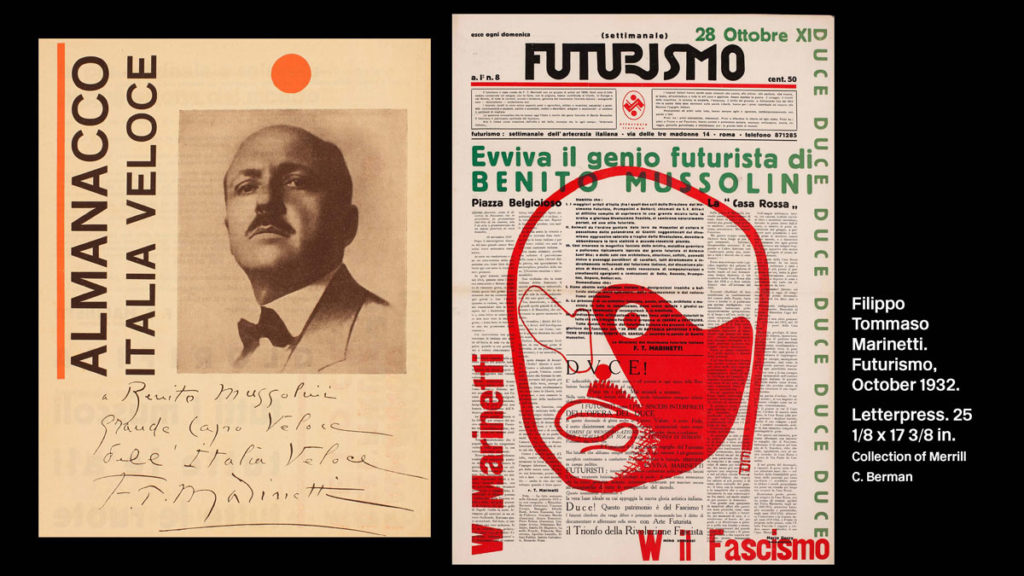
Italian Futurism was launched by F. T. Marinetti in 1909. Frankly, it’s hard to find a more patriarchal, exclusionary, white-dominated movement in the history of design-isms. Marinetti expanded our view of the printed page with his innovative typography, but he infused his ideas with hatred and violence. He wrote, “We will glorify war—the world’s only hygiene—militarism, patriotism, the destructive gesture of freedom.” He wanted to destroy museums, libraries, and schools in order to make way for a factory-born future.

Futurismo-filippo-tommaso-marinetti

Although Italian Futurism scorned women and embraced fascist ideology, the Futurists explored liberated styles of masculinity. The Futurist painter Giacomo Balla, who published his “Futurist Manifesto of Men’s Clothing” in 1913, dreamed of menswear tailored with interactive fabrics that could be changed at will to represent a man’s shifting moods: “Loving, Arrogant, Persuasive, Diplomatic, Unitonal, Multitonal, Shaded, Polychrome, Perfumed.” Italian Futurism took place in a particular place and time, and many of us reject its politics while admiring its revolutionary aesthetics.

Afrofuturism

Afrofuturism is a movement in music, art, and literature that arose in the 1950s and continues today. (The term was invented by critic Mark Dery in 1994.) Afrofuturism embraces world-building, a creative methodology arising from science-fiction and gaming. World-building emphasizes mythic time rather than historical time. It employs storytelling across many genres, from novels, comic books, and toys to fashion, movies, music, and fan fiction. World-building actively engages an audience in experiencing a world that is both real and imagined.

Afrofuturist artists include the musician Sun Ra (1914–1993), an American jazz composer, bandleader, and poet who claimed to be an alien from Saturn—and always dressed appropriately for his role, building a mythic world around his persona. George Clinton’s funk band Parliament created their own “P-Funk mythology,” generating an elaborate backstory to the music. The Afrofuturist album covers of the 1960s and 70s featured space ships, Egyptian pyramids, and other symbols of cosmic knowledge. Today, a new generation has brought feminist identities to Afrofuturism. Artists including Solange Knowles, Rihanna, and Janelle Monae use sound, performance, fashion, and storytelling to build vivid worlds ruled by warrior queens and rebellious androids.

Billy Graham was the first black art director in the comics industry. In addition to creating a character called Luke Cage, based on Blaxploitation action films, Graham was the main comic artist to work on the Black Panther comic book series, from 1969 through 1976. These comics continue to be published today, with storylines created by renowned Black authors including Ta-Nehisi Coates and Roxane Gay. In 2018 Ryan Coogler directed the international blockbuster film The Black Panther, featuring production design by Hannah Beachler and costumes by Ruth E. Carter. Together, this creative team designed a high-tech civilization that combines aspects of contemporary African urbanism, architecture, and fashion with futuristic details.

Each of these exercises in Afrocentric world-building questions culturally dominant readings of technology. Mainstream representations of the future—whether utopian or dystopian—have pictured technology as a primarily white, male instrument of power, in contrast with subjugated human bodies that are seen as female and/or non-white. These artists have transformed how technology is represented and understood across cultures.

The Cyborg Manifesto

Donna Haraway’s essay “Cyborg Manifesto” (1985) represents a third vein of futurist design and philosophy. Haraway questions the binaries that privilege white, male, human creatures while “othering” countless alternative modes of life. The cyborg is a being who is both biological and mechanical. The cyborg challenges cultural binaries such as male/female, animal/human, and human/machine. According to Haraway, cyborgs don’t appear only in science fiction. The cyborgs have arrived! They are here among us! Examples of cyborg life include A.I., virtual reality, bioengineering, psychoactive drugs, and countless medical technologies, from fertility treatments to cloning and transgender medicine. Fashion has always altered the body, while people with physical differences use wheelchairs, prosthetics, glasses, and hearing aids to expand their mobility and change their sense perceptions.

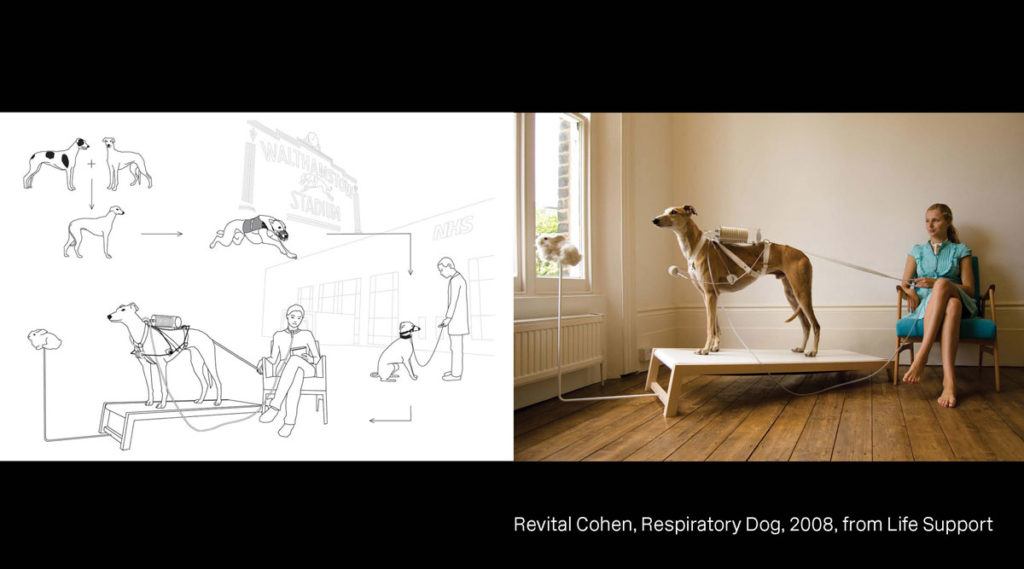
Designers working in the field of speculative design use techniques such as illustration, model-making, animation, and photo-illustration to imagine new, often dystopian futures. In their project Life Support: Respiratory Dog (2008), Revital Cohen and Tuur van Balen explored whether a dog could breathe for a human being. Living “service animals” help humans overcome many sensory and emotional challenges; the designers ask, why not have service animals augment our essential biological functions as well? The project is intended to be fictional and provocative, not realistic.

revital-cohen-respiratory-dog-design-futurism

Despite its fictional aims, Respiratory Dog has assumed new relevance today, a time when thousands of patients with severe Covid-19 require artificial life support. Every intubated Covid patient is a cyborg. Devices for respiratory life support are landmarks in the history of design and medicine. The Negative Pressure Ventilator—also known as the “iron lung”—was used to artificially ventilate patients who were paralyzed by polio. An iron lung encloses the user’s body in a negative-pressure chamber. Rhythmic pressure changes inside the chamber cause the person’s lungs to expand and contract. Thousands of these machines were mass-produced for use in homes and care facilities before the discovery of the polio vaccine in 1955. Iron lungs were eventually replaced with positive-pressure ventilators, which force air in and out of the patient’s lungs through the airway rather than exerting pressure against the chest. These modern ventilators require heavy sedation and put tremendous strain on the body. Today, modern versions of the iron lung are being reconsidered as a technology that is less expensive and more humane than a standard ventilator. One such prototype, Exovent, is being developed in the UK (as of April 2020). According to the developers of this old/new medical technology, the Exovent is a simpler, cheaper, and less invasive technology; it allows patients to remain awake, to eat, drink, and take medications on their own, and to talk on their phones.

What is “futurism”? All futurist movements, from Italian Futurism to Afrofuturism and speculative design, are opportunities to challenge the present by picturing what comes next. Designers are imagining the future whenever they question how things look, work, or signify in the current moment. Sometimes, the future arrives on the wings of catastrophe. Sometimes, the future must be created by excavating the past. Design history doesn’t have to be chronological. Like world-building, design history can pursue ideas across simultaneous and overlapping dimensions.


Bibliography


  • Reynaldo Anderson, “Afrofuturism 2.0 & the Black Speculative Arts Movement: Notes on a Manifesto,” Obsidian, Vol. 42, No. 1/2, (2016), pp. 228-236
  • Yytasha L. Womack, Afrofuturism: The World of Black Sci-Fi and Fantasy Culture (Chicago Review Press, 2013).
  • Ruth la Ferla, “Afrofuturism: The Next Generation,” New York Times, December 12, 2016, https://www.nytimes.com/2016/12/12/fashion/afrofuturism-the-next-generation.html
  • Anthony Dunne and Fiona Raby, Speculative Everything: Design, Fiction, and Social Dreaming (Cambridge: MIT Press, 2014).
  • Donna J. Haraway, Simians, Cyborgs, and Women: The Reinvention of Nature (New York: Routledge, 1991).
  • Dan Hassler-Forest, “The Politics of World Building: Heteroglossia in Janelle Monáe’s Afrofuturist WondaLand,” World Building, ed. Marta Boni (Amsterdam University Press, 2017).


About the Author

Ellen Lupton | Senior Curator of Contemporary Design at Cooper Hewitt, Smithsonian Design Museum in New York City. Her exhibitions include “How Posters Work,” “Beautiful Users,” and “The Senses: Design Beyond Vision.” Lupton is founding director of the Graphic Design MFA Program at MICA in Baltimore, where she has authored numerous books on design processes, including “Thinking with Type,” “Graphic Design Thinking,” and “Graphic Design: The New Basics.” Her recent books “Design Is Storytelling” and “Health Design Thinking” were published by Cooper Hewitt. She is an AIGA Gold Medalist and a Fellow of the American Academy of Arts & Sciences.


Tips for Staying Sane While Working From Home During the Coronavirus Outbreak

My company, along with many others, will be adding professional distancing to our social distancing regiment by transitioning to a remote workforce next week. As a software company, we consider ourselves fortunate to have numerous tools available to us, including our own product (insert shameless plug), to help us continue running the business without a hitch. But the decision wasn’t made lightly, and our department made sure to communicate expectations and concerns with each other before breaking for the weekend.

I worked remotely for a few years, and while I’m no expert, I got by with no budget (nor the extra room) for a home office renovation. I hope these tips will help you prepare and keep your sanity if you find yourself forced into a temporary work-from-home situation. It might not be the ideal home office of your dreams, but we’ll get through it!

Over Communicate

Let people know when it’s not working.
This tip comes from a coworker of mine who works remotely full time, while the majority of our team is in office. If something isn’t working, he always speaks up. And do it soon, rather than wasting time being polite while you can only hear every fifth word. He also reminded me that, “What you send isn’t always what is received,” which brings me to my next point.

Use emojis and GIFs to clarify tone.
If you tend to send short messages with no punctuation, your teammates might think you’re mad at them. Lighten it up 😊. Life-changing keyboard shortcut: on a Mac, use command-control-spacebar to pull up the emoji library!

Use communication tools. When in doubt, pick up the phone or turn on the camera.
We’re working remotely, but that doesn’t mean we’re doomed to spend the next few weeks emailing. Get comfortable being on the phone or in Google Hangouts with your teammates if you’re collaborating. Align your team with tools, and communicate expectations on how to use the tools.

Be on the lookout for software companies offering discounted access to their product during the Coronavirus outbreak, such as Loom for sending quick videos and screen recording.

Messaging apps: Slack, Flowdock, Whatsapp, and Facebook Workplace

Prepare for Video Conferencing

Test your internet and equipment.
Run a video conference test with coworkers before any important client or partner meetings. If you don’t have anyone to test with, just make sure to clear the air with the other person and ask them if they can see and hear you. Chances are, they’re working from home too, so use that to break the ice. Let them know if your dog might interrupt you, and have your mouse cursor on the mute button if that’s likely to happen.

Get familiar with your video conferencing tool’s settings. For example, if you use Zoom, you choose to automatically start with video off—that way no one’s caught pantsless! Another coworker shared these ground rules, which are a fantastic example of adapting communication for virtual spaces.

Get camera-ready.
My favorite trick is to open up the Photo Booth app before getting on a call, so I can see how the room looks behind me and clean up before starting the call. You aren’t the only one being thrust into a work-from-home situation, so there’s no reason to be embarrassed, but try to avoid a distracting background. You’re also going to be seeing your own face while you talk, which might take getting used to. I’ve noticed that I have a bad habit of messing with my hair when I see it on camera, so I try to get it behaving before the call.

Video conferencing tools: Zoom, GoToMeeting, Google Hangouts, BlueJeans

Be Your Own Snack Captain

If you’re lucky enough to be in an office with a well-stocked kitchen, you might find yourself cranky this week. So when you make your next grocery run, consider adding easy snacks and sandwich stuff to your cart. Prepare salads or sandwiches ahead of time, or go buy lunch if you feel healthy and comfortable doing so. Too many times, I skipped lunch because I didn’t have anything easy to make and felt too stressed to go out.

Food delivery services: Baltimore-based Hungry Harvest delivers recovered produce and pantry staples that would otherwise go to waste.

Set Boundaries

Get dressed.
Okay, wear sweatpants on the first day because you deserve it. But full-time work-from-home-ers agree that it makes a huge difference to act the same as you would if you were actually going to work. Shower, shave, and put on fresh clothes. Doing all of that will also help when you want to run out for lunch in the afternoon and realize you need to face the public.

When work is over, shut down the computer.
You’re saving time in your day by avoiding the commute, but that doesn’t mean you need to keep working all night. It’s Spring! Why not cap off your workday with a walk? Literally shutting down your computer will help prevent you from “just doing one last thing that will only take five seconds,” which we know always ends in you surfacing hours later. After all, sleep is crucial for maintaining good health, and your computer needs to rest and reboot too.

Go Outside

I’m serious. Try starting your day with a coffee on the porch or a stroll around the block. We may be quarantined, but the weather forecast is looking inviting and may be the best thing to quell Coronavirus anxieties. Also, you can’t always wait for a nice, natural break in your workflow. Sometimes you just need to drop it and step outside, even for a minute.

Support Local Businesses (if you can)

Stay sane, maintain your humanity, and support your local businesses and service industry workers. They are taking extra precautions, so if you’re healthy and comfortable, consider taking your laptop and hand sanitizer to the coffee shop for an hour. I visited the new Sizka sushi in O’Donnell Square today and noticed the WiFi password was prominently displayed in the spacious, clean, quiet restaurant. In Fells Point, Cafe Latte’Da even has a printer available.

That being said, the situation with COVID-19 is developing as we speak, so be informed and consider carrying a pack of tissues wherever you go to avoid touching door handles.

Connect Online

Tap into online communities such as the Baltimore Graphic Designers Facebook group, Baltimore Womxn in Tech (BWiT), Elevate and Cultivate Design Collaborative or Monument Women’s Creative Alliance (MWCA) to stay connected, get feedback on your work, and exchange knowledge.

Get a Puzzle

Okay, not entirely relevant, but have you done a puzzle lately? If you need something to distract you from work and COVID-19 tweets and keep you off your phone, this is it. They’re my new favorite winter activity, and it might be worth pulling one out if you’ll be practicing social distancing for an extended time.

Want more? I enjoyed this Instagram post by Post Typography co-founder and full-time work-from-home-er Nolen Strals:


Feature image by Glenn Carstens-Peters on Unsplash
unsplash-logoGlenn Carstens-Peters