How to Give and Receive a Good Design Critique

Why is critique so important?

As designers, we don’t design in a vacuum. A good designer will need to learn to take the feedback from their peers, clients, and bosses to solve a particular design problem. Critiques will also help you broaden your communication skills as a designer, as there is always the opportunity to articulate why you did what you did or to better explain your idea to the reviewer if they don’t see it as clearly as you do.

A good critique can involve both positive and negative feedback, which can be tricky to navigate. Here are some quick tips on how to give–and receive–good design feedback during a critique.

How to give a good critique:

The Love Sandwich
The best way to approach critiquing someone else’s work is to sandwich the feedback with love. If you think of your critique as the sandwich, the bread would be what you “love” about the work and the middle—the fillings—would be what you didn’t like as much.

First, tell your fellow designer what aspects you like about the piece, whatever they may be. Be descriptive. Instead of just saying “I like it” explain why you like it while using specific examples from the design whenever possible.

Next, move onto the constructive criticism. If you think certain aspects of a design aren’t working, try to explain why or offer suggestions on how they can be improved. Asking the designer questions may help them to see problems in the execution of the design that they may not have seen on their own.

You may also want to limit your use of personal pronouns, like “you,” to make sure your critique is about the design work and not about the designer. We all feel personally about our work, but during a critique it’s best to separate the person from the piece. For example, say you have a critique about a line intersection. You may want to say, “The way this line intersects with that line…” instead of “The way you intersected this line with that line…”. This will help reassure the designer that the criticism is about the work and not about them, as designers.

You don’t have to agree or like the decisions of the designer but their work deserves honest feedback. Put yourself in their shoes. If they are brave enough to share their work and ask for feedback, then they deserve to get that, both the good and the bad.

Finally, don’t forget to repeat or elaborate on what you liked about the piece so that the critique ends on a positive note. This way, the designer knows the piece may need some reworking, but also that there are aspects of the design that work as-is, too.

How to receive critique well:

A Grain of Salt
Hopefully, your fellow designer will follow the Love Sandwich guidelines and give you a great, honest critique. During a critique, It’s important that when you hear the good and the bad feedback to take it with stride. Design isn’t math. There are no right and wrong answers; only subjective opinions that may differ from one designer to another.

That being said, remember that a critique is about your work and making it the best it can be; it shouldn’t be about you. If you disagree with specific feedback, explain your decisions thoughtfully but also listen to what’s being said. Remember, those who are giving critiques generally do so because they want to help you grow as a designer, so try not to get defensive or take their criticisms personally.

And, if you don’t agree with specific comments you receive during a critique, it’s okay to ask for other opinions, too. Baltimore is filled with great designers who are willing to help and who love to give a good critique. There are also online resources like Dribbble or Behance that you can log into and share your work with others around the globe. Anyone, even a non-designer friend or coworker whom you trust to give honest and constructive feedback, can be a good resource. And, a good round of feedback is always better than no feedback at all.

Students and recent graduates! Want to have your work critiqued by Baltimore area design professionals? Register for Ink & Pixels, AIGA Baltimore’s Student Design Conference, before it is too late.

What’s the best or worse feedback you have ever gotten during a critique? What advice would you give to someone taking part in a design critique for the first time?

Related Articles:

The 4 essentials of a design critique

The Art of the Design Critique

Design Criticism and the Creative Process


Photo by Jeremy Drey for AIGA Central PA

Kate Lawless often daydreams about how she can make a full-time job out of what she does for AIGA Baltimore. When her head isn’t in the clouds, you can find her designing communications, digital signs, documentation, and online software demonstrations and interactive elearning for the operations department of a large healthcare company in Baltimore. Tweet her at @katereeez

Shannon Crabill is a New Media Specialist at T. Rowe Price. She has a love for social media, tech, all things do-it-yourself, baking, coffee and the occasional cringe-worthy pun. Outside of the Internet, you can find her dancing, riding her motorcycle and binge-watching home improvement shows on HGTV. Tweet her at @shannon_crabill

An INside look at Baltimore magazine

Baltimore Magazine was first printed in 1907 by the Baltimore Chamber of Commerce. It is to this day, the oldest city magazine in the U.S. In 1994, Steve Geppi, owner of Rosebud Entertainment acquired the magazine with the goal of reviving the publication by rethinking its content as a channel to celebrate the great things that Charm City has to offer. With over 50,000 magazines in circulation, its in-house creative team collaborates diligently to keep the look and feel of the publication fresh and dynamic. Amanda White-Iseli has been Art Director for the publication for the last 16 years and shares insight on her in-house team.

How far in advance do you start working on your next issue?

Baltimore is a monthly publication designed on a 4- to 5-week production cycle. My team and I work closely with each other and with the editorial team throughout the cycle. Work begins even before the previous issue hits newsstands as art directors and designers meet with editors and writers to discuss the stories for the next issue. As a department, we all rely on each other for collaboration and critique at every step of the process. We’ve developed a strong, harmonious relationship with the editorial staff as well as with our digital and social media divisions, whom we also work closely with.

Special Editions and Marketing Art Director, Staci Lanham designs our quarterly Home section, our annual Baltimore Bride magazine, and all in-house promotional materials. Our Design and Print Division—headed up by Art Director Vicki Dodson and Senior Designer Michael Tranquillo—is creating fresh, new looks for businesses all over the region including print advertisements, stationary, media kits, newsletters, brochures, and more. Jon Timian is our Production Manager and is responsible for the top-notch production of the magazine—color correcting, along with the image, print, and paper quality. Production Artist, Marina Feeser designs ads and manages ad production for the monthly magazine as well as Baltimore Bride. Craig Forbes is our digital designer handling our web design and many of our online videos.

Understanding the broad strokes of the story and the writer’s tone influences the direction of the design and helps with the initial concept stage. Stephanie Shafer, the editorial design assistant, is responsible for part of the front of the book and all of the departments. Sophia Belitsos, the assistant AD, designs the rest of the front of the book, some features, and our Local Flavor section. I design the cover as well as features, provide direction to the assistant AD and design assistant, and manage the art department as a whole.

The three of us meet weekly to review progress, discussing design direction and potential illustrators and photographers that would be a good fit for the stories. Each person is responsible for creating art assignments for the stories they are working on.

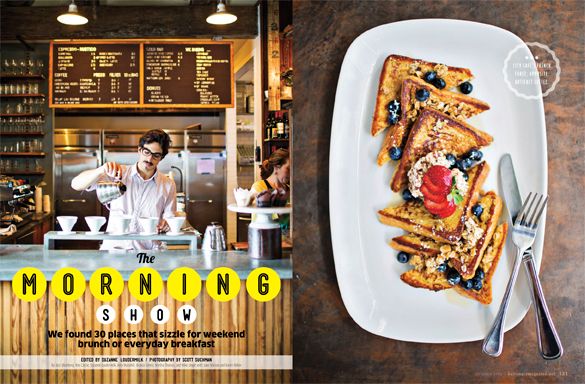
October 2013 issue. Photography by Scott Suchman.
Baltimore’s Best Breakfast Spots. October 2013 issue. Photography by Scott Suchman.
Photography and Illustration have become a huge part of your publication, is all of this done in-house?

David Colwell, our Director of Photography, shoots a large part of the photography for any given issue. Front of the book sections such as “Charmed Life” are typically shot in our studio during the second week of the production cycle. The studio—which is a block away from our Lancaster Street offices in Harbor East—is a large, open space that provides an area where we can paint walls, build sets, and do whatever is necessary to shoot everything from fashion to portraits to product and detailed documentary photography for the monthly magazine as well as our annual Bride publication. (It was even used for a short scene in Season 2 of “House of Cards.”)

We also assign work to photographers in our extensive network of talented freelancers. We try to choose photographers whose style and aesthetic is a good fit for that particular project. We then send a detailed art assignment explaining the story and our design ideas, often including sample images that will help describe the look we are after. We try to give them two weeks to complete each assignment, although time is a luxury we don’t always have.

Baltimore magazine. September 2014. Photography by Mike Morgan. Hand lettering by Martin Schmetzer

We approach illustration projects in much the same way, providing art assignments and examples of illustrations that will help guide the illustrator’s concept and initial sketches. We have worked with renowned painters and illustrators from all over the world as well as those in our own backyard, including MICA graduates and even some professors. We find most of our illustrators either through artist reps or as a result of their own dogged determination to promote themselves via print mailings and email inquiries (yes, a well-written email or catchy postcard still works).

Can you give an example of a recent concept for a cover that you really enjoyed working on? What was the process?
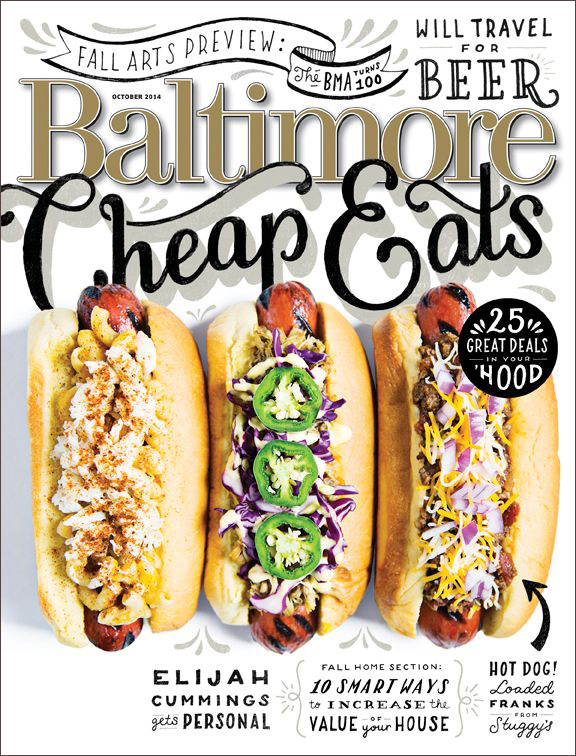
October 2014 issue. Photography by Scott Suchman. Hand lettering by Lauren Hom.

We recently produced our October 2014 Cheap Eats cover which was a lot of work–but really fun to do. The food stylists who I usually work with were unavailable, so I tried my hand at styling the dogs myself. I worked with photographer Scott Suchman who is gifted at shooting food. It was a long process that involved lots of buns, lots of toothpicks, and a soldering iron! I was really happy with the results. I also worked with illustrator Lauren Hom who is amazing! She did the hand lettering for the piece. I provided sketches of what I wanted to include and where—and she worked her magic.

How do you coordinate what goes into your print publication vs. digital?

We meet monthly with digital team to maximize the capabilities of digital media and make the content fresh and dynamic. This can include everything from redesigning charts and incorporating infographics to shooting behind-the-scenes footage from photo shoots as a supplement to the editorial content. We are active on Pinterest and Facebook, posting contests, polls, and generally maintaining an online presence that further nurtures our relationship with existing readers and helps develop new ones. That relationship, and the resulting communication, helps us deliver designs that complement and support the stories and enhance the reader’s experience.

Follow Baltimore Magazine: Facebook | Twitter | Pinterest

Jennifer Marin is co-president of AIGA Baltimore, you can follow her on Twitter: @hungry4design

What’s Up With Your Workspace?

If there’s one thing for certain, it’s that Baltimore designers have some fantastic workspaces. This is only evidenced by the growing number of Instagrammers out there tagging #bmoreAIGA100 on their #workspace photos this month.
So far, we’ve seen that many local creatives have multiple screens:

http://instagram.com/p/zCoI_JN2w0


some expansive workspaces:

http://instagram.com/p/ysn6O3RHii/


and even miniature workspaces with big visuals:

http://instagram.com/p/y0fCtbLLMH/


Speaking of big visuals, we’ve got some inspirational walls:

http://instagram.com/p/yu9mZ6qAtg/


a few ‘remote’ coffee shop spaces:

http://instagram.com/p/y5aydMvgQb/


and some well-appointed cubicles, too:

http://instagram.com/p/zAwgnJOx_i/


And this isn’t even half of the postings on Instagram, so go check out the rest with hashtag #bmoreAIGA100.
While you’re at it, snap a pic of your own #workspace and tag it on Instagram with #bmoreAIGA100. We don’t care if it’s messy and cluttered or clean and dust-free; just do it by February 28th and you’ll be entered to win one of two year-long Skillshare subscriptions!
BONUS ROUND: Want to double your chances? Come up with a creative way to spell out #bmoreAIGA100 in your photo for a second entry.
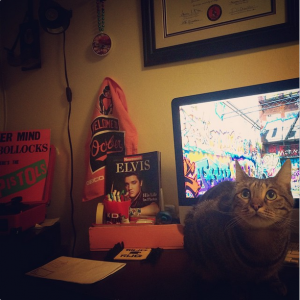
Oh, and here’s one last Instagram with a lovely Bmore feline to leave you feeling cozy on a cold winter’s night:


workspace with O's gear and a kitty
rmadar1: My lil corner workspace, lots of orange, lots of cat. #bmoreAIGA100 #workspace #Baltimore


Meet Megan Brohawn, Baltimore Designer

Megan Brohawn

Megan Brohawn is a powerhouse designer who brings a modern perspective and fresh approach to her projects at Novak Birch. Check out her work and get to know her a little better:

What’s your favorite project in your portfolio right now?
My favorite recent project was designing the Baltimore Triathlon logo. It was a really fun collaboration with Will, the owner of Elite Race Management. The inaugural race takes place in a few weeks, and I can’t wait to see the logo on the final materials – shirts, medals, stickers, banners, and more!

Who’s your favorite designer or design studio?
Jessica Hische; I am really inspired by her hand lettering.

What music do you listen to while you’re working?
Music is an absolute must for me when working! Currently I am listening to a lot of St. Vincent, Jack White, Yeah Yeah Yeahs, and Arcade Fire.

Choose one: Adobe Illustrator, InDesign, or Photoshop?
Indesign.

Why do you love AIGA?
I love AIGA because I enjoy sharing experiences with other designers and taking part in our local design community.

BMA’s Big Table Roundtable: A Conversation on Immersive Design

On Saturday, October 18th, AIGA Baltimore opened its third annual Design Week at the Baltimore Museum of Art with a roundtable discussion on immersive spaces.

The Big Table is a project headed off by Baltimore Museum of Art (BMA) that strives to address questions and criticisms about art posed by visitors. Each year, a designer or a team of designers is chosen to address one question or idea. Bruce Willen and Nolan Strals from Post-Typography, Ellen Lupton and Abbott Miller from MICA and Cooper-Hewitt (respectively), and David Plunkert of Spur Design, have all designed for The Big Table over the past few years. They gathered together to discuss their concepts at the BMA in the Fall of 2014.

Gamynne Guillotte, Director of Interpretation & Public Engagement for the BMA, talks about the purpose and format of The Big Table.
Words are Pictures are Words

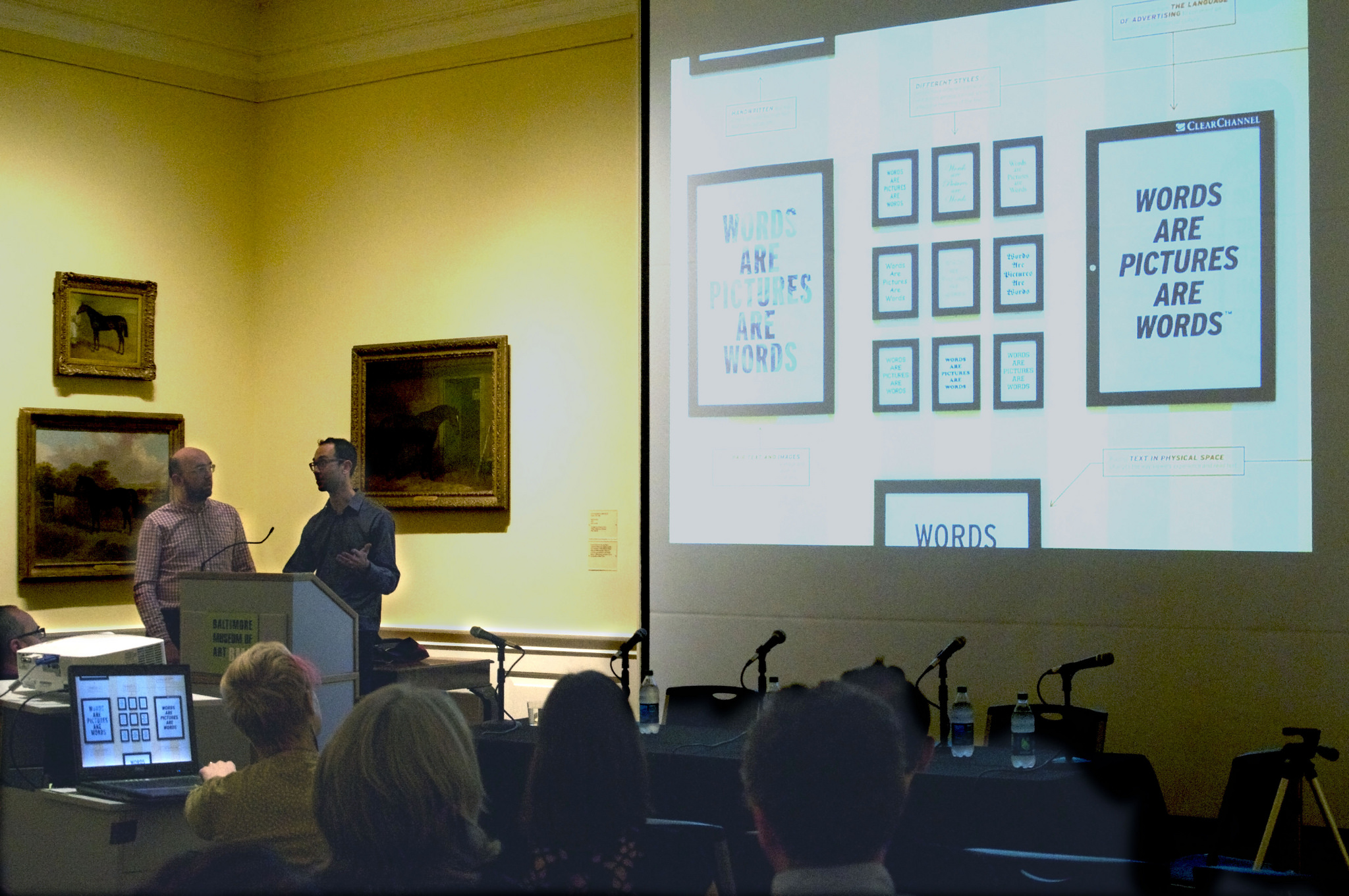
How do contemporary artists use text in their work? Willen and Strals approached this question by considering language and how meaning changes depending on how it’s written. They created their immersive space, titled Words Are Pictures Are Words by using that same phrase in several contexts, including a room-sized infographic, showing how the meaning of the phrase changes depending on type, style, and arrangement.

Willen and Strals talk about their concept for Words Are Pictures Are Words.
Point, Line, Grid

“The idea becomes the machine that makes the art.” This quote by Sol Lewitt inspired Ellen Lupton and Abbott Miller to create the work Point, Line, Grid. They created a bulletin board-style grid that explores the way an artist thinks by inviting visitors to create and display their own artwork to dominate the room for the next year. The environment was created to point to the inspiring artwork while letting the visitors create something of their own.

Ellen Lupton talks about how they implemented the grid on the walls, and suddenly the room became an interactive experience for viewers...or shall we say, participants?
Ellen Lupton talks about how they implemented the grid on the walls, and suddenly the room became an interactive experience for viewers…or shall we say, participants?
Extra-Ordinary Objects

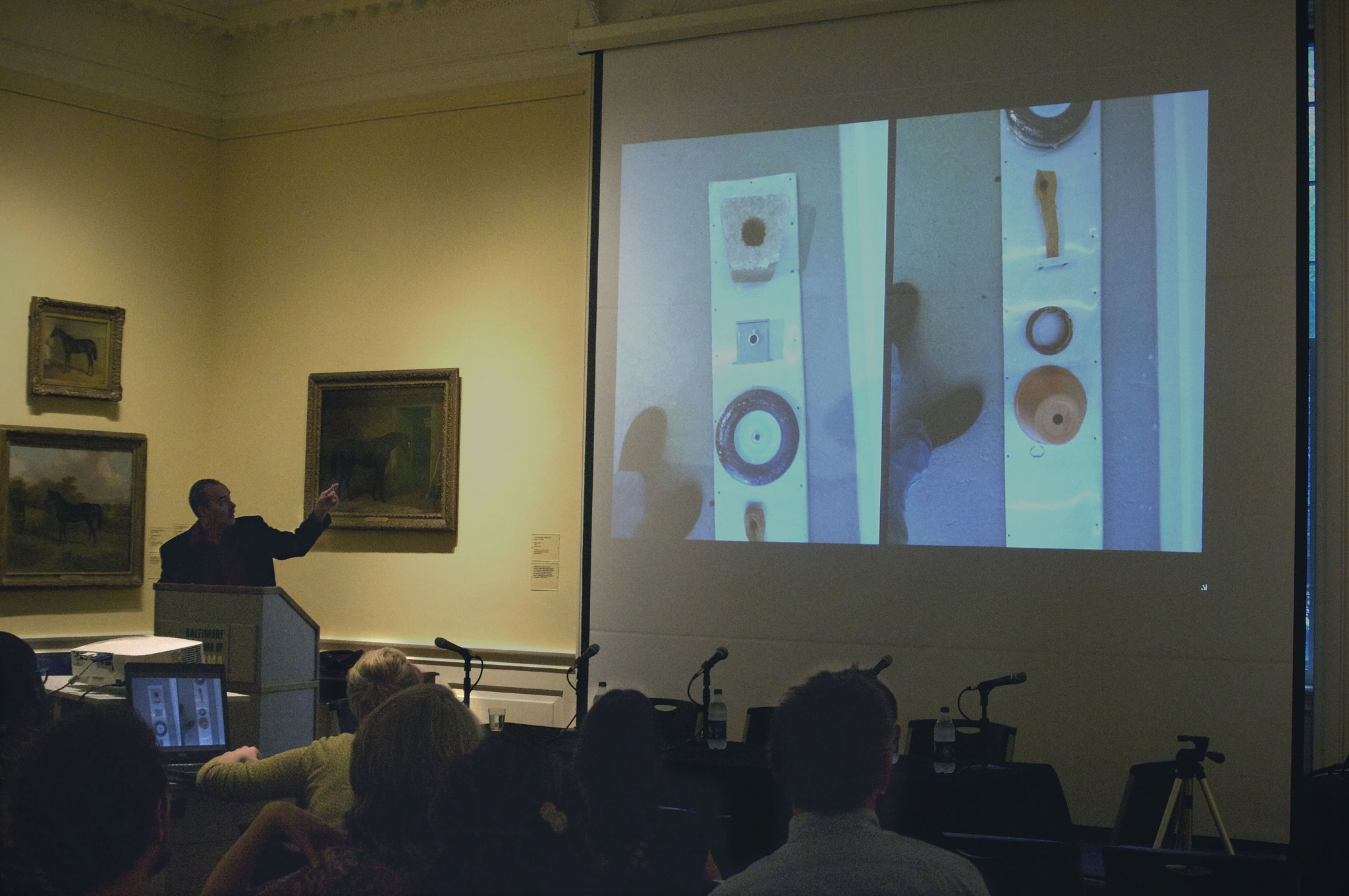
David Plunkett says that an object in a museum becomes something more important because it’s in a museum. He approached his Big Table project by studying the permanent exhibits in the contemporary wing and making a list of the common items he saw there and in an everyday environment. The resulting work, Extra-Ordinary Objects, is a room about objects one could find anywhere, remixed and displayed in ways that were unusual, presenting the viewer with a new, amusing way to see the relationships between those everyday objects. It will be on display in the Contemporary Wing until September 2015.

David Plunkert talks about a few of his extra-ordinary objects.

To see more photos from this event, check out the set on Flickr.


Greg Jericho spends an awful lot of time designing for clients that do not exist. Check out his work at gregoryjericho.prosite.com.

Touring through the National Parks Conservation Association’s Brand Journey

When Scott Kirkwood joined the National Parks Conservation Association (NPCA), headquartered in Washington, DC, as the senior editor of National Parks magazine 9 years ago, he knew he had a lot of work to do. The magazine was in desperate need of a redesign, the annual report had been neglected, and the logo hadn’t been revised since dinosaurs roamed the planet. He could sum up the brand in one word: stale.

But he said “We can do better!” Scott buckled down and began making small tweaks to the design department’s production and nearly 10 years later he’s lived to tell the tale of the NPCA’s brand revitalization. His side-kick, Annie Riker (who came on as a designer at NPCA in 2006) joined him on Tuesday, January 28, 2014, to talk to a large audience of brand-hungry design lovers at Groove Commerce’s new digs in Harbor East.

Participants nodded in agreement as Scott and Annie revealed their views on cultivating client and partner relationships and what constitutes engaging content. Check out some of the highlights from our Twitter feed below and some great moments captured above.

Continue reading “Touring through the National Parks Conservation Association’s Brand Journey”

HOW Interactive Conference 2013: Tools & Resources

When I first set out to write about what I learned over 3 fabulous days at the HOW Interactive Design Conference in Chicago, I realized (as I sifted through pages and pages of notes) that what’s needed here isn’t another recap of sound bites from the event. What I usually hear from design conference attendees is “it was good but I was expecting more” or “I had a great time but it only reinforced what I already knew.” If you’ve scoured hundreds of articles, blogs, and books about how to be a better designer then you don’t need to learn more, you need to do more. So, with this article, I figured you’d want tools to get the job done.

I’ve put together the tools and resources that the speakers shared at HOW, some of which are free.

PROTOTYPING & WIREFRAME TOOLS

sketches

Axure.com
Make interactive wireframe and prototypes without writing code.

UIStencils.com
Get the tools you need to sketch any type of prototype with pen and paper. Check out this iPhone Stencil Kit!

Protosketch
Build fully-interactive prototypes from your UI Stencil Sketches.

FluidUI.com
Design working mockups for mobile and tablet apps in the browser to share instantly.

Invision
Quickly share a mockup or demo a mobile app with this prototyping and collaboration tool for designers.

Flinto
Make your designs interactive. Create iOS prototypes with your rough sketches or final mock-ups. This tool adds interactivity by linking screens so you can quickly share with your client.

Skala preview
Send pixel perfect previews from your Mac to as many devices as you like. And if you’re working in Photoshop CS5 or higher, you can preview as you edit.

Codiga
A cloud-based drag-and-drop mobile interface builder. Import your own code or choose from their JQuery powered library of components.

Wirify.com
Convert any web page into a wireframe. The PRO version lets you export and edit the wireframes into a variety of formats.

Sketch
A vector graphics app (Mac only) for web and UI design. Render text, create artboards, and use its adjustable 960 grid for wireframes. Using Sketch Mirror, you can preview your work on your iPhone and tablet over Wi-Fi.

USABILITY TESTING

Silverback
Usability testing software for designers and developers. Screen capture, record live video & audio of your users testing your website.

Optimizely
Website Optimization and A/B Testing

UXrecorder
Mobile Website Testing for iOS

DESIGNING & BUILDING

Chris Butler

Macaw
Tired of designing in Photoshop and Illustrator? This web design tool writes code as you draw it.

Codrops
A web design and development blog that publishes articles and tutorials on the latest trends and techniques.

Hammer.js
Javascript library for multi-touch gestures.

Adobe Generator for Photoshop CC
Create image assets in real time.

Adobe Edge Reflow
Design responsive CSS layouts for all screen sizes and export to an HTML code editor with Adobe Edge Reflow CC.

Communication is Key

BOOKS, BLOGS, AND MORE…

Want to know more? Here are some books from the HOW speakers themselves. If I hadn’t brought all carry-on luggage, I might have bought every one of these. Thank goodness for the internet.

Patrick McNeal Twitter
Creator of designmeltodown.com
Session:  What You Need to Know To Be An Effective Web Designer
Books: The Mobile Web Designer’s Idea Book, The Web Designer’s Idea Book

Chris Converse – Twitter
Codify Design Studio
Session: How to Turn Your PSD Documents into Web Pages
Some Great Resources and Templates can be found here

James Victore – Twitter | YouTube
Keynote Speaker
Book: Victore or, Who Died and Made You Boss?

James Pannafino
Associate Professor, Millersville University
Session: Interdisciplinary Approach to Interactive Design
Book: Interdisciplinary Interaction Design

Chris Butler – Twitter | Blog
COO, Newfangled
Session: Master (minding) the Process: Presentation Slides
Book: The Strategic Web Designer

Margot Bloomstein – Twitter
Principal, Appropriate, Inc.
Session:  Making Meaning in Content and Design – Presentation Slides
Book: Content Strategy at Work

Todd Zaki Warfel
Co-Founder, Nimbly App
Session: Interactive Prototyping & Exploration of Standard Prototyping Tools
Book:  Prototyping A Practitioner’s Guide

Terry White, Sr.
Worldwide Evangelist, Adobe
Session: Create HTML Websites, iPad Apps and eBooks Without Writing Code
Tutorials

Cameron Moll
Founder, Authentic Jobs
Session: Visual Execution of Branding Across Platforms
Books: CSS Mastery , Mobile Web Design

Christopher Cannon
Senior Designer, Bloomberg
Session: Designing Data: How to Create Meaningful Visualizations – Presentation Slides

Brian Wood
Co-Owner, AskBrianWood.com
Session: Bridging the Designer/Developer Divide

David Sherwin – Blog
Principal Designer, frog
Session: Using Storytelling Techniques to Create Better Interactive Experiences
Book: Success By Design: The Essential Business Reference for Designers

Dan Rhatigan
Type Director, Monotype
Session: Tailored Type for Screens – Website

Want a play by play of the event? Here’s a beautiful summary of the social media from the conference as it happened.

Have you used some of these? Do you have something to add? We want to hear about them!

Jennifer Marin is the co-president of AIGA Baltimore and she clearly loves resources.

Nominate your favorite Baltimore Logo Designer!

This November, to highlight the contributions made by the many designers in Charm City, Edwin Gold, professor of Communications Design and director of Ampersand Institute for Words & Images, is curating a special exhibition featuring the very best logo designs by Baltimore creatives to be displayed in the UB Student Center Gallery.

The exhibit, which is to be on display for three months, opens with a reception for the designers and friends. Further information, including the panel of judges and instructions for mounting are to be finalized in coming weeks.

To nominate your favorite local designer (or yourself), contact Ed: egold@ubalt.edu and include name, contact information, and samples of your favorite logo designs.

DEADLINE FOR SUBMISSIONS: September 20, 2013.

25 Ways to Rejuvenate Your Creativity

To celebrate AIGA Baltimore’s 25th year, Jon Barnes, Director of Communications at ADG Creative, has a to-do list for you that’ll motivate your imagination.

Dig out some of your old work or go through an earlier portfolio to see how far you’ve come.

Go to a museum you’ve never been to but always wanted to visit.

Watch a documentary on an artist or visionary who inspires you.

Have your best friends bring their favorite inspirational documentaries over for a movie night.

Focus on 1 artistic project you’ve had brewing in your head and get started on it. Not for work, just for you.

Volunteer at a career fair for local students or visit your high school art teacher just to say hi.

Rearrange your home office or studio for a fresh look and feel. Throw some junk out.

Start a file on your computer called “dreams” and start putting thoughts, notes, and ideas into it of your artistic visions.

Go the bookstore and browse through the art or design section. Buy something motivational for your coffee table.

Create a guerrilla art project somewhere secretive in public. Tell no one.

Make a really stylish homemade card for the next family member of yours who has a birthday. Work so hard on it that the card itself becomes the gift.

Post some of your favorite motivational quotes on sticky notes and put them in your car/bathroom/kitchen.

Create a motivational quote wall at your home or office and ask your friends to contribute their favorite inspirational quotes to it.

Take a day off from work and go to the beach. There is something deep and real about the ocean that connects with the artistic process. Schedule it now.

Spoof something famous (Mona Lisa, Abbey Road album cover) and post your subversive work around the office.

Take a new route or mode of transportation to work for a week.

Change your schedule drastically for a month, prioritizing your “personal creative time” above everything else.

Start a Facebook group asking your friends to post links to their favorite art and design websites. Call your group “Design Motivations” or something with the word “-licious” in it.

Get in touch with a local non-profit and offer to do a free piece of design work for them.

Commission a piece of artwork from a child you know. Pay them handsomely for it and hang the artwork in your house or office.

Repaint one of your rooms. Single color or mural.

Have an art show for all your friends and family at your house. Call it an “art party” and post up your work on all the walls. Even better: Rent a few cheap hotel rooms and have your show there.

Volunteer at a senior center or hospital to give some free art lessons or do a fun collaborative design project.

Pick an obscure holiday and plan a celebratory office party around it (Potato Day, Thomas Crapper Day, etc.). Go overboard with decorating, contests, activities and food. Pull in your co-workers to conspire with you in the planning.

Take a look at your personal website or online portfolio. Overhaul the content, get it updated, refresh the look. Barter with someone if you need help.

Design Week 2012 RECAP!

Complete and utter madness yields lovely, lavish design…GO BALTIMORE DESIGN WEEK!
– Seth Kaiser, Bmore Design Week attendee

Sarah's winning design

Aw, rats…

On October 15, we began our first annual Bmore Design Week: five days of celebrating design in Charm City. While there’s no shortage of art festivals year-round, Design Week gave us the opportunity to show how the celebration of our local pop culture can become great publicity work for the town and its people.

The opening event was the Out of My Hands Workshop where, Sharpies at the ready, designers got together to create a unique Baltimore alphabet inspired by this great city. Helen Armstrong and Zvezdana Stojmirovic, authors of the book Participate: Designing with User-Generated Content, kicked off our Design Week with a unique workshop where designers let go of control and allowed their visions to be built as a team. Each designer was given a sheet of paper with an outlined letter and asked to designate a rule or guideline inspired by Baltimore that would guide the next designer to fill the letter with images related to that rule. AIGA’s Jennifer Marin was intimidated by the thinly outlined letter and its theme at first. “Would I go abstract and choose a theme that would stifle the next person’s creativity? Or a more cliché concept like Baltimore Crabs?” she asked.

After a few minutes, she chose “Salty Like Old Bay” as the topic of her letter. Some of the other letter themes included the Ravens, Baltimore City Rats, Waterfront Living, Brick Row Homes, and the good old 695 Traffic Jam. In five minute intervals everyone passed their letter forms to the right and watched as a unique alphabet was born. It was great to see how each person interpreted the individual themes.

A special thank you to all who attended, Helen and Zvez, and MICA for donating the space. Stay tuned to see the final artwork.

Tuesday brought us to Mother’s in Federal Hill for Industry Trivia Night. As the teams entered the bar with names like “The Ringers” and “Winner Winner Chicken Dinner,” it was obvious we had assembled some creative people for this challenge. The questions covered design, the printing industry, advertising, marketing, photography, and Baltimore.

Our trivia host, Patrick Storck, asked 50 questions that got trickier with every round. Who designed the Nike Swoosh? What musical was based on a 1990 John Waters movie (not so fast: Hairspray was made in 1988)? Pantone mugs, camera lens shot glasses, and other design-related prizes awaited the victors.

Wednesday exploded into Creative Alliance with the Shutterstock-sponsored Pixels of Fury, an ‘art fight’ where the contestants are given 20 minutes to dream up, design, and finish a project, the subject of which is revealed at the beginning of the round. National President of AIGA, Doug Powell, and Bob Shelley, AIGA Baltimore’s first chapter president were on hand as a judges. The first round of designers were Dave Colson, Sarah Jennings and Dirk Torrijos, their task was to create something that inspires them about Baltimore.

Round Two saw Micah Piccirilli’s crab project and Bob Gillespie’s crab project fighting each other, while Jill Blum chose a Smalltimore theme. Each minute revealed something new and clever in each design, some added seconds before time was up. Judges and audience voted Micah into the Championship Round.

Sarah came into the round slowly, carefully choosing the right images for her Bmore Rat frame, while Micah ran with a representation of our friendly President Street windshield maintenance crew. Sarah won the judges, Micah won the audience, and everyone went out to John Davis’ photo set-up to act silly for the camera.

Sarah Jennings and her award

Sarah and the coveted Furious Pixel

Local design studio Post Typography gave a brilliant lecture on Thursday. In a beautifully rustic and open space at 2640 Saint Paul St., guests came and gathered round for local treats, pies from Dangerously Delicious Pies and coffee from Zeke’s Coffee. We settled down in our seats to enjoy custom lettering and hear stories of success, great misses, and ways to approach the same project differently each year.

Friday saw attendees visiting three of the city’s design studios. First up was Baltimore Print Studios, where Kyle and Kim invited us into their fully equipped letterpress and screen print shop in Station North. They explained the different presses in the studio, the history of printing, and led the attendees in a hands-on press demonstration.

Next was Fastspot, housed in a Butcher’s Hill rowhome, where Kurt showed the group around and explained the history of the firm and the type of work they do. He talked about their workflow and the culture of the studio: open-concept, no doors, and different types of work stations.

Our last tour was B. Creative Group, an inter-disciplinary studio in Woodberry. Described by the owner, Christian, as a creative agency, the studio does both print and web design for regional and national clients. During the tour, we got insight on how B. Creative Group develops within a collaborative environment while seeing examples of their award-winning design work and a recent proposal.

The first annual Baltimore Design: some were inspired, some were educated. Everyone definitely had a blast. Clear that calendar for October 2013 because as good as it was this year, it will be a do-not-miss event for sure as we’ll also be celebrating AIGA Baltimore’s 25th anniversary!

some of the AIGA Baltimore Board

AIGA Bmore. We’re a little… different.