Design_v2021 Panel Recap

Thank you to those who registered and attending our Ink & Pixels panel discussion for 2021! Our panelists from Stevenson University, JP Morgan Chase, Planit, Jones Knowles Ritchie, and Quicken/Rocket Companies had a fantastic discussion about the most important industry shifts designers need to know as they prepare to get hired in a post-COVID world. Watch the recording below to get all kinds of great insights on preparing your portfolio, being interactive on social media, and learning about all of the great tools and resources out there.

Connect with the panelists:

Lori Rubeling, Professor at Stevenson University
Raksa Yin, VP, Visual Designer at JP Morgan Chase
Nikki Bracy, PR & Social Media Account Director at Planit
Taylor Woods, Senior Designer at Jones Knowles Ritchie
Benjamin Guarino, Team Leader, UX Design at Quicken/Rocket Companies (panel moderator)

Quotes from the Chat:

Designers definitely need to be involved early on in the decision-making process for new products—makes a world of difference! Too many teams assume and don’t do the work to gather research from the end-user.
—Valerie Anderson, President, AIGA Baltimore

Keeping social media post simple and effective can be the toughest battle between you and the client. They want to advertise every CTA in one post. This has been a great reminder to not back down from what you know works and use evidence to show why it works.
—Aja McDaniels, Graphic Designer, Aja Mac Designs

Keep a student/learner mindset always, no matter your age or skill level!
—Kim Loper, Education Director, AIGA Baltimore

Watch the Recording!

Great Website Resources/Groups

Tools to Use:

Podcasts:

Free Ebooks & Short Reads:

Books & Longer Reads:

Reconnected: January 2021 Community Meeting Recap

In January, AIGA Baltimore held a virtual Community Meeting to bring more voices into our plans for the year. Community Meetings like this were a bi-monthly occurrence pre-2020, and we plan to bring them back quarterly in 2021. Stay tuned for the next meeting in April and in the meantime, here’s a recap of what happened in January’s meeting.

AIGA Baltimore’s mission, goal, and motto

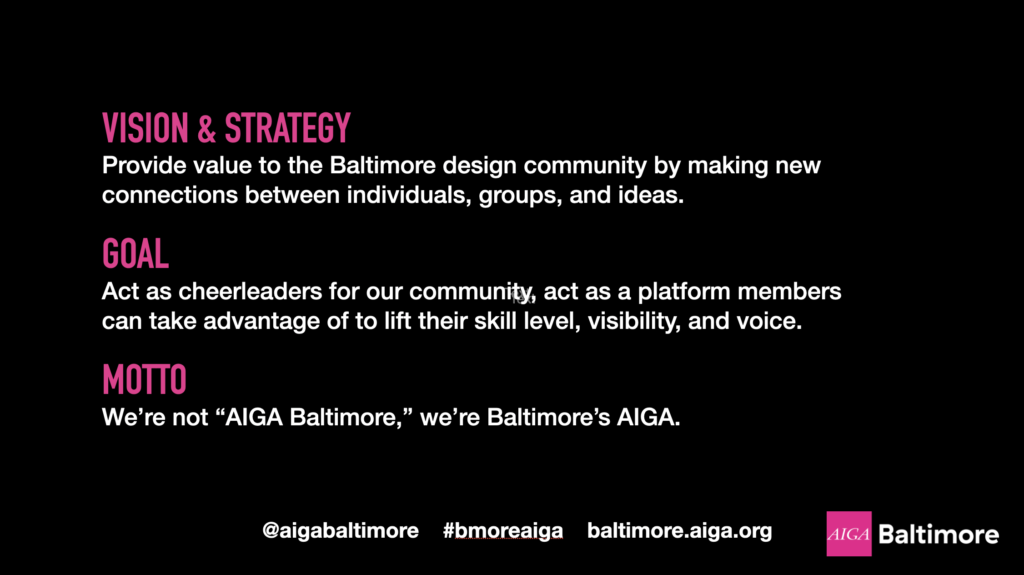
To kick things off, we shared the main vision, goal, and motto that was shaped by past boards and has driven our chapter over the past few years. No matter what 2021 brings, we will provide value to the Baltimore design community by making new connections between individuals, groups, and ideas. Our goal is to act as cheerleaders for our community and to be a platform for members to take advantage of to lift their skill level, visibility, and voice. Our motto, coined by President Emeritus Joseph Carter-Brown, is that we’re not “AIGA Baltimore,” we’re Baltimore’s AIGA.

AIGA Baltimore's Mission, Goal, and Motto

2020 Year in Review

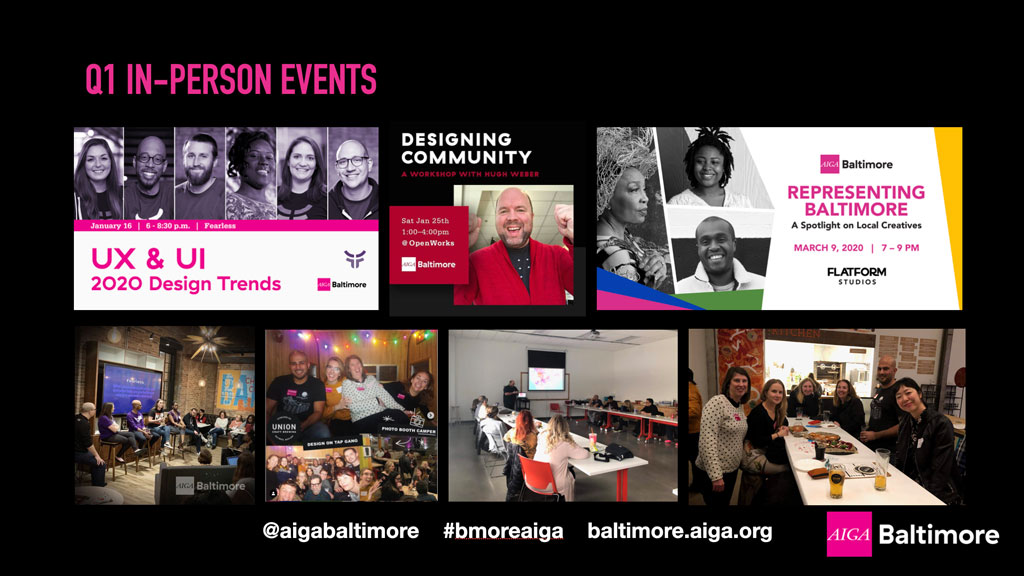
Valerie Anderson, chapter President, gave a rundown of what AIGA Baltimore accomplished in 2020. Like all of you, the year looked nothing like we had envisioned, and it was a challenging year for a fully volunteer-run group. Nevertheless, we still managed to host 15 virtual events—on top of the 5 in-person events from Q1. One week before the shutdown, some of our board participated in a Bias Training workshop with the AIGA DC board. We partnered with wonderful organizations like Society of Design Arts, Ladies, Wine & Design, Baltimore Womxn in Tech, and the Asheville and Saint Louis AIGA Chapters to combine our powers on collaborative events, and we spread the word about other opportunities and events through our email newsletter.

2020 Q1 AIGA Baltimore events

AIGA Baltimore 2021 Preview

We shared the 3 main goals our board set for the year during our January virtual board retreat sessions:

  • Innovation: Break the barrier of our virtual world to create connections with and among our Baltimore design community.
  • Partnership: Streamline an official process to utilize strategic partnerships to reach new and diverse audiences and bring value to our community.
  • Inclusion: Integrate Diversity, Equity, and Inclusion initiatives to better represent and be inclusive of the Baltimore community.

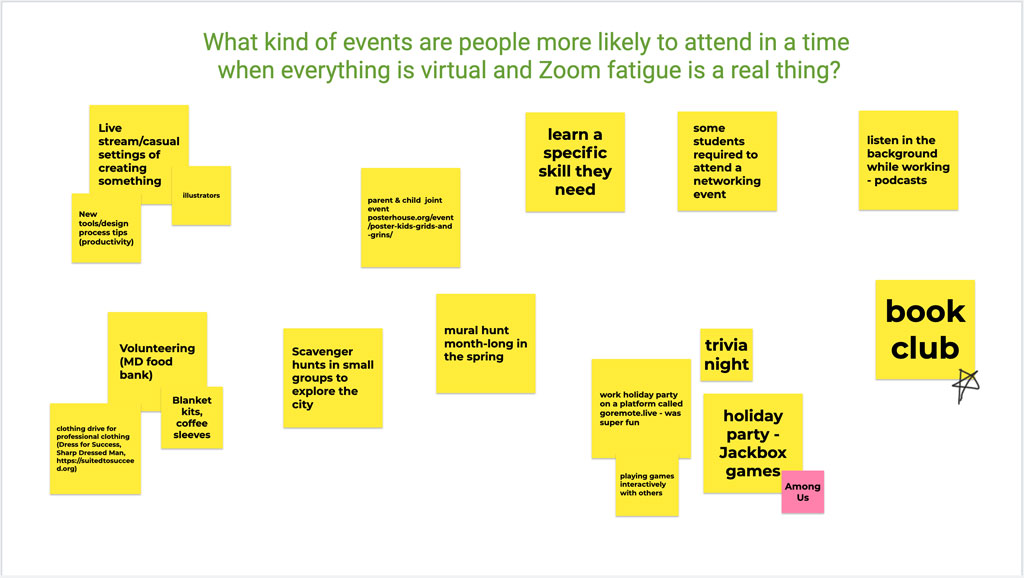
We then split up into breakout rooms and used Google Jamboard to discuss these topics and brainstorm specific ideas for the year. Our attendees shared that they joined the meeting to connect with other creatives in the area. We left feeling confident with our goal to foster connections, and we are already working on several activities for the Spring.

What type of virtual or socially distanced events do people want

Want to help? Get involved!

We need people like you to make these things happen. We’re currently looking to fill several open board positions, including Diversity, Equity, and Inclusion Chairs; Treasurer; Programming Chairs; Community Partnerships Chair; Communications Chairs; and General Volunteers and Committee Members. If you’re passionate about bringing people together and using design to improve our world, we want to talk with you!

I&P Panel: Your Questions Answered!

If you missed the Ink & Pixels Designer Panel last week, we highly recommend you go back and watch the replay. “If I Knew Then What I Know Now” focused on honest, practical advice for new designers as well as those of us in a career transition, on how to navigate the job market during these uncertain times.

We had a vibrant community-led discussion with three experienced designers, who shared unique insights and tips from different perspectives across the design field. Our panelists opened up and gave us a raw and authentic view into their professional lives, as did members of our community who came together to share resources and provide emotional support.

For those who did make it, thank you for your incredible energy and engaging questions. We wish we could’ve answered them all before our brief time ran out. For those of you hungry for more, here’s the next best thing. Our three expert panelists are back to answer a few more of your most burning questions.

Emilee Beeson, Designer, and Illustrator

emileebeeson.com
Etsy | Instagram

Emilee Beeson is a graphic designer and illustrator with a broad creative skill set, contagious enthusiasm, and relentless drive for growth and learning.

What’s one non-design job you had that taught you something important? What did it teach you?
In the summers before I graduated from college I would work as much as I could to pay for my apartment and other expenses during the school year. At one point I was working three jobs. I started at 4 am at a gym smoothie stand, then had a shift at Chipotle, and in the evenings I worked at Coldstone Creamery. While it’s not a unique experience it makes me so grateful to have found a place in the design world. Having a good-paying job that aligns with your passions is such a privilege and it really helps me to find joy in my work when things get tough.

How can we use design for advocacy and social justice initiatives?
I am sure there is a bigger picture answer to this but I want to speak to the actionable side of it. Design is incredibly expensive so your skills can be a huge asset to organizations that can’t afford it. Social justice organizations and advocacy groups need logos, T-shirts, posters, print materials, websites, and social media assets just like any other group or business. A small and actionable way to use design is to volunteer your time and skills to these groups. Reach out to them and see how you can help. There are also a few events locally that you can participate in like the MICA Grassroots Design Fest and Make-A-Mark Baltimore.

As a job candidate, what is the appropriate amount of follow up, and how can you stand out and stay memorable among other applicants?
Unfortunately, there is no magic formula for the amount of follow up you should do. It’s awkward no matter what and each job situation is different. The reality is that your entire world might be hinging on that response and theirs probably isn’t. I personally think a phone call is a bad idea but a quick email doesn’t hurt if a considerable amount of time has passed.

I have found a good way to stand out is to have a leave behind for your interview. For me, that means a small package with my business card, resume, art prints, zines, and stickers. You are usually being interviewed by other designers/creatives that geek out about the same stuff you do. Giving them something physical that might hang around the office is a good way to stand out. I have also been on the receiving end of these leave-behinds and they are always a total delight. Make sure you bring extra in case someone wasn’t able to make it to your interview.

Perry Sweeper, Design Strategist

www.psweeper.com

Perry Sweeper is a 2020 doctoral candidate at the University of Baltimore, studying Information and Interaction Design.

What was your first step after graduation?
My first step after graduation was to take a comprehensive look at the classes that I completed and inventory the knowledge/skill-set that I gained during matriculation. I wanted to get a good understanding of the skills I acquired and the work that I produced. Then I could effectively communicate my experience to seek out the right next career steps. It was very important to me to be able to view my career in a multidimensional way: past, present, and then future.

What’s one non-design job you had that taught you something important? What did it teach you?
The non-design job that taught me something important was working as a shoe salesman. There was a mother that came into the store with her son who was looking for new shoes to wear to an important job interview. To help them I had to deal with many competing needs. The mother primarily sought a presentable shoe, at a good price point, that would make him look professional and would work for him later once he got the job.  But for the son, his main concern was to find shoes that were cool and that his friends would like. Because I knew the product well, I helped them find the right shoe in a sea of options and provided them with complimentary items like the right belt, socks, and shoe care. I also met my sales goals for the day and followed the company standards. When you do your job well in sales,  you increase the possibility that a customer will come back for a second, third, or fourth pair. It is also possible that their family will become lifetime customers and ambassadors for your brand. If you do enough of this, you could get even get a company bonus.

Design jobs require the uncanny ability to please multiple stakeholders, be detail-oriented, use effective communication, creativity, and sometimes serve angry customers. Much like retail and customer service jobs. Retail can be tough, especially during the holiday season. At the least, it can be a motivator to one day quit and move into that coveted design job you desire 😉

What kind of professional development should I be pursuing while in graduate school? Is it better to just focus on grad school until graduation?
In my opinion, it is important to focus on school while you are enrolled. School can require an incredible investment of time, energy, and money. It is in one’s best interest to do well. However, I believe in the value of experiential learning opportunities during academic breaks. They provide a way to apply all that one has learned during the semester in a real-life scenario. The right combination of theory and practice can lead to growth and career progression.

Alex Reynolds, Sr. Recruiter

cargocollective.com/alexanderreynolds
Instagram

Alexander is a Sr. Recruiter with Robert Half and Specializes in placing candidates that concentrate in the technology and creative fields.

What kind of professional development should I be pursuing while in graduate school? Is it better to just focus on grad school until graduation?
It entirely depends on the type of position you are looking to pursue. The easiest way to find out what kind of professional development that can assist in your job search is to look at job descriptions from industries/companies you would want to work for. They list the various software, certifications, or applications they find desirable in their candidates. – I would also seek to develop your professional network by going to Meet-Up Groups, Webinars, or Social Events. If you are more unsure about the kind of positions you are interested especially in the design/marketing space the main focuses (in a more general sense) tend to be Adobe Photoshop/Illustrator/InDesign, Social Media Management Tools, Email Management Tools, and Microsoft Office/Google Suite.

As a job candidate, what is the appropriate amount of follow up, and how can you stand out and stay memorable among other applicants?
The appropriate amount of follow up for a position you applied for is generally around 1 week if you haven’t heard any feedback – unless they have told you a specific time/date. The best way to stand out is to make sure your resume is able to speak to your skillset and experience and tie it back to a metric or result. Keep your resume to the point (bullet points tend to work best) because recruiters and hiring managers have to sort through a lot of resumes (sometimes in the hundreds) A lot of times hiring managers will just CTRL-F (Find Keywords highlighted in your resume). Make sure you are able to talk about how you have used a software, programming language, or tool and provide an example. A simple list at the bottom of the software you’ve used with no context is not enough.

How important do you feel a Masters’s degree is in the design field these days? Should I pursue it after graduation, or should I focus on looking for jobs and/or clients?
I think a Masters’s Degree tends to be more important if you are interested in teaching – or if you are looking at a specific field that requires one. Most design positions tend to look at a Bachelor’s degree or years of equivalent experience along with a solid portfolio and experience.

Futurism(s): An Inclusive History of Graphic Design

It is always an honor and a pleasure to have Ellen Lupton present. A huge thank you to Ellen for her generosity in delivering the recent talk on Futurism(s) as well as writing this article, for those who weren’t able to listen live.

On Wednesday, April 22, 2020, Baltimore’s stalwart design history group launched its new identity. Formerly known as SHAG (Society for History and Graphics), the group is now called SoDA, Society of Design Arts. It was my pleasure to deliver a talk called “Futurism(s)” as SoDA’s first event, in collaboration with AIGA Baltimore and Stevenson University. This online event attracted over 200 guests from the Baltimore region and beyond. Thanks to SoDA’s energetic new member Raquel Castedo, many designers from Brazil logged on to hear the talk and participate, as well as people from Utah, Tennessee, and elsewhere.

Below is my short summary of the talk, which was not recorded. —Ellen Lupton


“Futurism(s)” represents an approach to teaching Graphic Design History. At MICA, my colleague Brockett Horne and I are striving to tell a more inclusive history of design than the chronology we learned back when we were students. Most GD History courses include an ode to Italian Futurism. This canonical all-male art movement can be a leaping-off point for discussing other forms of future-leaning art and creativity. “Futurism(s)” is a talk with three chapters: Italian Futurism, Afrofuturism, and the Cyborg Manifesto.

Italian Futurism

Italian Futurism was launched by F. T. Marinetti in 1909. Frankly, it’s hard to find a more patriarchal, exclusionary, white-dominated movement in the history of design-isms. Marinetti expanded our view of the printed page with his innovative typography, but he infused his ideas with hatred and violence. He wrote, “We will glorify war—the world’s only hygiene—militarism, patriotism, the destructive gesture of freedom.” He wanted to destroy museums, libraries, and schools in order to make way for a factory-born future.
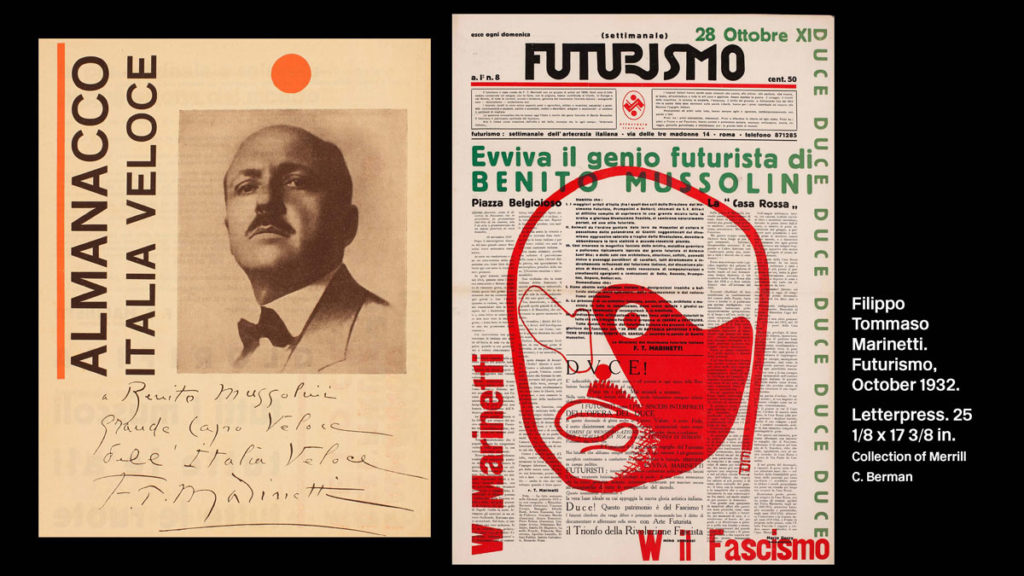
Futurismo-filippo-tommaso-marinetti

Although Italian Futurism scorned women and embraced fascist ideology, the Futurists explored liberated styles of masculinity. The Futurist painter Giacomo Balla, who published his “Futurist Manifesto of Men’s Clothing” in 1913, dreamed of menswear tailored with interactive fabrics that could be changed at will to represent a man’s shifting moods: “Loving, Arrogant, Persuasive, Diplomatic, Unitonal, Multitonal, Shaded, Polychrome, Perfumed.” Italian Futurism took place in a particular place and time, and many of us reject its politics while admiring its revolutionary aesthetics.

Afrofuturism

Afrofuturism is a movement in music, art, and literature that arose in the 1950s and continues today. (The term was invented by critic Mark Dery in 1994.) Afrofuturism embraces world-building, a creative methodology arising from science-fiction and gaming. World-building emphasizes mythic time rather than historical time. It employs storytelling across many genres, from novels, comic books, and toys to fashion, movies, music, and fan fiction. World-building actively engages an audience in experiencing a world that is both real and imagined.

Afrofuturist artists include the musician Sun Ra (1914–1993), an American jazz composer, bandleader, and poet who claimed to be an alien from Saturn—and always dressed appropriately for his role, building a mythic world around his persona. George Clinton’s funk band Parliament created their own “P-Funk mythology,” generating an elaborate backstory to the music. The Afrofuturist album covers of the 1960s and 70s featured space ships, Egyptian pyramids, and other symbols of cosmic knowledge. Today, a new generation has brought feminist identities to Afrofuturism. Artists including Solange Knowles, Rihanna, and Janelle Monae use sound, performance, fashion, and storytelling to build vivid worlds ruled by warrior queens and rebellious androids.

Billy Graham was the first black art director in the comics industry. In addition to creating a character called Luke Cage, based on Blaxploitation action films, Graham was the main comic artist to work on the Black Panther comic book series, from 1969 through 1976. These comics continue to be published today, with storylines created by renowned Black authors including Ta-Nehisi Coates and Roxane Gay. In 2018 Ryan Coogler directed the international blockbuster film The Black Panther, featuring production design by Hannah Beachler and costumes by Ruth E. Carter. Together, this creative team designed a high-tech civilization that combines aspects of contemporary African urbanism, architecture, and fashion with futuristic details.

Each of these exercises in Afrocentric world-building questions culturally dominant readings of technology. Mainstream representations of the future—whether utopian or dystopian—have pictured technology as a primarily white, male instrument of power, in contrast with subjugated human bodies that are seen as female and/or non-white. These artists have transformed how technology is represented and understood across cultures.

The Cyborg Manifesto

Donna Haraway’s essay “Cyborg Manifesto” (1985) represents a third vein of futurist design and philosophy. Haraway questions the binaries that privilege white, male, human creatures while “othering” countless alternative modes of life. The cyborg is a being who is both biological and mechanical. The cyborg challenges cultural binaries such as male/female, animal/human, and human/machine. According to Haraway, cyborgs don’t appear only in science fiction. The cyborgs have arrived! They are here among us! Examples of cyborg life include A.I., virtual reality, bioengineering, psychoactive drugs, and countless medical technologies, from fertility treatments to cloning and transgender medicine. Fashion has always altered the body, while people with physical differences use wheelchairs, prosthetics, glasses, and hearing aids to expand their mobility and change their sense perceptions.

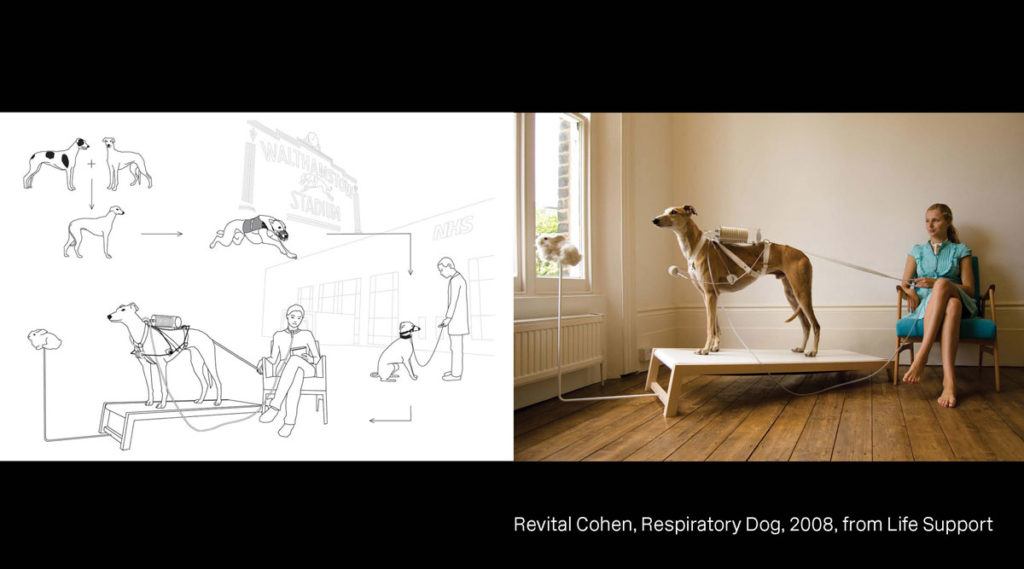
Designers working in the field of speculative design use techniques such as illustration, model-making, animation, and photo-illustration to imagine new, often dystopian futures. In their project Life Support: Respiratory Dog (2008), Revital Cohen and Tuur van Balen explored whether a dog could breathe for a human being. Living “service animals” help humans overcome many sensory and emotional challenges; the designers ask, why not have service animals augment our essential biological functions as well? The project is intended to be fictional and provocative, not realistic.
revital-cohen-respiratory-dog-design-futurism

Despite its fictional aims, Respiratory Dog has assumed new relevance today, a time when thousands of patients with severe Covid-19 require artificial life support. Every intubated Covid patient is a cyborg. Devices for respiratory life support are landmarks in the history of design and medicine. The Negative Pressure Ventilator—also known as the “iron lung”—was used to artificially ventilate patients who were paralyzed by polio. An iron lung encloses the user’s body in a negative-pressure chamber. Rhythmic pressure changes inside the chamber cause the person’s lungs to expand and contract. Thousands of these machines were mass-produced for use in homes and care facilities before the discovery of the polio vaccine in 1955. Iron lungs were eventually replaced with positive-pressure ventilators, which force air in and out of the patient’s lungs through the airway rather than exerting pressure against the chest. These modern ventilators require heavy sedation and put tremendous strain on the body. Today, modern versions of the iron lung are being reconsidered as a technology that is less expensive and more humane than a standard ventilator. One such prototype, Exovent, is being developed in the UK (as of April 2020). According to the developers of this old/new medical technology, the Exovent is a simpler, cheaper, and less invasive technology; it allows patients to remain awake, to eat, drink, and take medications on their own, and to talk on their phones.

What is “futurism”? All futurist movements, from Italian Futurism to Afrofuturism and speculative design, are opportunities to challenge the present by picturing what comes next. Designers are imagining the future whenever they question how things look, work, or signify in the current moment. Sometimes, the future arrives on the wings of catastrophe. Sometimes, the future must be created by excavating the past. Design history doesn’t have to be chronological. Like world-building, design history can pursue ideas across simultaneous and overlapping dimensions.


Bibliography


  • Reynaldo Anderson, “Afrofuturism 2.0 & the Black Speculative Arts Movement: Notes on a Manifesto,” Obsidian, Vol. 42, No. 1/2, (2016), pp. 228-236
  • Yytasha L. Womack, Afrofuturism: The World of Black Sci-Fi and Fantasy Culture (Chicago Review Press, 2013).
  • Ruth la Ferla, “Afrofuturism: The Next Generation,” New York Times, December 12, 2016, https://www.nytimes.com/2016/12/12/fashion/afrofuturism-the-next-generation.html
  • Anthony Dunne and Fiona Raby, Speculative Everything: Design, Fiction, and Social Dreaming (Cambridge: MIT Press, 2014).
  • Donna J. Haraway, Simians, Cyborgs, and Women: The Reinvention of Nature (New York: Routledge, 1991).
  • Dan Hassler-Forest, “The Politics of World Building: Heteroglossia in Janelle Monáe’s Afrofuturist WondaLand,” World Building, ed. Marta Boni (Amsterdam University Press, 2017).


About the Author

Ellen Lupton | Senior Curator of Contemporary Design at Cooper Hewitt, Smithsonian Design Museum in New York City. Her exhibitions include “How Posters Work,” “Beautiful Users,” and “The Senses: Design Beyond Vision.” Lupton is founding director of the Graphic Design MFA Program at MICA in Baltimore, where she has authored numerous books on design processes, including “Thinking with Type,” “Graphic Design Thinking,” and “Graphic Design: The New Basics.” Her recent books “Design Is Storytelling” and “Health Design Thinking” were published by Cooper Hewitt. She is an AIGA Gold Medalist and a Fellow of the American Academy of Arts & Sciences.

Top 3 Skills UX and UI Designers Need to Know in 2020

Thanks to Kelly Strine, owner of Left-brained Creative, LLC for writing this blog post!


The AIGA Baltimore community had the pleasure of sitting down with Fearless, a full-stack digital services firm, this January to discuss current trends and skills user experience (UX) and user interface (UI) designers need to know. And it’s not as scary as you might think.

Meet the Players

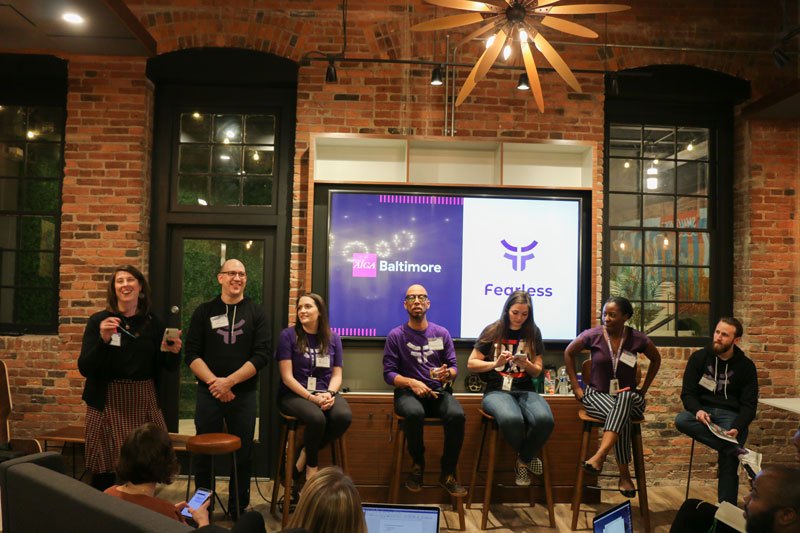
Held at Fearless headquarters inside of Spark Coworking Spaces in downtown Baltimore, the event was a panel-style Q&A. Panelists included:

Jordan Watts, Lead UX Designer, UX Coach
Antoine RJ Wright, Lead UX Designer, @ARJWright
Amanda Mancuso, UX Designer
Tyler Bolchoz, Product Designer
Rachel Petrucci, Product Designer
Daedriana Harvey, UX Designer

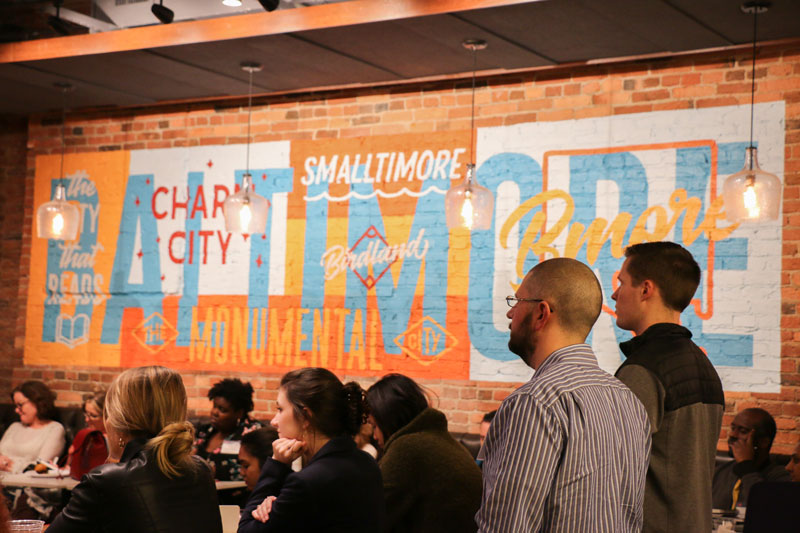
fearless tech baltimore designers seated for panel discussion
Photography Credits: Krystal Carpintieri

The Landscape

The UX/UI space is constantly changing as technology advances at lightning speed. Designing for non-traditional interfaces (smartwatch, eyewear, ring, etc.), voice user interface (VUI), and augmented reality (AR) and virtual reality (VR) will be the shiny new skills UX and UI designers will be homing in on. However, as technology changes, it’s often challenging for designers to gain experience in the latest and greatest and break into the UX/UI field.

What we learned from speaking with Fearless is that yes, UX and UI designers should have experience in design, code, content, research, and strategy (at varying levels of each, and that’s okay!); but that it’s equally important for UX and UI designers to possess super-sleuth soft skills and a fierce desire to learn. That’s far less daunting.

Photography Credits: Krystal Carpintieri

Skill 1: Collaborate Well with Others

In the past, there’s been clear segregation between designers and programmers. Designers would figure out what the “thing” (website, landing page, app, etc.) would look like, then hand it over to the programmers to code and be done with it. And as you can imagine, there’s bound to be some friction with this process.

“It’s not really a design hand-off, it’s a design implementation.”
Rachel Petrucci, Product Designer

These days, the concept of a “hand-off” has vanished. At Fearless, as with many other agencies, designers and programmers work together in a very integrative process. Designers and programmers come together for scrum reviews and standup meetings, and developers are invited to design reviews and product testing. As Rachel put it, “it’s not really a design hand-off, it’s a design implementation.”

That means whether you’re a designer or a programmer or a magical unicorn who does both, you must possess strong communication skills and a willingness to collaborate. Designing in a technologically advanced space means you’ll need to rely on others to create a successful product. Designing at this scale does not happen in a vacuum. As Tyler said, “you’re doing the product a disservice if you just hand it over, but if you’re collaborating everyone is engaged.”

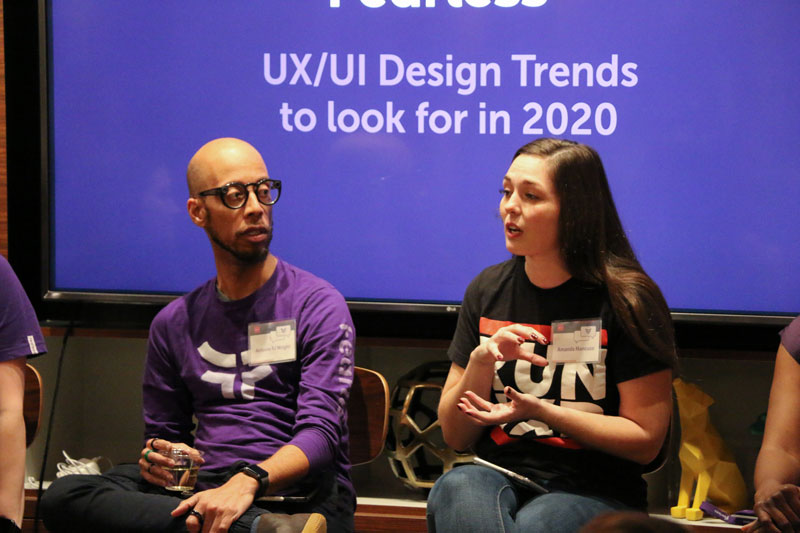
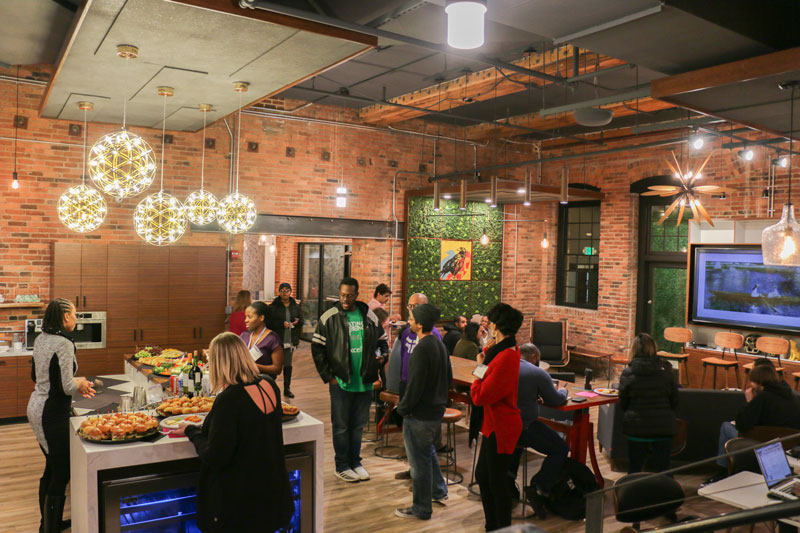
audience listening to panel discussion on UX design
Photography Credits: Krystal Carpintieri

Skill 2: Learn How to Build Empathy

We asked our Fearless panel what steps they take when asked to build a website from scratch. Across the board, step one was research. Before design is even a consideration, learn everything you can about the needs of your client. Do they need a website, or would they be better served by an app? The research phase also includes market research, identifying pain points and opportunities, and sitting with the users—it can take weeks.

“Your perspective is not the default”
—Jordan Watts, Lead UX Designer, UX Coach

But the critical part of researching is gaining the ability to build empathy for your users. Putting yourself in the shoes of the user is the most effective way to create successful UX and UI design. As we discussed inclusive design, Antoine suggested starting a design with the least-sited person in mind, then build up. Can this person use the product on a watch, how about on a mobile phone, tablet, non-touch computer, touch computer, etc.

Jordan summed it up best by saying, “your perspective is not the default.” Having empathy for users and being able to tap into how others will use the product (via user testing, research, etc.) will help you reach every user and create a better product.

AIGA baltimore attendees at spark coworking spaces
Photography Credits: Krystal Carpintieri

Skill 3: Be Hungry to Learn

As technology continues to evolve the only way designers and programmers can stay relevant is to stay hungry…to learn. Without a constant desire to learn, the skillsets of those in the tech industry will inevitably turn stale.

When we asked panelists what the top characteristic trait was that they look for in a new hire, Rachel and Amanda said they would hire someone who is curious and actively seeks out opportunities to learn and develop new skills. Antoine and Jordan discussed the merits of cross-functionality—and yes, there is value in knowing how to design and code—but it is equally important to understand your area of expertise.

So, if you’re looking to impress your current managers or are looking to break into the UX and UI space, take the initiative to develop your skillset. Attend hands-on boot camps and workshops (rather than lectures) to develop your skills, portfolio projects, and gain experience. As Amanda put it, in an interview she would rather hear about what you learned from failed experiences, rather than hear a candidate prattle on about what they think she wants to hear.

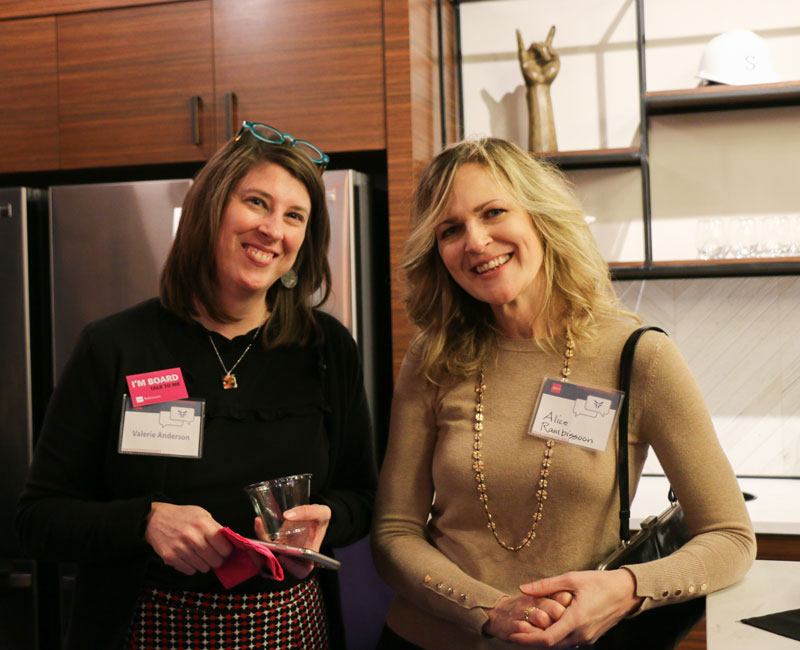
valerie anderson and alice rambissoon smiling for photo
AIGA Baltimore President, Valerie Anderson with the Interior Designer of the Spark Co-Working Space, Alice Rambissoon. Photography Credits: Krystal Carpintieri

What Did We Learn?

It’s no big surprise that the UX and UI fields are growing, and the demand to create beautiful, interactive products for numerous interfaces will continue to grow as well. Being on the cutting-edge of these technologies means possessing the technical skills, yes, but equally as important is being able to demonstrate how UX and UI can add value. That means learning how to be a strong communicator (and listener!), being empathetic toward clients and teammates, and being a dedicated, lifelong learner.

If you’re interested in learning more about Fearless, head over to fearless.tech; and if you want to join the Fearless team, check out fearless.tech/careers

Follow Fearless on Twitter, Instagram, LinkedIn, and Facebook at @fearlessbmore. And follow AIGA Baltimore—@aigabaltimore—on all your favorite channels so you never miss great events like this one!

 Share your thoughts below on what skills should be on the minds of UX and UI designers as we move into 2020!