Handset Type Workshop

A few weeks ago, six Baltimore-Area designers traveled to the studio of Lead Graffiti in Newark, DE to participate in a moveable-type workshop. The group of designers worked as a team—with considerable help from Lead Graffiti—to produce a 14-page art book based around the 6 letters that compose the word “D-E-S-I-G-N.” Each participant designed a 2-page spread inspired a by a specific quote about design.

The participants set their own type by hand from among hundreds of cases of lead type. The spreads were printed on a single sheet using a Vandercook press. Designers got the opportunity to have some hands-on time printing on the Vandercook as well as line-casting type using an Intertype machine. Everyone received enough materials to make multiple copies of the book (several of which will be available for sale very soon on our Felt & Wire store).

Many thanks to Rey Nichols, Jill Cypher, Mike Kaylor and Tray Nichols for sharing their wealth knowledge of hand-set type and letterpress printing, as well as for their hard work and assistance during the workshop.

Post written by Sean Heavey.

Debbie Millman Speaks To AIGA Baltimore Audience On Brands …

Debbie Millman presents to the audience.

Debbie Millman, president of Sterling Brands, presented to an AIGA Baltimore audience of approximately 70 people on the topic of the essence of brands. The talk discussed brands, not so much from a pure design point-of-view, but discussed the nature of brands, their development and where they’ve gone and where they will go in the future.

As people, she categorized the human existence as “making and marking,” each with a valued role in the distinguishing of the tools, products and services that are in our lives. The talk spanned the quintessential meaning of what branding was (the physical impression bof ownwership on livestock…) to the development of simple and then more dramatic iconography, the elaboration of which we live with today.

She also delved into the nature of branding and discussed the evolving nature of modern brands with the modern era legalization of the trademark in 1876. She even uncovered the first “modern brand” for the audience.

As for the nature of brands, 5 waves of modern branding:

  1. brands guarantee of quality (1875-1920) and safety. Brands were often first associated with particular people. (Qualities and values of those folks).
  2. brands become “human”… (1920 – 1965)
  3. brand as self-expressive statements… (1965 – 1985) brand –status
  4. brands as an experience…
  5. limbic brands — brands as connectors/communicators

Brands are now ways to frame conversations for increasingly divided and singular audiences. These brands now connect people to experiences, initiatives beliefs and ways of living. In an increasingly individual existence, brands and modern technology increase or enhace our connectedness to the world.

She pointed out some staggering facts: Average young people in the US spend approximately 8 hours a day online. Human brains create new frameworks to connect in the computer and digital age to keep up with the evolving technology of communication (low and high-tech).

She maintains: “We can create symbols that create ways for people to understand and live”. We have the power to craft a view of how people relate to life.” All this underscores the value of both the maker and the marker.

Dave Plunkert of Spur Design, The Interview

Pulp Ink & Hops Artwork, courtesy of Dave Plunkert of Spur Design

Dave Plunkert is a nationally-recognized designer and illustrator based here, in Baltimore, where he operates Spur Design with Joyce Hesselberth. Their studio provides full graphic design and marketing communications services for both print and interactive media. Since 1995, the studio has produced award-winning work for national and local clients.

According to Wikipedia, In 2009, Plunkert received the Best Poster Award at the South by Southwest Festival (SXSW) for the poster he designed for Antidote Films’ documentary “The Dungeon Masters. “Recently, Dave was gracious in agreeing to speak with us and designing and illustrating the poster for the upcoming 2010 Pulp, Ink & Hops.

Q: Any interesting projects you’d like to discuss?

Spur recently completed the Directory of Illustration 27 featuring artist Colin Johnson.  Aside from the editorial illustration jobs there are a number of poster jobs currently on my table.

Q: With 15 years under your belt as a studio principal, what do you know now that would have helped you had you known it when you first hung a shingle?

It took a while to realize that a big part of business is simply finishing a job and moving onto the next one.

Q: Has the economy changed the nature and/or scope of your work?

Budgets are a bit tighter and the flow isn’t as heavy as it was during the boom years but its nice not working every Saturday. But I’ve fortunately never had to lay anyone off since we opened the doors.

Q: How does Baltimore figure into your work? Does it (being local to Baltimore) shape the way national clients view what your studio brings to the table?

Not that I’m aware of on illustration side. As a designer I think that opportunities still tend to be somewhat local because the process sometimes requires face-to-face meetings.

That said, I think our California clients like that we’ve been working on their projects for a few hours before they start their work day.

Q: The AIGA organization has initiative in place to describe the skill/work process set of the designer of 2015. That would be the 20th anniversary of your studio and looking forward, what skill/work process do you see the designer of 2015 as having or needing to possess?

Same as always…. they need to be able to concept and execute an idea from start to finish and be flexible, curious and on their guard in regards to technology. Hopefully the initiative won’t include a lot of stuff specifically about the internet and social media.

Q: Describe the tension of doing work that allows you and your studio to do work that’s not defining, but yet being known or a particular style:

Well, the tension comes from striking that balance of experimentation and formula on a given job but not giving into trends or getting lost in the woods.

Q; What Have You Learned? (Free Form Parting Thought, like Esquire Magazine).

That the best thing you can do for yourself as a designer is not get too comfortable.

Find Dave Plunkert and Joyce Hesselberth on the web at spurdesign.com. Interview by Chris Jones.

Photopolymer Workshop

Last weekend was the Photopolymer Workshop by AIGA Baltimore and Typecast Press. Mary Mashburn, of Typecast gave a tour of the shop while going over letterpress history. Then she showed the magic of creating a photopolymer plate. Each participant go to print their own Baltimore themed postcard design, and they then did a print exchange at the end. Everyone got to work on the two Vandercook presses, and a good time was had by all.

Amanda Brainerd, Ayumi Yasuda, Eric Conrad, Rachel Beser, Cat Paquin and Mary Mashburn; (c) Alissa Jones

(c) Alissa Jones

Cat Paquin pulling a print from the Vandercook Press; (c) Alissa Jones
Zvezdana Stojmirovic getting ready to print. (c) Alissa Jones
Amanda Brainerd's design fresh off the press! (c) Alissa Jones

The Art of The Mistake …


Sanitary Sfwer?

We all know mistakes happen. Sometimes, there’s little more one can explain. But often more times than not, we can be mindful of not only eliminating the mistake, but the conditions under which they occur.

For instance, I know nothing about the circumstances under which this sewer cover was mass-produced and put into my neighborhood, and ostensibly others. There are at least two like this in my neighborhood, by the way. Nonetheless, people twenty years from now have the opportunity to ask themselves “what happened” that might allow this to occur? While I may never know it gave me a chance to muse on mistakes I’ve made and how continuing to be unafraid to make mistakes anew, while redoubling the process behind dealing with mistakes can help to eliminate as many as possible.

While some confuse me with a designer, very few confuse me with a writer. I do write, of course, but not in the way a real writer writes. I focus on getting it done and getting it out. This means that even if I’m working the solo project or the big board project, I have to have a system in place to catch the little errors and gaffes that easily slip by when I’m working—my mind going a mile a minute.

When I played baseball, I used to write “E5” (the classification of an error by a third baseman—my former position) on my fielding glove, a constant reminder that the next error was right around the corner. This gave energy and passion to the process of preparing myself for as many situations as I could by taking as many practice ground-balls, to get myself as ready as possible. Instead of being afraid of the possibility of the mistake existing, I tried to confront the reality that they may very well happen, but preparedness may help to deal with the problem.

Same in civilian life. We all have processes that can help avoid mistakes, but in truth, we (society) don’t always take them seriously. Look at the reductions in staph infections when hospital workers (no, not just cafeteria people, nurses and doctors, too) take the care to address cleanliness, and subsequently witness and enjoy significant reductions in infections when processes are put into place regarding simple things like washing hands, etc.

Or, my favorite—and one of the more ubiquitous—is the airline pilot’s checklist system (emulated for many things including software to prepare files for press) as a way to decrease unchecked issues which can affect safety. While we are all familiar with these methods of reducing errors, that doesn’t mean we take the time to practice them. Like the difference between an art (practice) and the science (knowledge) many mistakes persist, when we (and by we, I mean I) fail to discipline ourselves to follow our systems for reducing mistakes.

And as we pointed out, it’s simple things. On the board, it’s a process of having the web chair review and set up the newsletter or email that was prepared to send out. The mistakes have a familiar story (I had to rush it…) In my own work, it may mean having a fruitful free-development session followed by an equally vigorous editing session.

A lack of discipline to adhering to a process that allows us to do our best work allows the opportunity for mistakes to creep in and for those mistakes to threaten the body of work on which we work. As a designer, I am the goalkeeper of the a work’s printed existence. While there are other steps in the process whom are all accountable: proofreader, client, mistakes reflect just as bad, if not worse on the designer.

(c) Shapiro, Allworth Press

I’ve come to think of the best designers as exhibiting control, not controlling. They volunteer (and build it into their fees) to do press checks, to review the files, etc., because they recognize the time-cost of doing these things is well-worth the value in comparison to a process where the file has to be reprinted. They proactively communicate their schedule and availability, including client-review timelines, to fully inform the client of the time needed to properly turn files. As a designer and a responsible party in the process, it’s up to us to take the reins and eliminate the mistakes.

Just as threatening can be the process of setting expectations for colleagues and clients. One of my favorite book covers is the cover for Ellen Shapiro’s The Graphic Designer’s Guide To Clients: How To Make Clients Happy And Do Great Work. The book is a great read and reminds me that the process of working with clients is very much a contact sport. Clients hire designers for their expertise and designers must be professional in exhibiting that expertise in their projects and work process, because it helps the work.

While there’s often a give-and-take there, better clients, no matter what type, will respect the process that a designer exhibits (and by exhibits, I mean informs in writing and in practice) in order to put the best product out there.

I’ve had clients for whom this was an issue and, get this, I felt it was a”mistake” for us to continue working together. Because when the same concerns crop up and there’s nothing or little I’ve done to help them, I only had myself to blame because I saw them in the process. So, in some cases, the art of not making mistakes is about embracing the courage to execute projects in the best way for them to be done well and backing that up with the discipline and the process to see them through.

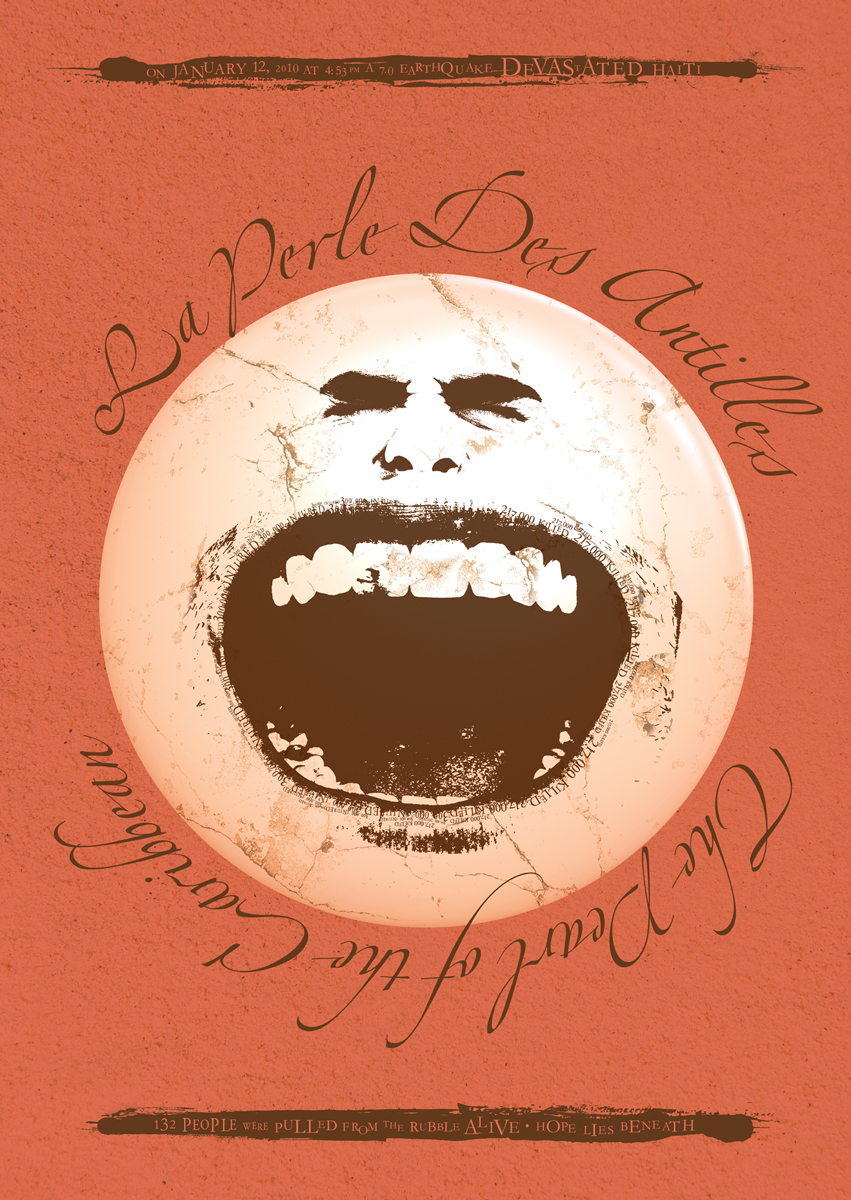
Finch Paper & Baltimore Color Plate joins forces with award-winning design director Greg Bennett aka WORKtoDATE to help make a difference in Haiti.

The Haiti Poster Project

Recently, Finch Paper joined forces with internationally recognized, award-winning design director Greg Bennett aka WORKtoDATE (www.worktodate.com) to help make a difference in Haiti. This poster and many others have been donated to the Haiti Poster Project. The Haiti Poster Project was launched three days after the January 12th, 2010 earthquake in Haiti. The project is a collaborative effort by the design community to help effect change through our work. Signed and numbered, limited edition posters have been donated by designers and artists from around the world. All money raised will be donated to Doctors Without Borders. This poster is now available among many others.

The concept for this poster “hope lies beneath” was inspired by Haiti’s nickname, La Perle des Antilles. La Perle des Antilles translated from French to English means The Pearl of the Caribbean. A pearl is symbolic of something precious that is sought after. I chose to use it in my design to represent the people affected by this earthquake. I’ve incorporated several Easter eggs in this design revealing facts about this earthquake and if you look closely, you may find a silhouette of Haiti’s country.

A special thanks to Signe Renn and Baltimore Color Plate (www.baltimorecolorplate.com) for donating their printing expertise and Mike Chester of Finch Paper  (www.finchpaper.com)  for donating the premium paper.

Please visit THPP to purchase this poster or learn more.   http://www.thehaitiposterproject.com/

Gilah Press + Design Letterpress Tour

courtesy of Alissa Jones

In a world where computers can do almost everything, there is a little print shop in Baltimore named Gilah, that is about 100 years behind. Gilah Press + Design and AIGA provided a tour of the letterpress print shop on August 25th. This quaint little shop is a perfect fit for Baltimore—with its Natty Boh mustaches around every corner, and gnomes guarding every door. A press operator led the presentation—showing us everything from how they make their photo emulsion stamps, to loading the press up with ink, and getting the job “rolling.”

During the example, we were showed how to change the depth of the impression left by the stamp, by changing the amount of paper under the mount. By the end of the example, everyone had a beautiful, handmade thank-you card to take along with them. Gilah Press + Design set the bar high with a night that was sure to get the creative mind winding, while waiting in anticipation for the next three parts of AIGA’s Letterpress series.

To learn more about AIGA Baltimore’s Letterpress Series, check out the events page on the AIGA site.

Lastly, this post was written by Kristin Kosmides, a member of our volunteer group, the AIGA Crew. Much thanks for your help, Kristin!

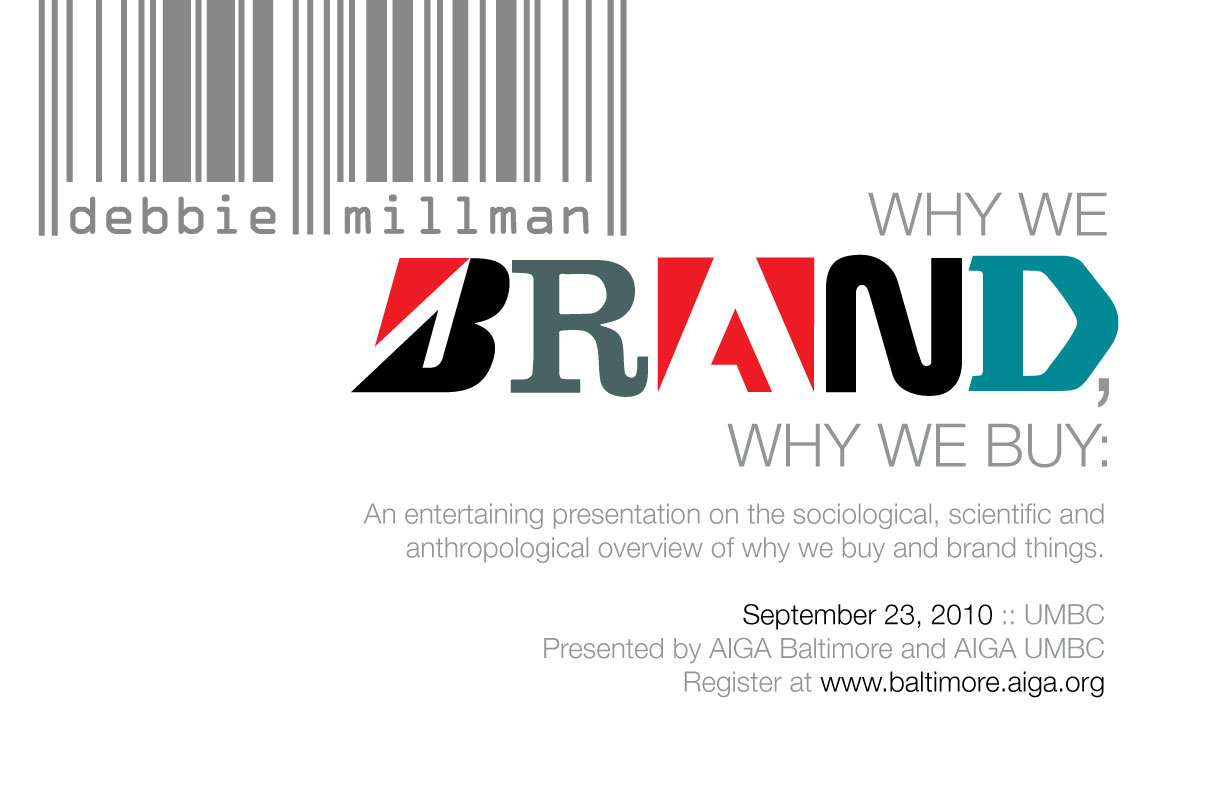
“Re-Brand”: The Debbie Millman Interview Re-aired…

Millman Lecture Art

Discussing Business, we have an interview with Debbie Millman, president of AIGA. She hosts the podcast, ‘Design Matters’ and has been in the design business for 25 years. She regularly blogs on topics related to the field at http://debbiemillman.blogspot.com, she is a Partner and President of the Design division at Sterling Brands, and she is the Chair of the new Masters in Branding program at the School of Visual Arts in NYC. And she answers a few questions for us.

Q:  Using the AIGA Confidence Index (http://www.aiga.org/content.cfm/confidence-index) the economy was at about its worst point (50 out of 100) approximately one year ago October 2008. With confidence in business low and similarly design as a profession, how do you think the emerging role of designers has been affected?

A:  Downturns such as the one we are in are times when designers can make the most difference. One of the biggest tcchnological and cultural innovations in the last ten years came during the last big recession: Apple’s iPod. Believe it or  Steve Jobs launched the iPod 6 weeks after 9/11.

Recessionary times come with new needstates and the requirement for new solutions to the problems we face. Designers are the most qualified people to solve those problems.

Every problem our planet faces is cinematic because it gets swept up in to a swift sequence of gestures that precede and follow it. Sort of the ultimate domino effect. Our ability to effect change is greater than it has ever been. And I am not talking about iPods here! Rather than our culture being a prisoner of politics, design can be an inspiration to our culture. An opportunity to constantly reach for higher ground.

Q: Speaking at the recent leadership conference, you mentioned that your legacy is focused on “connectivity”. How does the value of connectivity relate to AIGA?

A: The way in which we humans connect with each other has changed forever. Just in this country alone, we went from three television channels to over 500 hundred channels, from no web pages to billions. It took 35 years for 150 million people to own televisions. It took only 7 years for 150 million people to own cell phones. And it will likely take only take 3 years for 150 million people to sign up for Twitter. The average teenager sends over 2500 text messages! The structural frameworks of the way we live, communicate and organize ourselves has fundamentally changed and I am committed to charting a new connective structure for AIGA that is authentic, transparent and meaningful. I believe that some of the most exciting things happening within AIGA are in the local chapters. The entire membership should be aware of this great activity and benefit from it. I also believe that there is great opportunity for younger designers to benefit from the access to more established designers for mentorship, job opportunities and training. So I am working on instilling new practices in the way the entire 20,000 plus membership is communicating and connecting.

Q: You’ve conversed with alot of great designers (and others) in your work. Are there common denominators that connect legendary work despite the different backgrounds, approaches and challenges?

A:  One of the ironic and fascinating common denominators is that most legendary designers, no matter what the background, approach or challenge, everyone deeply, rigorously questions the validity and quality of their work. Other than Massimo Vignelli and Milton Glaser (who are both in their 70s), everyone I have interviewed worries about the quality and meaning of their work. Everyone is insecure. Everyone wonders if they are good enough or smart enough or courageous enough. Everyone.

Q: How does the “new economy” and the requisite valuations of the work designers do relate to designers in the trenches in their effort to create great work?

A: Designers today experience a condition of ambiguity and compromise— building, aiding, and abetting what we now call “the new economy” seems an inevitable consequence of our work. Prospects of that condition changing seem remote. Especially if we want to build groovy offices and pay talented staffs.

But, Chris, I have to ask: what is the definition of ‘great work’? I looked back to the 1964 design manifesto, First Things First to find an answer. Originally written by British designer Ken Garland and twenty-one of his design colleagues, the manifesto boldly encouraged students, designers and teachers to reconsider their opportunities outside the noise and “high-pitched scream of consumer selling” in favor of applying their talents to promote education, culture and a greater awareness of the world. This was not intended to advocate the abolition of contemporary design, but was simply a call for the re-evaluation of our profession’s priorities. So rather than only applying our skills to selling dog biscuits, designer coffee, diamonds, instant film, french fries, detergents, hair gel, cigarettes, credit cards, sneakers, light beer, and heavy-duty recreational vehicles, they tried to inject passion, truth and reality into their design work. But herein lies the inherent dichotomy with that statement.There will always be a need to design dog biscuits and hair gel and french fries! And despite what many marketers now believe, a computer is not the only tool you need to do this. We must…we HAVE to inject passion, truth, reality and integrity to this work as well. All design—no matter where and what it is, has the power to inspire us to think and grow, to teach us what we don’t know and to inform and remind us of what is truly important. And what is important is honesty. What we need to create, in response to the torrential acceleration of this new economy is honesty.

Q: Esquire does a feature called “What I Learned”. Well, what two things have you learned about business that are on the tip of your tongue?

A: Work harder than anybody else that you know.

Shoot for the stars. Seriously. So many people start out by thinking about all the things that they can’t do and once you take that path, it’s very hard to get off of it. The only person that can make every dream that you want to come true is you. And if you start out with limited dreams, you’ll only achieve limited dreams. And that’s really sad when that happens.

Debbie is author on the design blog Speak Up, a regular contributor to Print Magazine and she hosts a weekly internet radio talk show on the Design Observer Media Channel titled Design Matters. Her first book, “How To Think Like A Great Graphic Designer,” was published by Allworth Press in 2007; her second, “Essential Principles of Graphic Design,” was published by Rotovision in 2008, and a book of illustrated essays titled “Look Both Ways” will be published in the Fall. Debbie can be reached at debbie.m@sterlingbrands.com

She’ll be in Baltimore speaking September 23rd.

Felt & Wire call for designers!

Felt & Wire Graphic

Ever want to design without a client?

Do you love to play with paper?

Now is your chance to to design products for the AIGA Baltimore Felt & Wire shop. Visit http://feltandwireshop.com for inspiration. You can pretty much make anything you would like as long it uses paper goods in some way and is something customers would want to purchase.

When you have the design ready (We are happy to review anything in progress too), email alissa@baltimore.aiga.org an image of it and also provide the following information:

  1. Quantity you are willing to make (can be as little as 1)
  2. Your production costs (You can either donate the items to the chapter or AIGA Baltimore can compensate you for your production costs. We will need receipts of these costs when applicable).
  3. Any other information you think might be helpful.

If your item is approved, we will post it on the AIGA Baltimore Felt & Wire shop along with a credit to you. All proceeds from sales will go towards future events and initiatives for AIGA Baltimore.

This will be an ongoing opportunity, however, if you would like your work to be included in the official launch, please submit work before October 1.

Types of products that could be submitted

  • note cards
  • gift wrap
  • journals
  • sketch books
  • posters
  • prints
  • artist books
  • buttons
  • and anything else you can come up with that involves paper!

If you have questions, email alissa@baltimore.aiga.org.

Pulp, Ink & Hops in Station North …

Courtesy Dave Plunkert, Spur Design

AIGA Baltimore * 407 N Charles St. Studio C * Baltimore MD 21201

13th Annual

Pulp, Ink and Hops

Join AIGA Baltimore in the heart of Baltimore’s Station North Arts District for the region’s largest paper show, featuring paper and print samples from more than 20 vendors and free hops from a local microbrewery. Get connected to the latest trends in papers, design services and swatches while viewing live letterpress demos.

Thursday, October 21, 2010

5:30 to 9:00 pm

Baltimore Print Studios

18 W. North Avenue. Baltimore MD

advance

$15 members. $30 non-members.

door

$25 members. $40 mon-members.

for information

www.baltimore.aiga.org/events

design by www.spurdesign.com printed by www.baltimoreprintstudios.com